Artwork
Haji Sh. El Arishi [?]
![Haji Sh. El Arishi [?], by Godfrey Thomas Vigne, watercolor, 1844](https://artifactworldgallery.com/img/godfrey-thomas-vigne--haji-sh-el-arishi--4954cf53752ca3e0-w1024.webp)
Haji Sh. El Arishi [?] is a watercolor work on paper by the Romanticist artist Godfrey Thomas Vigne. It dates from 1844 and is held in the collection of the Victoria and Albert Museum.
About this work
The loose brushwork and simple details suggest this was drawn quickly, maybe while traveling.
This sketch shows an older man sitting on a horse or donkey. He’s dressed in loose, layered clothes—light blue over a darker shirt—and wears a turban. His hands hold the reins loosely, and he looks off to the side with a calm expression. The background is just rough lines, like a quick sketch of trees or hills.
The artist left some notes in the corners, including the name *Haji Sh. El Arishi* and the year *1844*. The loose brushwork and simple details suggest this was drawn quickly, maybe while traveling.
If you like this style, check out the Victoria and Albert Museum for more works like this.
Overview
Created in 1844 by Godfrey Thomas Vigne, this watercolour sketch depicts a seated figure identified as Haji Sh. El Arishi. Executed with minimal detail and fluid brushwork, the piece reflects the artist’s practice of rapid field studies during his travels in South Asia. The work was later inherited by Frank Vigne, the artist’s great-nephew, who acquired it in two separate purchases from Charles Griffin of Monmouth between 1978 and 1979.
Subject & Meaning
The subject is an older man, likely a religious traveler or local dignitary, seated on a horse or donkey. His loose, layered garments and turban suggest regional dress, while his calm gaze and relaxed grip on the reins convey stillness and dignity. The inclusion of his name and the date implies the artist recorded him as a specific individual encountered during a journey, preserving a moment of personal observation rather than a generalized portrait.
Technique & Style
Rendered in watercolour with sparse, economical strokes, the drawing emphasizes immediacy over finish. Background elements are suggested with loose, sketchy lines, and details like fabric folds and facial features are hinted rather than defined. The use of light washes and minimal shading reflects a travel sketcher’s approach—focused on capturing form and presence quickly, without elaborate preparation or studio refinement.
History & Provenance
The work remained in the Vigne family after Godfrey Thomas Vigne’s death. In the late 1970s, Frank Vigne, a great-nephew, acquired the piece from Charles Griffin of Monmouth through two transactions totaling £320. No earlier ownership records are documented, suggesting the drawing had been preserved privately within the artist’s circle before entering Frank Vigne’s collection.
Context
Godfrey Thomas Vigne traveled extensively across South Asia in the early 19th century, producing numerous sketches of local figures and landscapes. This work belongs to a broader body of observational drawings made during his journeys, often serving as personal records rather than commissioned pieces. Such sketches were common among British travelers seeking to document unfamiliar cultures during the colonial era.
Legacy
The sketch survives as a quiet example of 19th-century travel documentation, valued for its unembellished realism and personal tone. While not widely exhibited, it contributes to the understanding of how British artists engaged with local populations during their journeys. Its preservation within the family underscores its role as a private memento rather than a public artwork.
Artist & collection


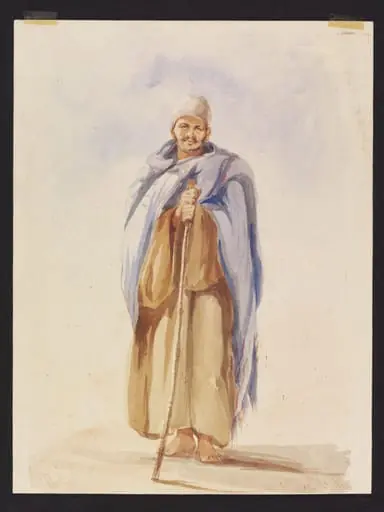 A Man with a Staff, Thebes
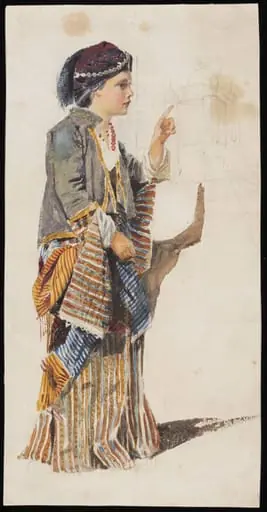 Untitled
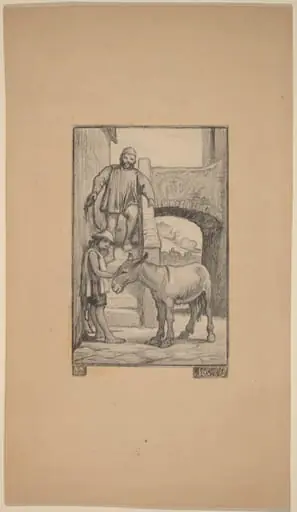 The Son and the Donkey
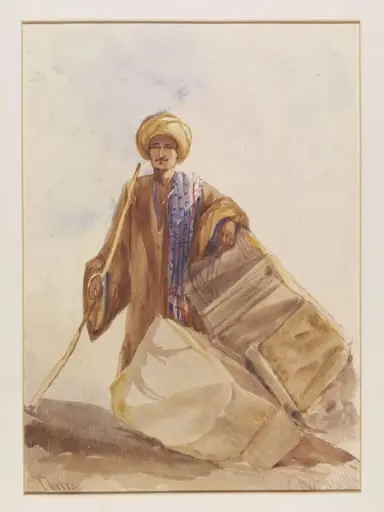 A Man standing by Rocks, Thebes
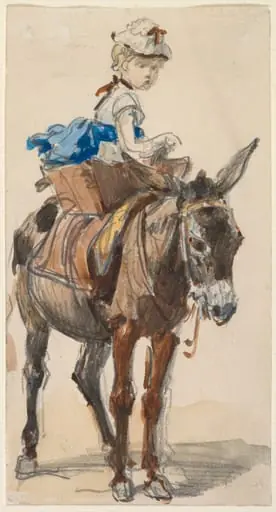 Girl on a Donkey
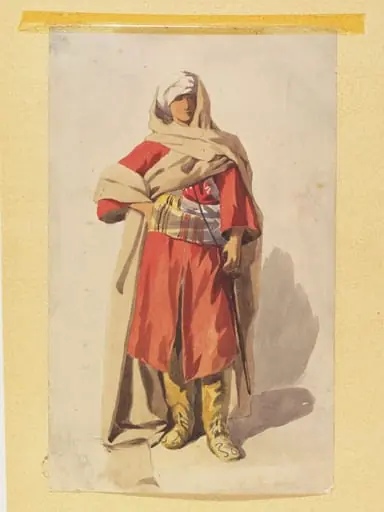 Soldier
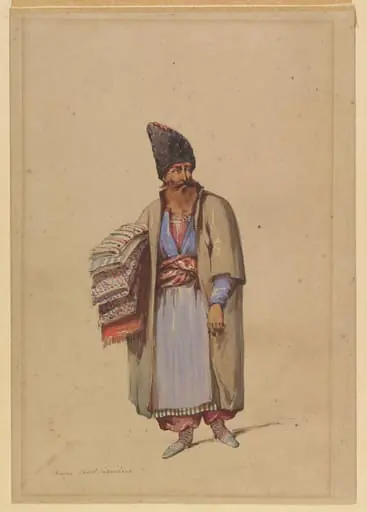 Persian Shawl-Merchant
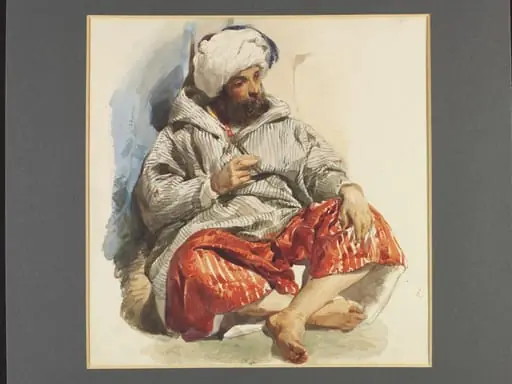 A European in Oriental dress, seated cross legged
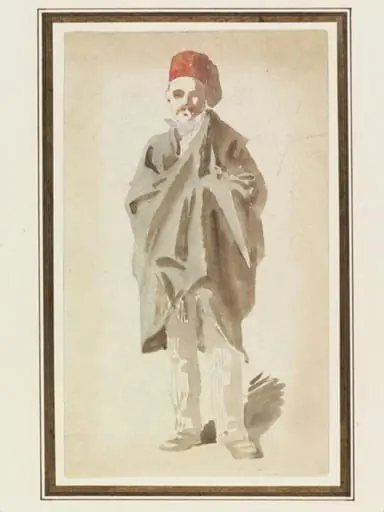 A man wearing a fez and wrapped in a long cloak
![A Shaykh with his Son[?] on Mules, with their Sais [groom], by S. Bossi](https://artifactworldgallery.com/img/s-bossi--a-shaykh-with-his-son-on-mules-with-their-sais-groom--240d85ba529e2bf3-w320.webp) A Shaykh with his Son[?] on Mules, with their Sais [groom]
A Shaykh with his Son[?] on Mules, with their Sais [groom] Philosophe
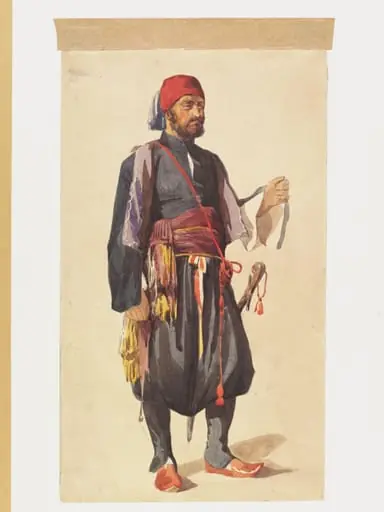 Officer, possibly a Spahi