Artwork
Planks Attached to Four Trees
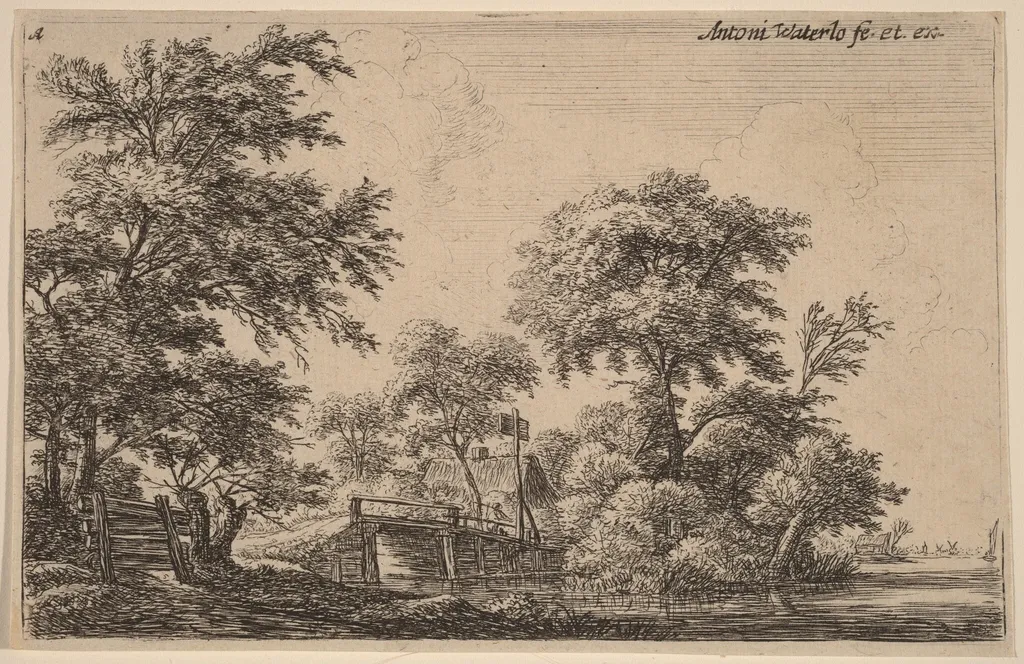
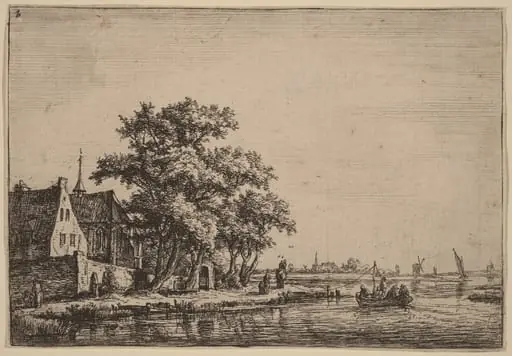
Planks Attached to Four Trees is an ink print by the Baroque artist Antonie Waterloo. It dates from 1650 and is held in the collection of the National Gallery of Art. Created in 1650, this etching by Anthonie Waterloo depicts a modest riverside setting where four trees anchor the composition.
About this work
Overview
Their trunks and roots dominate the foreground, while a rudimentary wooden platform, constructed from nailed planks, rests near the water’s edge.
Created in 1650, this etching by Anthonie Waterloo depicts a modest riverside setting where four trees anchor the composition. Their trunks and roots dominate the foreground, while a rudimentary wooden platform, constructed from nailed planks, rests near the water’s edge. The scene is quiet and unadorned, offering no figures or narrative action, instead emphasizing the quiet presence of nature and human intervention in equal measure.
Subject & Meaning
The subject centers on a humble structure—planks fastened to the ground by four trees—suggesting a functional, perhaps temporary, riverside platform. The absence of people invites contemplation of human interaction with the landscape, not as conquest but as subtle adaptation. The trees, rendered with textured bark and sprawling roots, appear as enduring witnesses, framing the structure as an incidental addition rather than a monument.
Technique & Style
Waterloo employed etching to achieve fine, expressive lines that capture the roughness of bark and the irregularity of wooden planks. The lines vary in density, some sharp and deliberate, others faint and blurred, suggesting a spontaneous, almost sketch-like approach. The use of atmospheric perspective softens the distant shoreline, while the dense foliage obscures much of the water, directing focus to the tactile qualities of the trees and their immediate surroundings.
History & Provenance
This work originates from Waterloo’s Dutch period, when he was active in the mid-17th century, producing landscape prints influenced by both Flemish and Dutch traditions. Though not widely exhibited, it appears in several institutional collections of Northern European prints. Its survival reflects its status as a modest but carefully executed example of topographical etching from a time when landscape was increasingly valued for its own sake.
Context
In mid-17th-century Holland, landscape art flourished beyond grand vistas to include quiet, everyday scenes. Waterloo’s etching aligns with this trend, favoring understated naturalism over dramatic effect. The focus on trees as structural and emotional anchors reflects broader cultural interest in the relationship between human activity and the natural world, particularly in regions shaped by water and land reclamation.
Legacy
Though not among Waterloo’s most famous works, this etching exemplifies his quiet, observational style and contributes to the broader recognition of printmaking as a medium for intimate landscape studies. Its emphasis on texture and restraint influenced later artists who sought to convey the dignity of ordinary natural settings without embellishment or narrative.
Artist & collection

 Traveler Passing Two Large Trees
 Landscape with a Winding Road
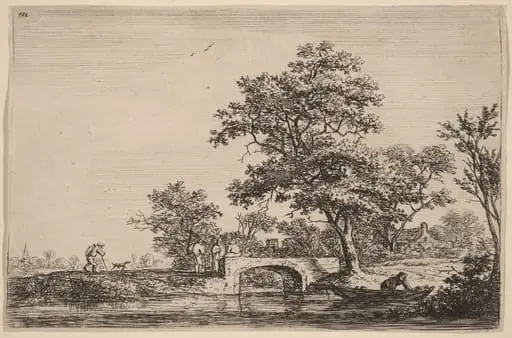 Four Men on a Stone Bridge
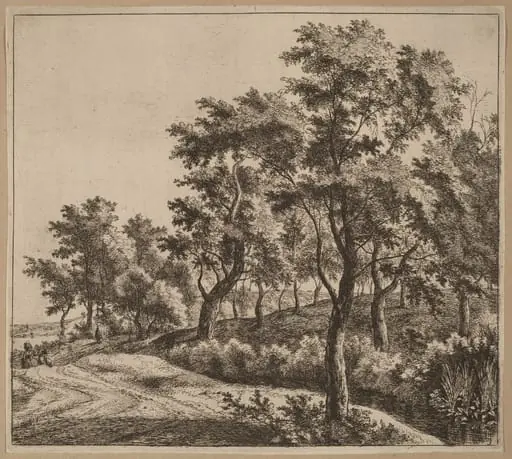 Landscape with a Stream
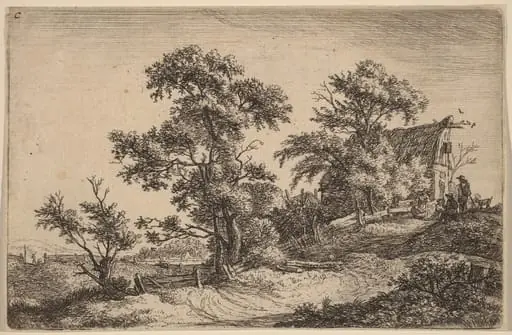 Cottage on a Hill
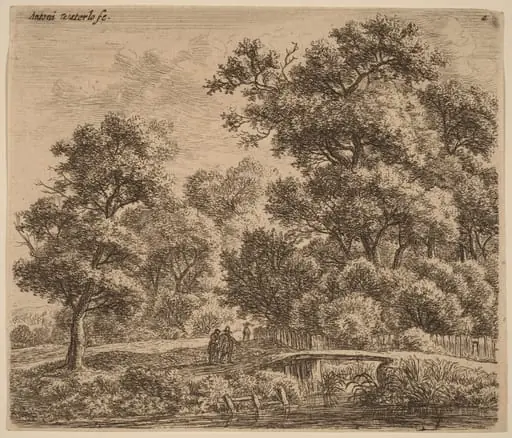 Wooded Landscape with a Bridge
 Six views in the Wood of the Hague: Plate 6, Two Deer
 The Narrow Stream
 Landscape with Fisherman Carrying his Net
 Landscape with Four Trees
 Churchyard at the Waterside