Artwork
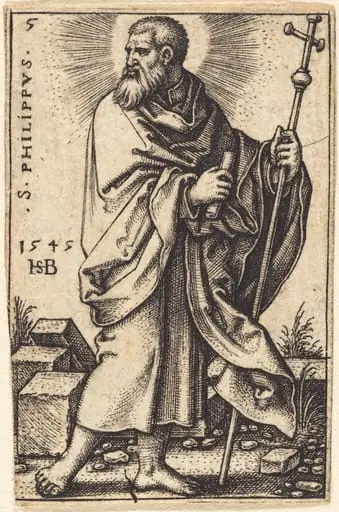
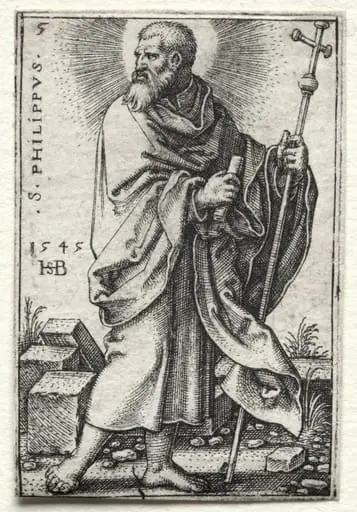
S. Philippus
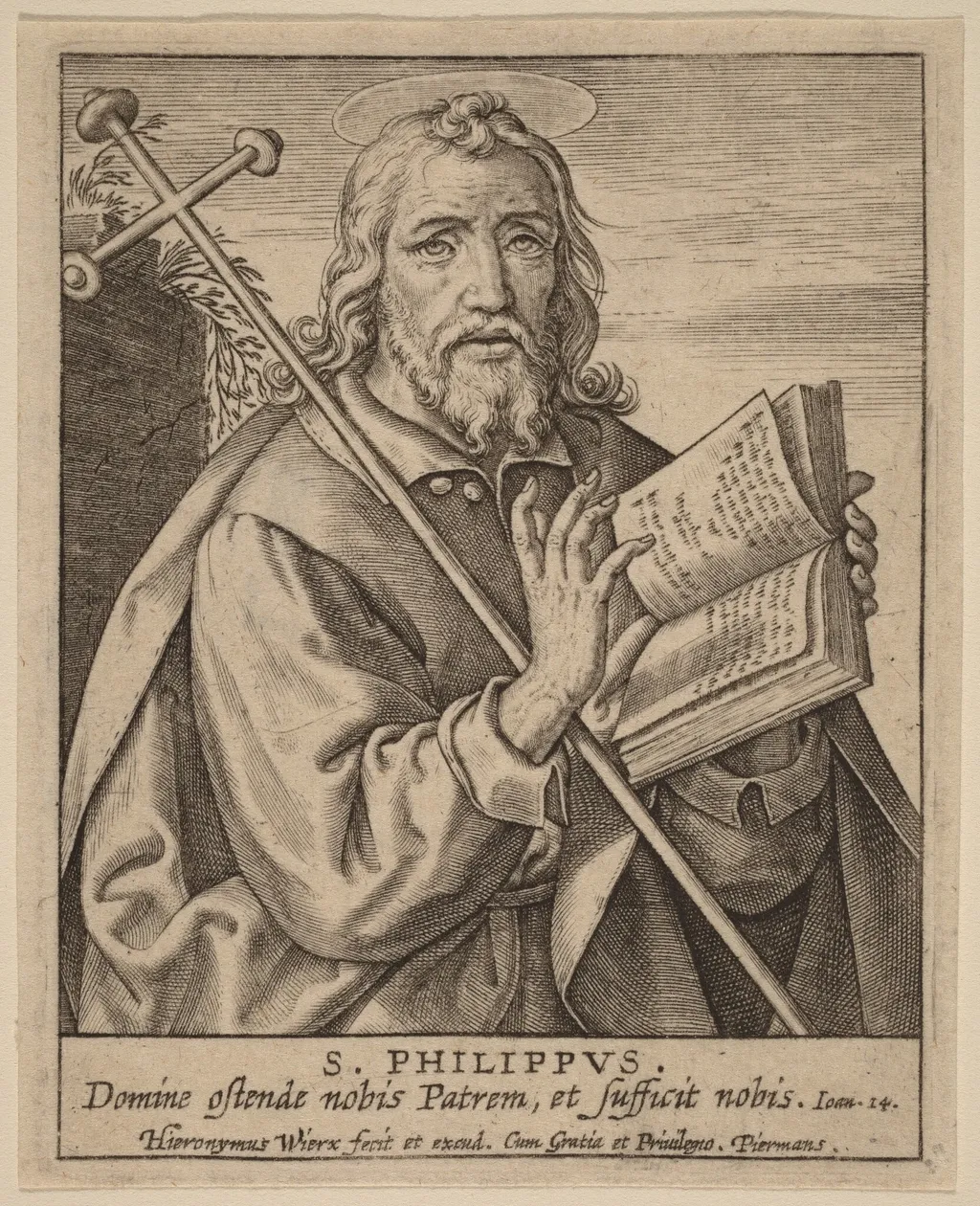
S. Philippus is an ink print by the Renaissance artist Hieronymus Wierix. It dates from 1586 and is held in the collection of the National Gallery of Art.
About this work
Overview
As a reproductive printmaker, Wierix specialized in translating religious imagery into detailed line work, often after established compositions.
Created in 1586 by Hieronymus Wierix, this black-and-white engraving depicts Saint Philip, one of the twelve apostles. As a reproductive printmaker, Wierix specialized in translating religious imagery into detailed line work, often after established compositions. The piece was produced during a time of intense religious conflict in the Southern Netherlands, where print culture served both devotional and propagandistic ends. Its precise engraving technique reflects the craftsmanship of a family workshop deeply embedded in the European print trade.
Subject & Meaning
The figure is identified as Saint Philip by the Latin inscription 'S. PHILIPPVS.' He is portrayed as an elderly man with a long, curly beard, holding a large open book—symbolizing scripture—and a staff topped with a cross, indicating his apostolic authority. The composition draws on traditional iconography to convey spiritual wisdom and steadfast faith. The absence of narrative context focuses attention on the saint’s contemplative presence, aligning with Counter-Reformation ideals that emphasized personal piety and doctrinal clarity.
Technique & Style
Wierix employed fine, controlled lines to model form and texture, using cross-hatching to render the folds of the robe and the depth of facial features. The engraving’s tonal range emerges from the density of incised lines rather than shading, characteristic of Northern Renaissance printmaking. The sharp definition of the beard, hair, and wrinkles suggests a deliberate emphasis on age and dignity. The inscription and artist’s name are integrated into the lower margin, following the conventions of scholarly print production of the period.
History & Provenance
The engraving was made by Hieronymus Wierix as part of a broader family enterprise based in Antwerp, which produced thousands of religious prints for export across Europe. These works circulated widely among clergy, scholars, and devout households, often serving as aids for meditation or instruction. While the specific early ownership of this print is unrecorded, its survival in multiple institutional collections attests to its enduring presence in early modern devotional culture.
Context
Produced during the height of the Counter-Reformation, this engraving reflects the Catholic Church’s use of visual media to reinforce orthodoxy amid Protestant challenges. The Southern Netherlands, under Spanish rule, became a hub for religious printmaking, with artists like Wierix translating theological messages into accessible imagery. Saint Philip, as a figure of apostolic continuity, was a fitting subject for a period seeking to reaffirm ecclesiastical tradition through art.
Legacy
Wierix’s engravings, including this one, helped standardize the visual representation of saints across Catholic Europe. His technical precision and adherence to established iconography influenced later generations of printmakers. Though his name is less known today than Dürer’s, his output played a crucial role in disseminating religious imagery during a time when printed images were among the most effective tools for shaping public devotion.
Artist & collection

Artist
Hieronymus Wierix (1553–1619) was a Flemish engraver, draughtsman and publisher. He is known for his reproductive engravings after the work of well-known local and foreign artists including Albrecht Dürer. Together with…