Artwork
The Book of Job: Pl. 4, And I only am escaped alone to tell thee
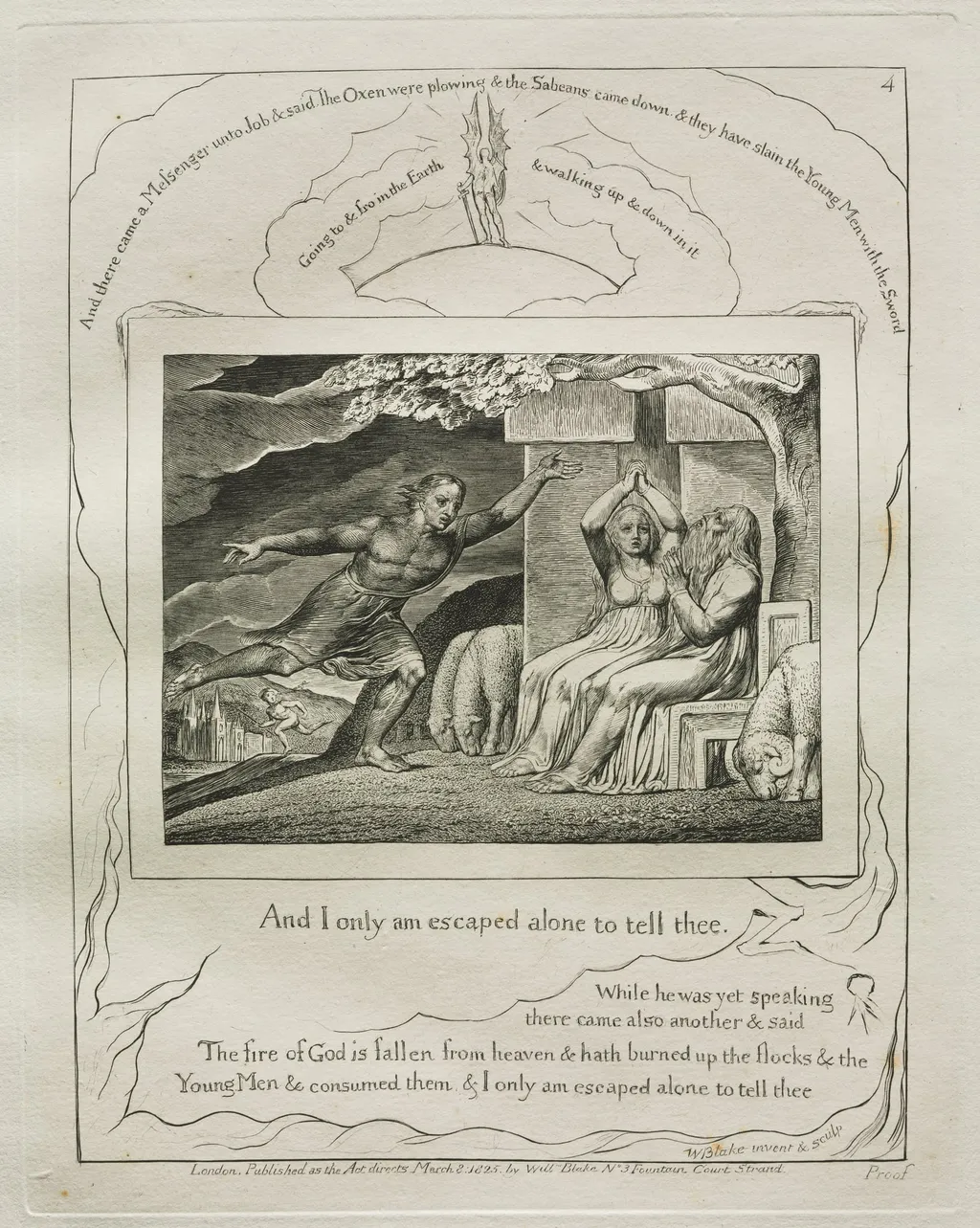
The Book of Job: Pl. 4, And I only am escaped alone to tell thee is a work on paper by the Romanticist artist William Blake. It dates from 1825 and is held in the collection of the Cleveland Museum of Art.
About this work
Overview
The work reflects his lifelong engagement with theological themes and his rejection of conventional artistic norms in favor of personal, visionary expression.
Created in 1825, this engraving is the fourth plate in William Blake’s illustrated series of the biblical Book of Job. Executed in relief etching, it forms part of a larger project in which Blake combined poetry and visual imagery to reinterpret sacred narrative. The work reflects his lifelong engagement with theological themes and his rejection of conventional artistic norms in favor of personal, visionary expression.
Subject & Meaning
The scene captures the moment described in Job 1:15, where a lone survivor arrives to announce the destruction of his kin and possessions. One figure, crouched in the storm, appears overwhelmed by divine wrath; another, sheltered indoors, reacts with dread. The burning village and turbulent sky symbolize divine judgment, while the lone messenger embodies the burden of witness—survival as both curse and testimony.
Technique & Style
Blake employed relief etching to integrate text and image seamlessly, a method he developed to maintain creative control. Bold chiaroscuro defines the composition: stark contrasts between the infernal glow of the sky and the deep shadows of the figures amplify emotional tension. The figures are rendered with elongated, expressive forms, characteristic of Blake’s symbolic language, where physical posture conveys spiritual states.
History & Provenance
The series was commissioned by John Linnell, a patron and fellow artist, and completed over several years. Blake hand-colored each impression, making every copy unique. The plates were printed in small batches during his lifetime, and few complete sets survive. This particular plate was likely produced between 1823 and 1826, during the final phase of Blake’s artistic career.
Context
Blake created this work amid growing public interest in biblical illustration and Romantic-era explorations of suffering and transcendence. His approach diverged from academic traditions, favoring mystical interpretation over literal representation. The series reflects his critique of institutional religion and his belief in direct, personal revelation, aligning with broader dissenting spiritual currents in early 19th-century England.
Legacy
Blake’s Job engravings are now recognized as pivotal in the history of illustrated literature and visionary art. Though largely overlooked in his lifetime, they later influenced Symbolist and modernist artists drawn to his fusion of text and image. Scholars value the series for its radical reimagining of scripture and its challenge to the boundaries between poetry, printmaking, and theology.
Artist & collection
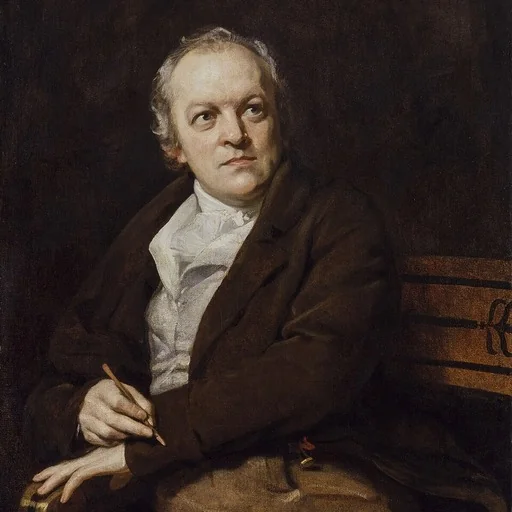
Artist
William Blake (28 November 1757 – 12 August 1827) was an English poet, painter and printmaker.

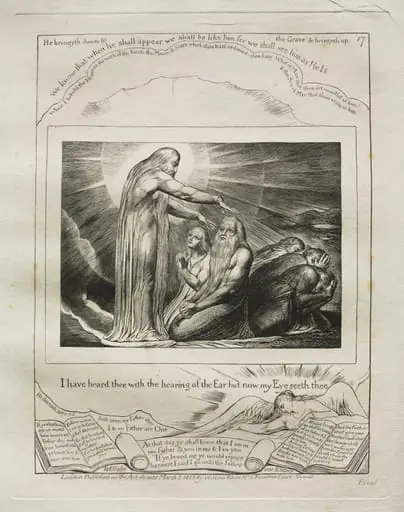 The Book of Job: Pl. 17, I have heard thee with the hearing of the Ear but now my Eye seeth thee
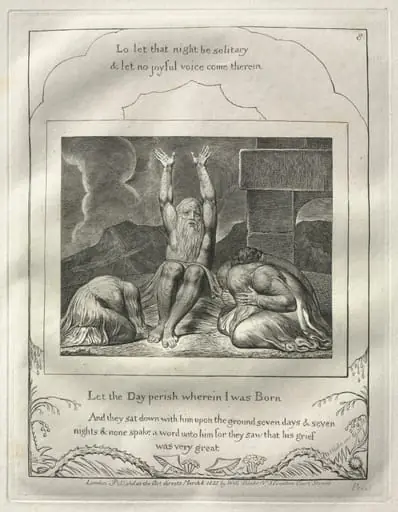 The Book of Job: No. 8, Let the Day perish wherin I was born
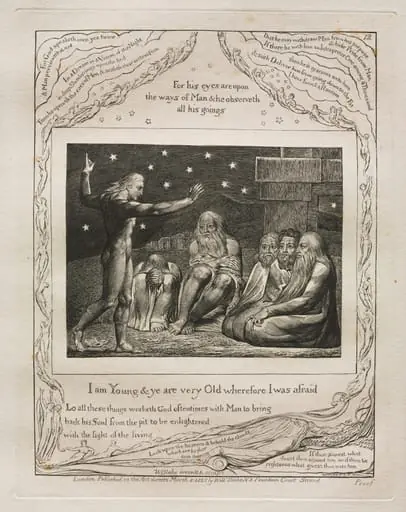 The Book of Job: Pl. 12, I am Young and ye are very Old wherefore I was afraid
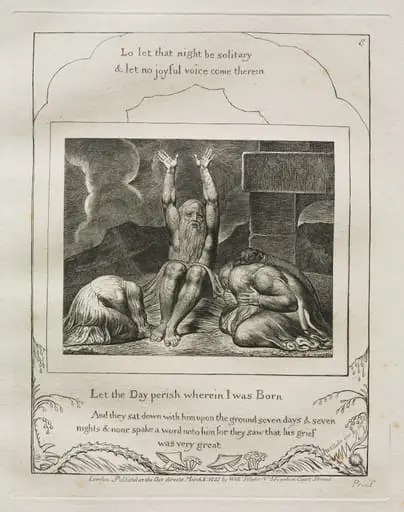 The Book of Job: Pl. 8, Let the Day perish wherein I was Born
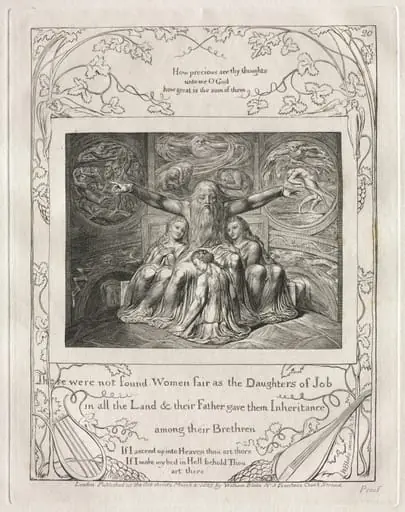 The Book of Job: Pl. 20, There were not found Women fair as the Daughters of Job
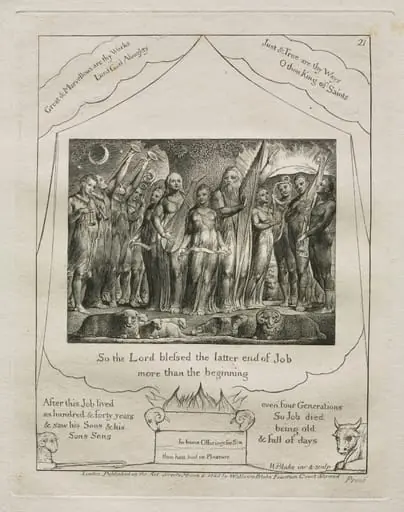 The Book of Job: Pl. 21, So the Lord blessed the latter end of Job
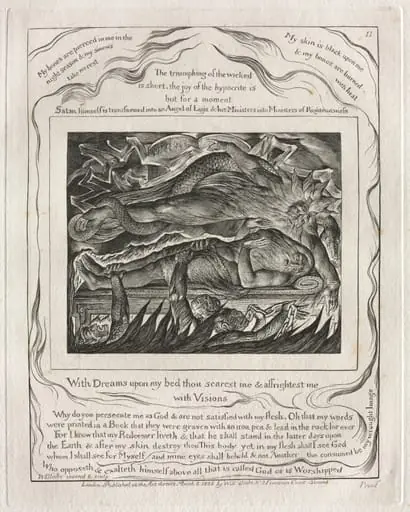 The Book of Job: Pl. 11, With Dreams upon my bed thou scarest me and affrightest me
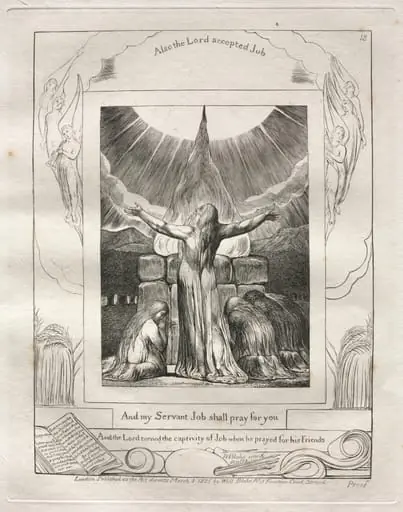 The Book of Job: Pl. 18, And my Servant Job shall pray for you
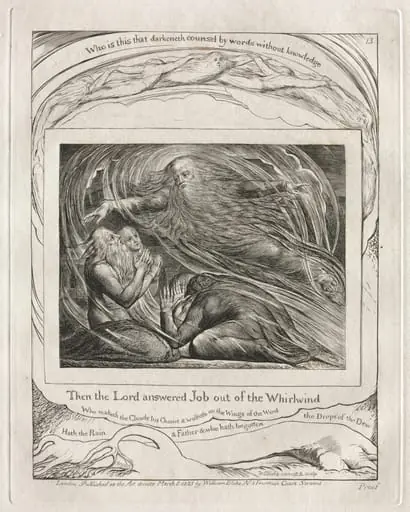 The Book of Job: Pl. 13, Then the Lord answered Job out of the Whirlwind
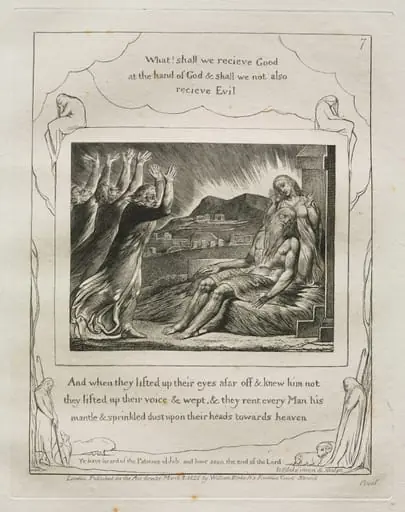 The Book of Job: Pl. 7, And when they lifted up their eyes afar off and knew him not
 The Book of Job: Pl. 10, The just upright man is laughted to scorn
 The Book of Job: Pl. 5, Then went Satan forth from the presence of the Lord