Artwork
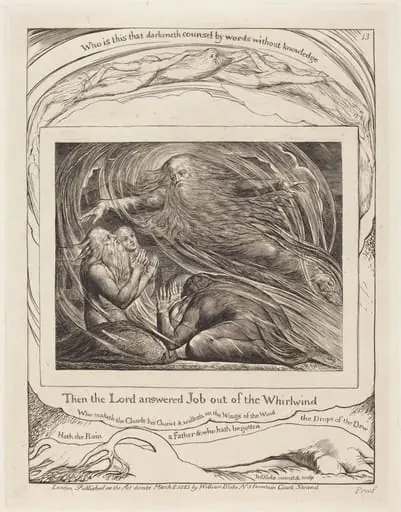
The Book of Job: Pl. 13, Then the Lord answered Job out of the Whirlwind
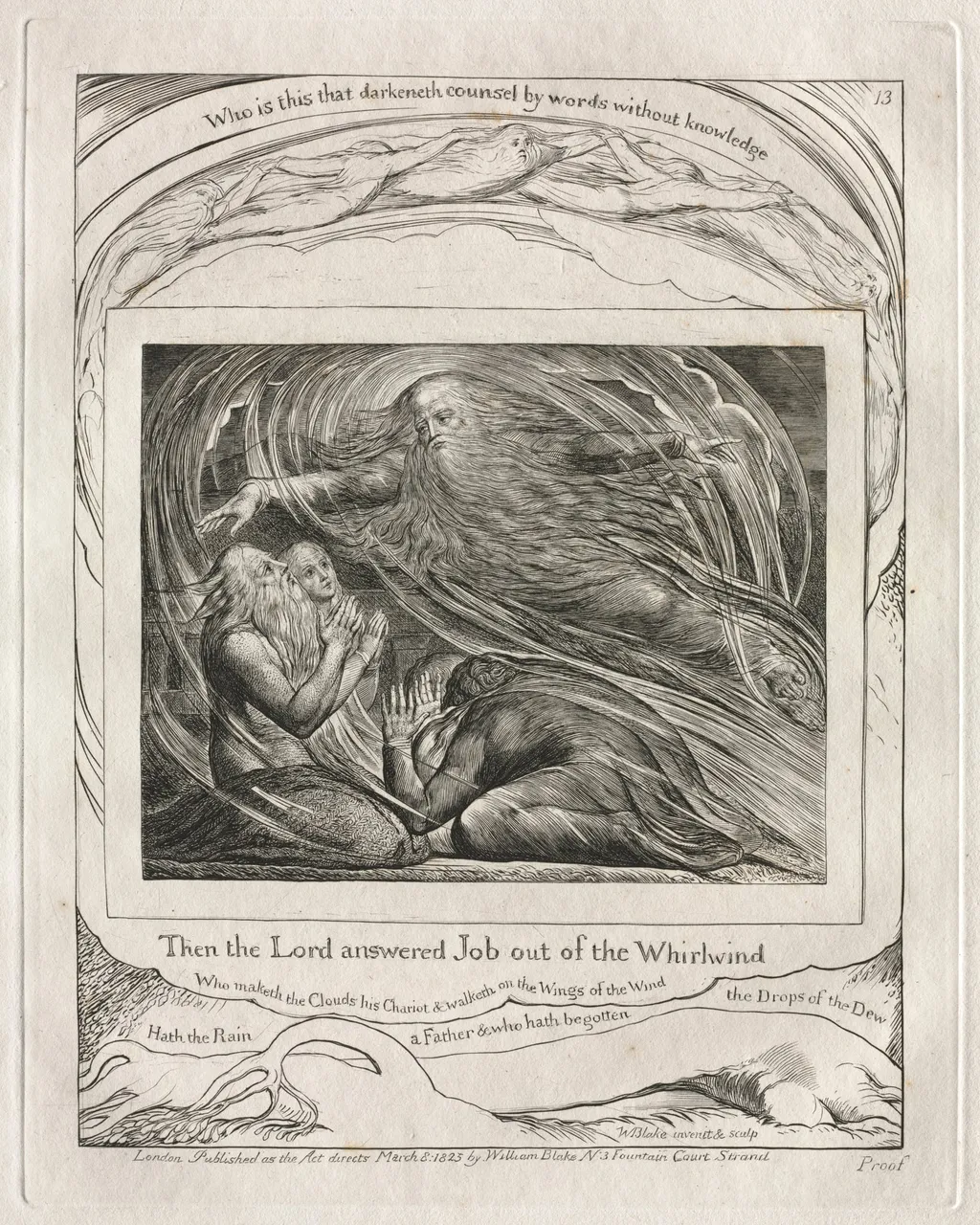
The Book of Job: Pl. 13, Then the Lord answered Job out of the Whirlwind is a work on paper by the Romanticist artist William Blake. It dates from 1825 and is held in the collection of the Cleveland Museum of Art.
About this work
Overview
Created in 1825, this print is the thirteenth plate in William Blake’s illustrated series of the biblical Book of Job.
Created in 1825, this print is the thirteenth plate in William Blake’s illustrated series of the biblical Book of Job. Executed as a relief etching with watercolor, it forms part of a larger project Blake undertook late in life to visualize sacred texts through his unique artistic vision. The work was produced in his London studio, where he combined poetry, engraving, and painting into a unified medium.
Subject & Meaning
The scene depicts the moment from Job 38 when God speaks to Job from a whirlwind, responding to his suffering with divine authority. A towering, cloud-enshrouded figure represents the divine presence, while Job, smaller and seated, raises his hands in silent reception. The composition conveys awe and humility, emphasizing the ineffable nature of divine revelation over human comprehension.
Technique & Style
Blake employed relief etching, a method he invented, allowing him to integrate text and image on a single plate. The swirling, agitated lines evoke turbulent wind and cosmic energy, while the rough, uneven inkwork enhances the sense of elemental chaos. Hand-applied watercolor adds subtle tonal depth, reinforcing the spiritual intensity without softening the rawness of the storm.
History & Provenance
The complete series of twenty-one plates was commissioned by John Linnell, a patron and fellow artist, and completed between 1823 and 1826. Only a small number of hand-colored copies were printed during Blake’s lifetime. This particular plate survives in several known impressions, held in major institutional collections, including the British Museum and the Huntington Library.
Context
Blake’s Job illustrations emerged during the height of Romanticism, a movement that valued inner experience, emotional depth, and nature as manifestations of the divine. Rejecting Enlightenment rationalism, Blake used myth and symbolism to express spiritual truths. His visual language diverged sharply from academic conventions, favoring personal revelation over classical harmony.
Legacy
Blake’s Book of Job series is now recognized as a landmark in British printmaking for its fusion of textual and visual prophecy. Though largely overlooked in his lifetime, the series influenced later Symbolist and modernist artists drawn to its psychological intensity and innovative technique. It remains a vital example of how art can serve as a conduit for theological contemplation.
Artist & collection
Artist
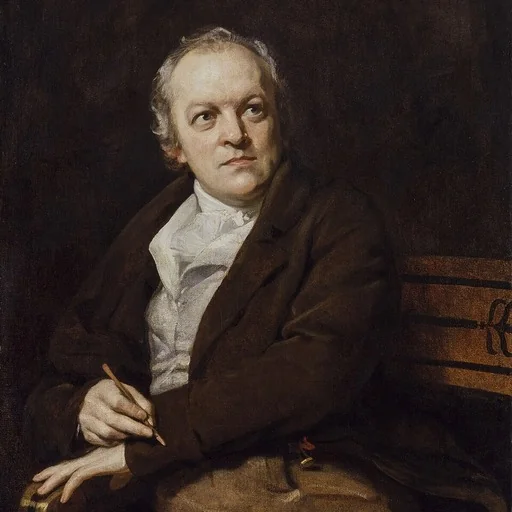
William Blake (28 November 1757 – 12 August 1827) was an English poet, painter and printmaker.

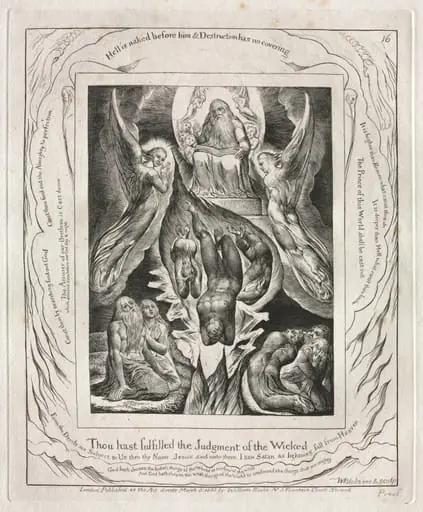 The Book of Job: Pl. 16, Thou hast fulfilled the Judgment of the Wicked
 The Lord Answering Job out of the Whirlwind
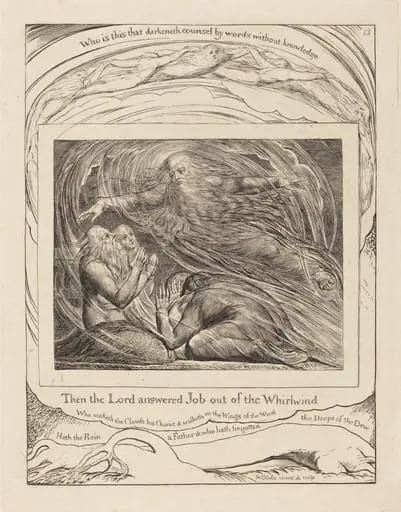 The Lord Answering Job out of the Whirlwind
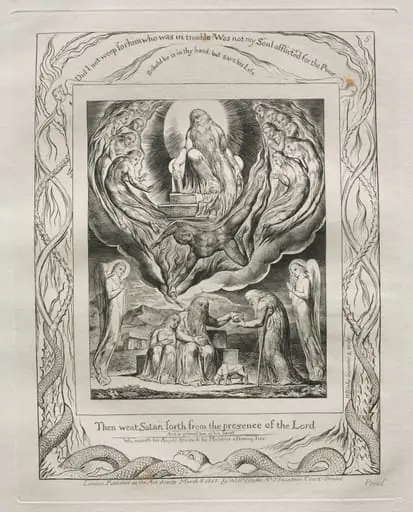 The Book of Job: Pl. 5, Then went Satan forth from the presence of the Lord
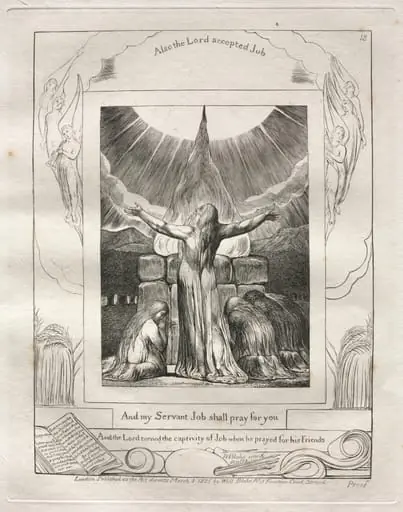 The Book of Job: Pl. 18, And my Servant Job shall pray for you
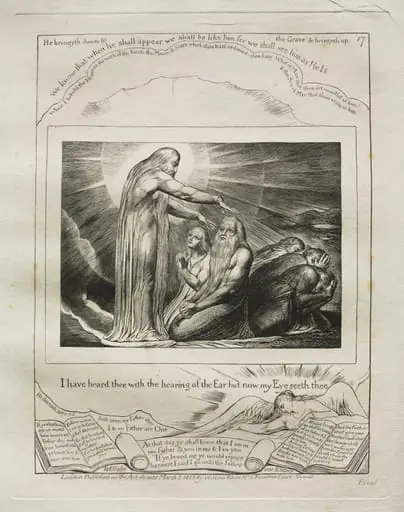 The Book of Job: Pl. 17, I have heard thee with the hearing of the Ear but now my Eye seeth thee
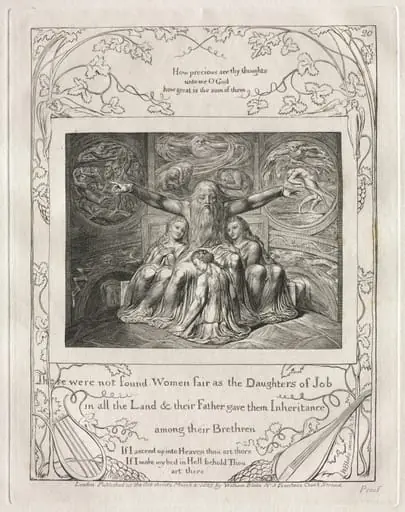 The Book of Job: Pl. 20, There were not found Women fair as the Daughters of Job
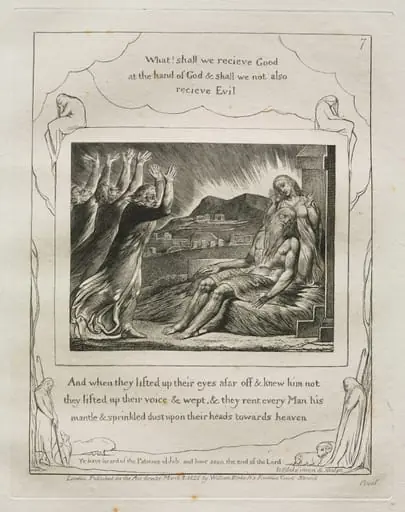 The Book of Job: Pl. 7, And when they lifted up their eyes afar off and knew him not
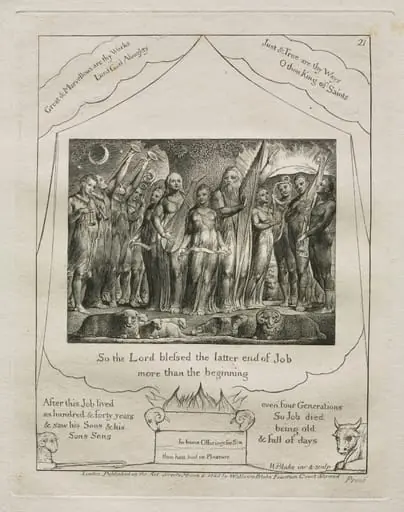 The Book of Job: Pl. 21, So the Lord blessed the latter end of Job
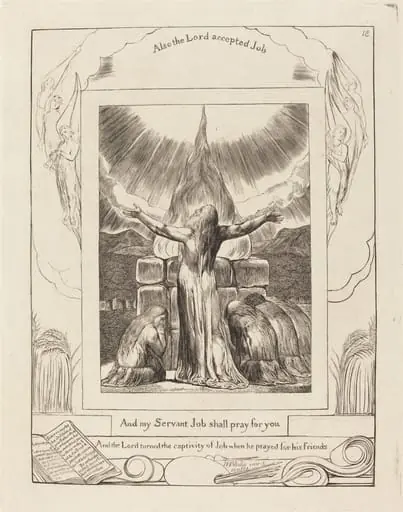 Job's Sacrifice
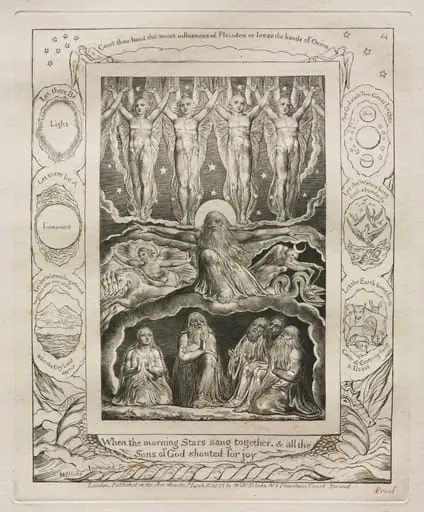 The Book of Job: Pl. 14, When the morning Stars sang together, and all the
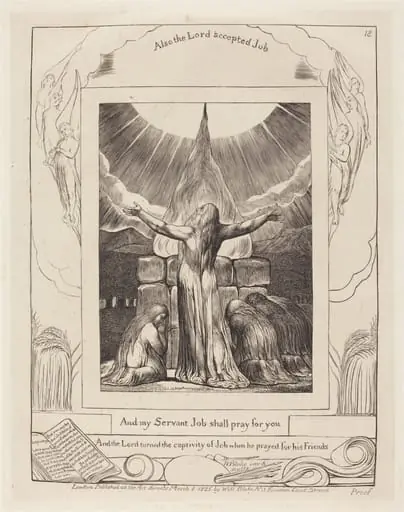 Job's Sacrifice