Artwork
William V, Duke of Julich and Cleves
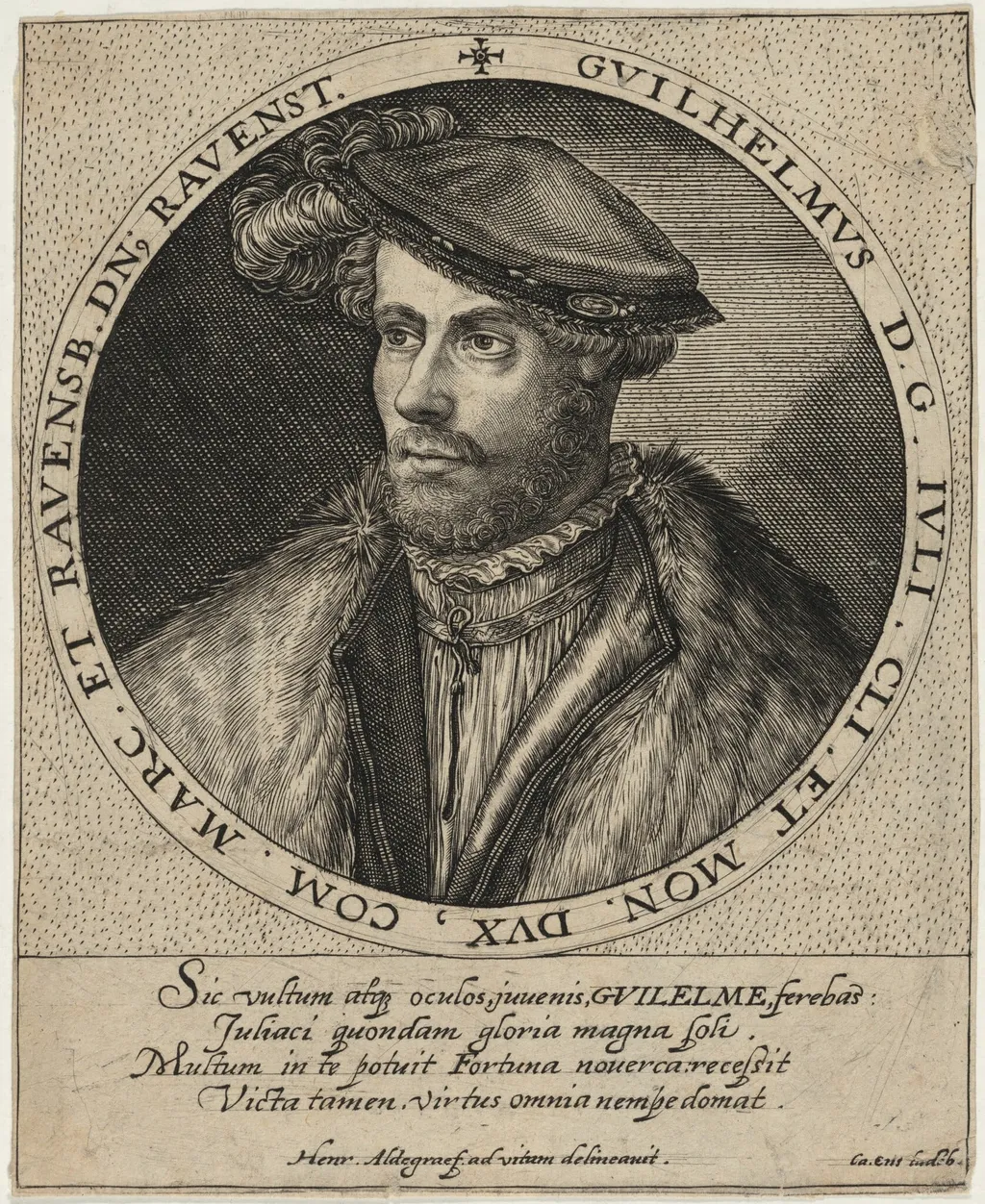
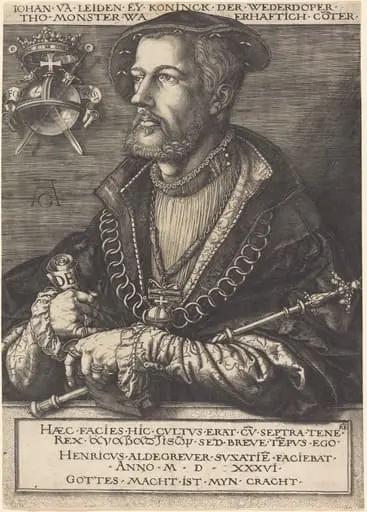
William V, Duke of Julich and Cleves is an ink print by the Northern Renaissance artist Heinrich Aldegrever. It dates from 1532 and is held in the collection of the National Gallery of Art.
About this work
Overview
The work is a small-scale portrait executed with precision, reflecting the era’s interest in detailed, intimate depictions of nobility.
Created in 1532, this black-and-white engraving portrays William V, Duke of Julich and Cleves, by Heinrich Aldegrever, a German artist linked to the Little Masters. The work is a small-scale portrait executed with precision, reflecting the era’s interest in detailed, intimate depictions of nobility. Aldegrever’s technique emphasizes fine linear control, characteristic of engraving’s capacity for subtle tonal variation without color.
Subject & Meaning
The portrait presents William V in formal attire: a dark hat, a high ruffled collar, and a chain of office, signaling his status as a regional ruler. His stern gaze and restrained posture convey authority and gravitas. Surrounding Latin inscriptions identify him and likely affirm his title or lineage, reinforcing the image’s function as a public declaration of power rather than a personal likeness.
Technique & Style
Aldegrever employed fine, controlled lines to render texture in fabric, hair, and skin, using cross-hatching and delicate stippling to suggest depth and volume. The plain background focuses attention on the figure, while the precision of the engraving reflects the Little Masters’ dedication to intricate detail. The absence of color heightens the emphasis on line and form, typical of printmaking in early 16th-century Germany.
History & Provenance
The engraving was produced during William V’s early rule, likely for distribution among courtiers or allied nobles. As a print, it could be reproduced and circulated more widely than a painted portrait, serving political and dynastic purposes. Its survival suggests it was valued within noble circles, though its early ownership records remain undocumented.
Context
Aldegrever worked in the generation after Albrecht Dürer, adapting his techniques to smaller, more refined compositions. Engravings like this one catered to a growing literate elite who collected prints as both art and status symbols. The Latin text and formal pose align with humanist ideals of leadership, blending Renaissance portraiture with northern European traditions of civic representation.
Legacy
Though less celebrated than Dürer, Aldegrever’s work exemplifies the technical refinement of the Little Masters. This engraving contributes to the broader understanding of how German printmakers used portraiture to articulate political identity. Its restrained elegance and meticulous execution influenced later generations of engravers focused on portraiture and miniature detail.
Artist & collection

Artist
Heinrich Aldegrever or Aldegraf was a German painter and engraver. He was one of the "Little Masters", the group of German artists making small old master prints in the generation after Albrecht Dürer.