Artwork
Johan van Leyden (Jan Beukels)
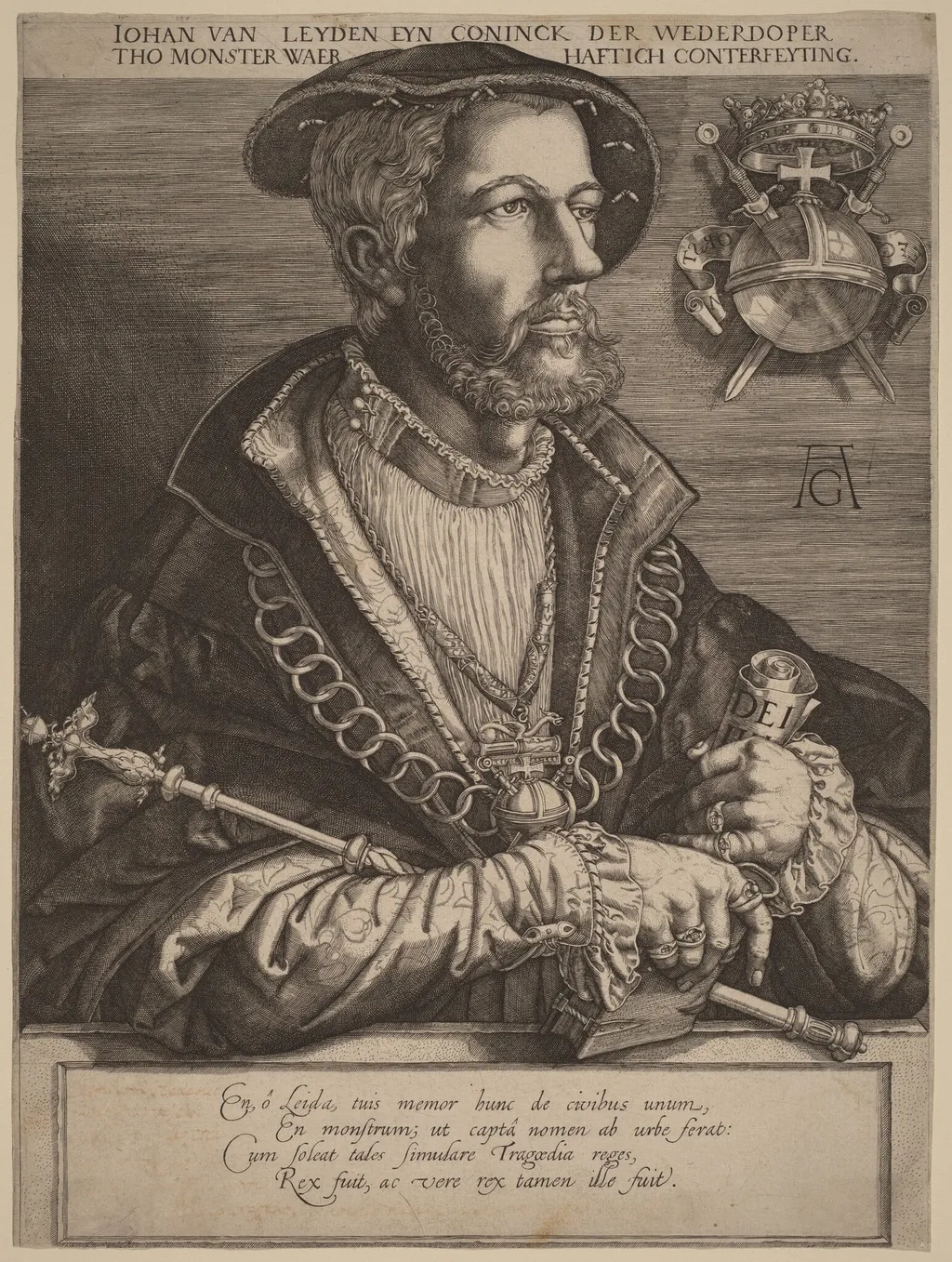
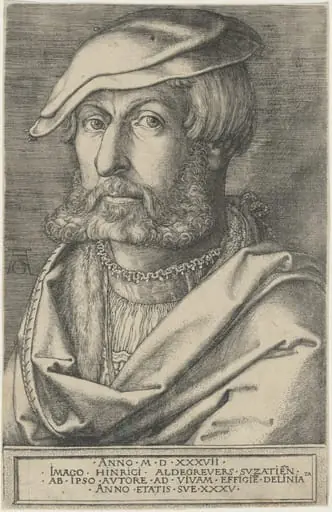
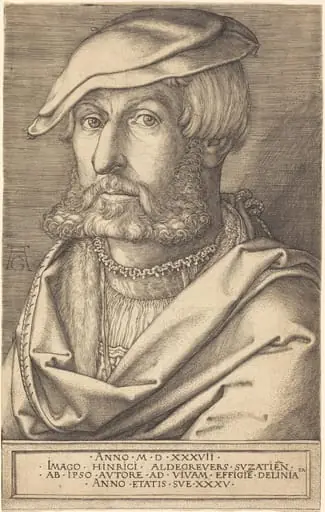
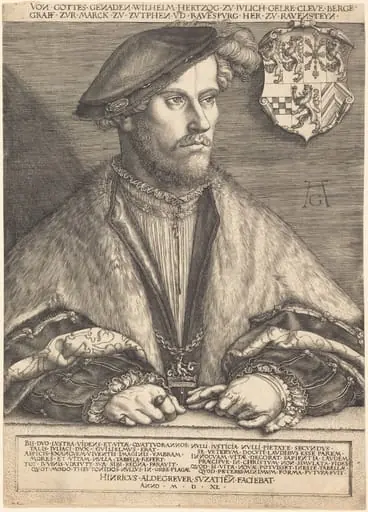
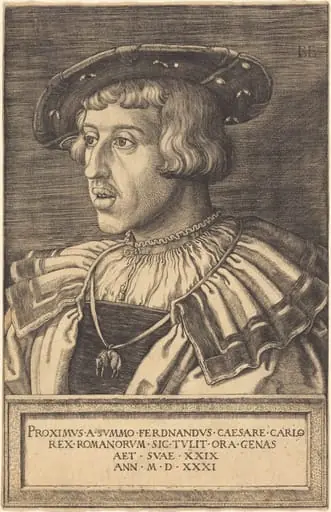
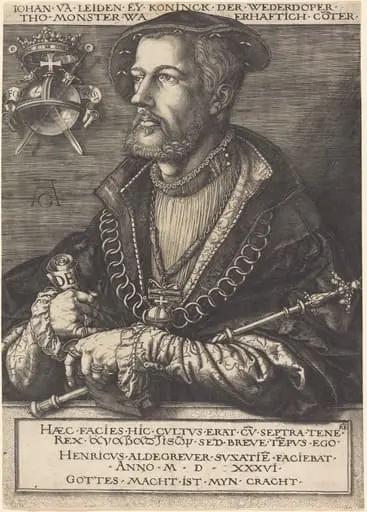
Johan van Leyden (Jan Beukels) is an ink print by the Baroque artist Jan Muller. It dates from 1615 and is held in the collection of the National Gallery of Art. Created around 1615 by Jan Harmensz.
About this work
Overview
Muller, this engraving portrays Jan Beukelsz, known as Johan van Leyden, a leader of the Anabaptist rebellion in Münster.
Created around 1615 by Jan Harmensz. Muller, this engraving portrays Jan Beukelsz, known as Johan van Leyden, a leader of the Anabaptist rebellion in Münster. Muller, trained in his father’s Amsterdam print shop and influenced by his time in Italy, produced this work as part of a broader tradition of historical portraiture in print. The image is rendered in fine linear detail, typical of early 17th-century Northern European engraving.
Subject & Meaning
The portrait depicts Jan Beukelsz in regal attire, wearing a dark coat, white collar, and a heavy chain, holding a scepter and a rolled document. These attributes suggest claims to temporal and spiritual authority, reflecting his brief rule over Münster during the Anabaptist uprising. The stern expression and formal pose convey gravitas, aligning with contemporary efforts to visually codify political and religious figures, even those later deemed heretical.
Technique & Style
Muller employed precise cross-hatching and fine line work to model form and texture, particularly in the fabric of the coat and the metallic sheen of the chain. The background is uniformly dark, isolating the figure and enhancing the three-dimensionality of his features. The composition follows a rigid frontality, emphasizing dignity over narrative, characteristic of portrait engravings intended for dissemination among educated audiences.
History & Provenance
Jan Harmensz. Muller inherited his father’s print business and became a leading engraver in Amsterdam, producing portraits and biblical scenes for a growing market. This engraving likely circulated as a printed image to inform or warn viewers about radical religious figures. No early provenance is documented, but its survival in institutional collections suggests it was preserved as a historical record rather than a devotional object.
Context
The engraving emerged during a period when the Dutch Republic was consolidating its identity, often contrasting its Protestant orthodoxy with the excesses of radical sects like the Münster Anabaptists. Images of figures like Beukelsz served as cautionary symbols, reinforcing civic and religious norms. Muller’s work reflects the role of print media in shaping public perception of political and religious dissent.
Legacy
Muller’s engraving remains one of the few contemporary visual records of Johan van Leyden, preserving a standardized image of a figure otherwise known through textual accounts. While not widely reproduced today, it contributes to the visual archive of early modern religious conflict and the role of print in constructing historical memory.
Artist & collection

Artist
Jan Harmensz. Muller (1571–1628) was a Dutch engraver and painter. Muller was born in Amsterdam. His father was a book printer, engraver and publisher. He learned the engraving trade while working in the family…