Artwork
The Triumph of Julius Caesar
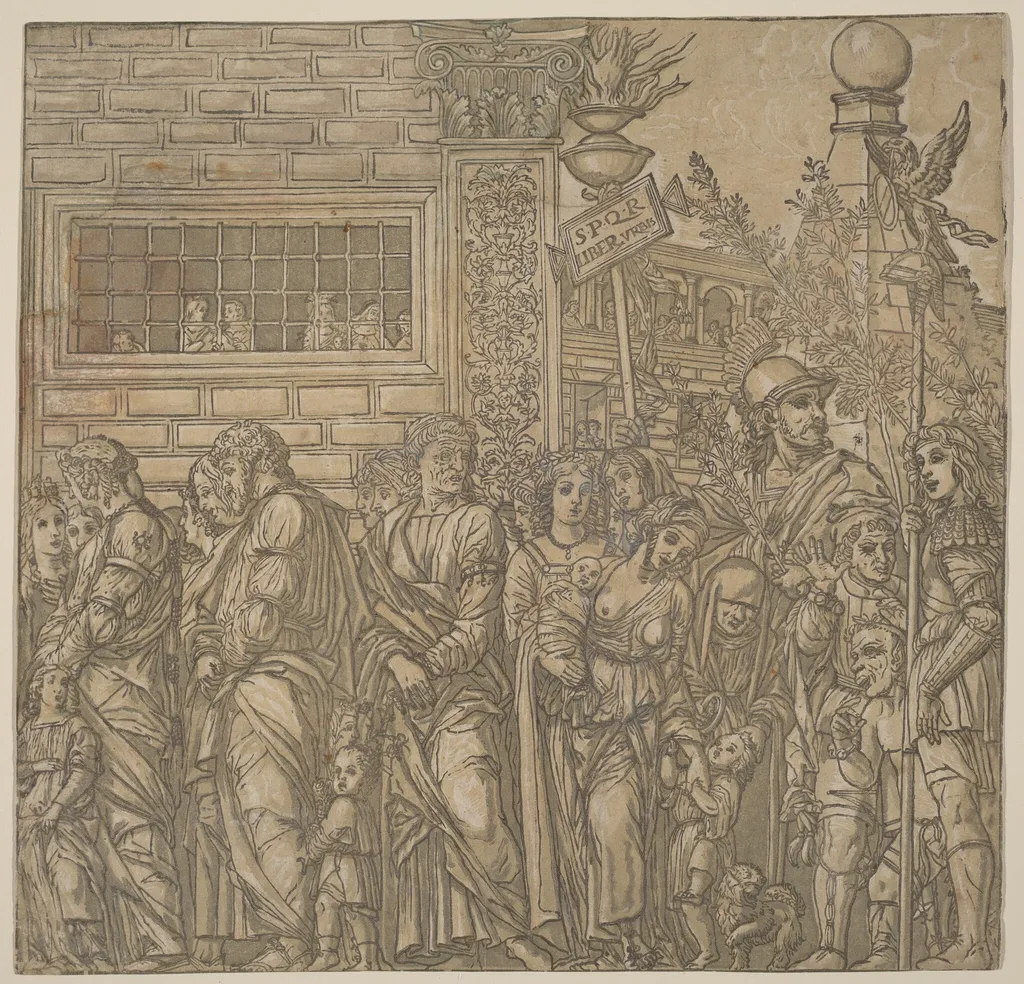
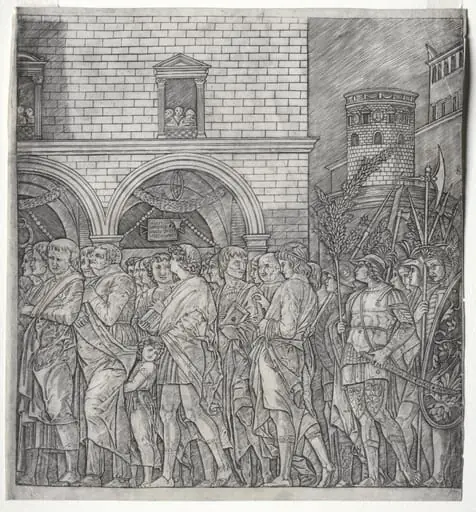
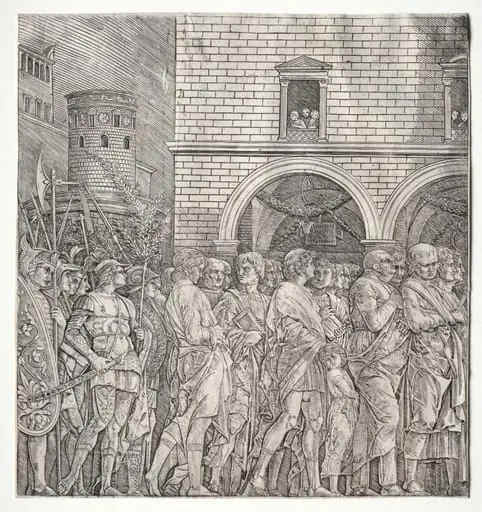
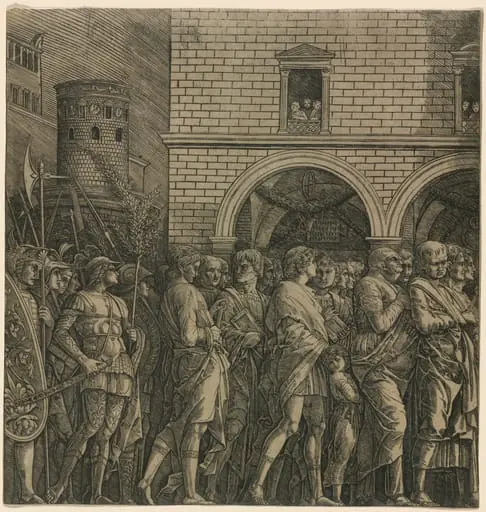
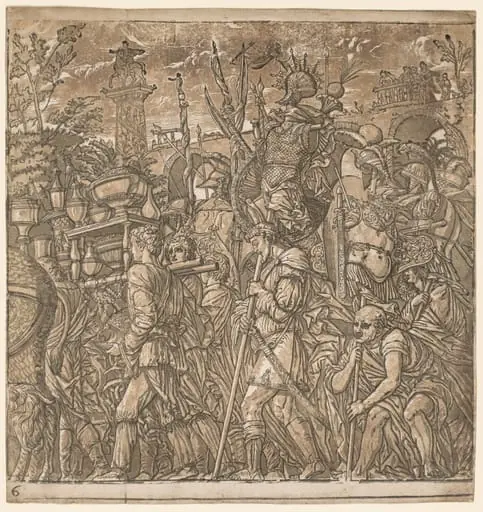
The Triumph of Julius Caesar is an ink print by the Renaissance artist Andrea Andreani. It dates from 1599 and is held in the collection of the National Gallery of Art.
About this work
Overview
The print reproduces a design originally conceived by Andrea Mantegna, translated into multiple tones through layered woodblocks.
Created in 1599 by Andrea Andreani, this chiaroscuro woodcut depicts a ceremonial procession honoring Julius Caesar. The print reproduces a design originally conceived by Andrea Mantegna, translated into multiple tones through layered woodblocks. Its intricate composition captures a public spectacle with architectural grandeur and dense human activity, rendered in subtle gradations of light and shadow to simulate depth.
Subject & Meaning
The scene portrays Caesar’s triumphal entry into Rome, marked by the presence of SPQR, the emblem of the Roman Senate and People. Figures in elaborate attire accompany the victor, while commoners and children observe from the margins. A winged figure above holds a globe, symbolizing imperial dominion. The composition blends historical narrative with allegory, reinforcing Caesar’s authority and the ceremonial weight of Roman victory.
Technique & Style
Andreani employed the chiaroscuro woodcut technique, using separate blocks for each tonal layer to achieve a range of grays. This method allowed for modeling of forms through careful shadow and highlight, giving figures and architecture a sculptural presence. Unlike flat line engravings, the print mimics the volume and texture of painted compositions, demonstrating technical innovation in printmaking of the late Renaissance.
History & Provenance
The work is a reproduction of Mantegna’s lost painted series commissioned by the Duke of Mantua. Andreani, active in Mantua, translated the designs into woodcuts around 1599, likely for wider dissemination. Surviving impressions are rare, held in major European collections. The print reflects the enduring interest in classical antiquity among Renaissance patrons and printmakers seeking to preserve monumental imagery.
Context
In late 16th-century Italy, classical themes remained central to artistic expression, especially in courtly circles. The revival of Roman iconography served both cultural prestige and political messaging. Andreani’s print aligns with broader trends in printmaking that sought to elevate the medium beyond reproduction, transforming it into a vehicle for sophisticated visual storytelling rooted in antiquity.
Legacy
Andreani’s Triumph of Julius Caesar stands as a high point in Italian chiaroscuro woodcut production. Its technical ambition influenced later printmakers exploring tonal depth without color. Though not widely known today, it remains a key example of how Renaissance artists reinterpreted classical subjects through new print technologies, bridging painting and print in the service of historical commemoration.
Artist & collection


![The Triumph of Julius Caesar [no.9 plus 2 columns], by Andrea Andreani](https://artifactworldgallery.com/img/andrea-andreani--the-triumph-of-julius-caesar-no-9-plus-2-columns--26f4d2249baf2916-w320.webp)
![The Triumph of Julius Caesar [no.3 and 4 plus 2 columns], by Andrea Andreani](https://artifactworldgallery.com/img/andrea-andreani--the-triumph-of-julius-caesar-no-3-and-4-plus-2-columns--58c944449efc96df-w320.webp)
![The Triumph of Julius Caesar [no.1 and 2 plus 2 columns], by Andrea Andreani](https://artifactworldgallery.com/img/andrea-andreani--the-triumph-of-julius-caesar-no-1-and-2-plus-2-columns--72fc49376c9f9633-w320.webp)
![The Triumph of Julius Caesar [no.7 and 8 plus 2 columns], by Andrea Andreani](https://artifactworldgallery.com/img/andrea-andreani--the-triumph-of-julius-caesar-no-7-and-8-plus-2-columns--75ccf1616a5609e2-w320.webp)