Artwork
Two Royal Turban-Bearers on horseback
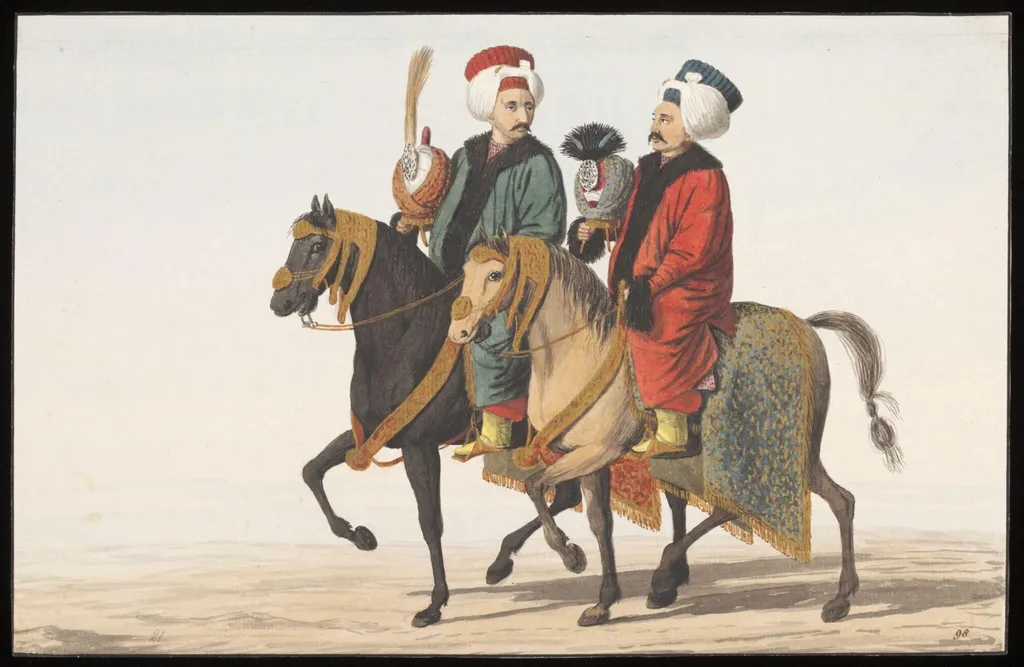
Two Royal Turban-Bearers on horseback is a watercolor work on paper by the Romanesque artist Anonymous Greek artist. It dates from 1809 and is held in the collection of the Victoria and Albert Museum.
About this work
Overview
Created around 1810, these works were produced by an anonymous local artist, likely trained in the tradition of Konstantin Kapidagli.
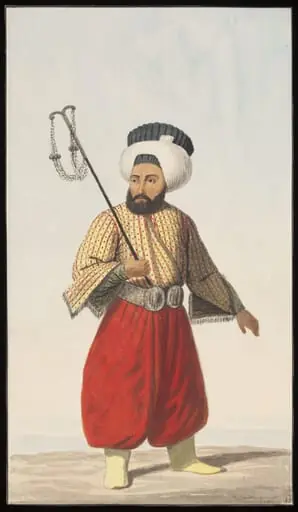
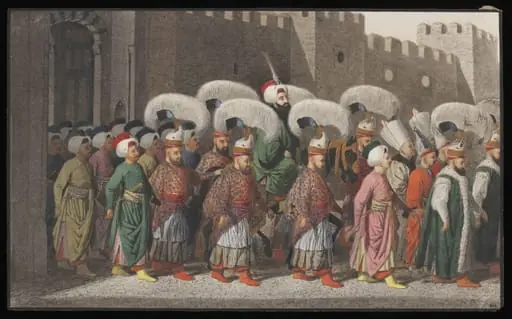
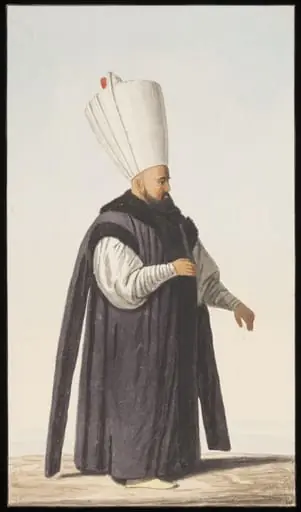
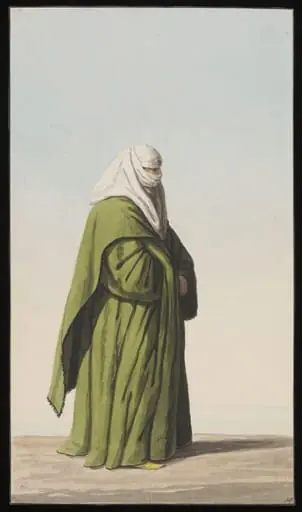
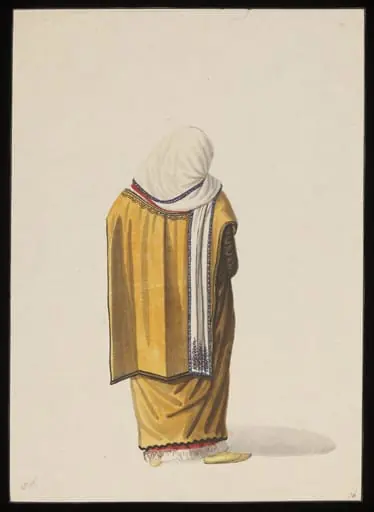
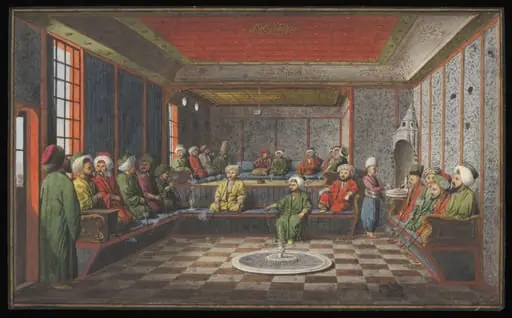
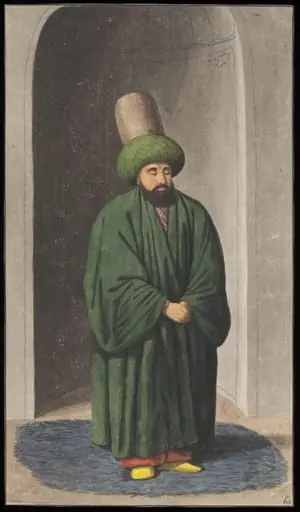
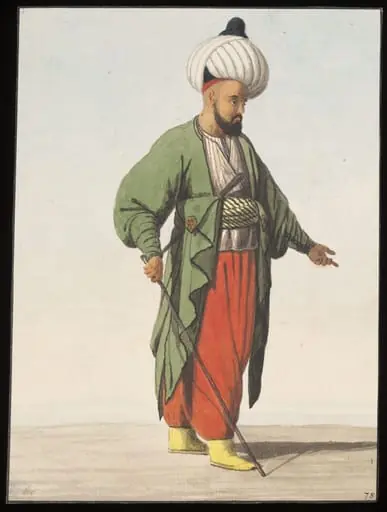
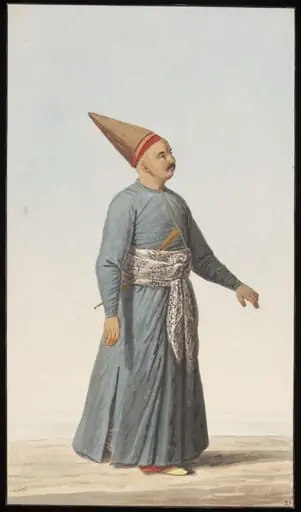
A series of watercolour drawings commissioned by British diplomat Stratford Canning during his early posting in Istanbul captures Ottoman court life with unusual detail. Created around 1810, these works were produced by an anonymous local artist, likely trained in the tradition of Konstantin Kapidagli. The series reflects Canning’s scholarly interest in Ottoman institutions, blending local artistic practices with European visual conventions to document ceremonial and architectural subjects.
Subject & Meaning
The image depicts two attendants wearing ornate turbans, mounted on horseback, likely part of an official procession or royal escort. Their poised posture and elaborate headgear signify status within the Ottoman hierarchy. The scene is not merely decorative but serves as ethnographic record, preserving the visual language of courtly ritual at a time when Western observers sought to understand Ottoman governance and ceremony through direct observation.
Technique & Style
The watercolours employ dense, luminous pigments typical of Ottoman miniature traditions, yet incorporate Western linear perspective and spatial depth. The artist’s handling of texture in fabric and horse anatomy shows familiarity with both local pigment use and European draftsmanship. This hybrid approach suggests a skilled practitioner trained in Istanbul’s artistic milieu, adapting indigenous methods to meet the expectations of a foreign patron seeking documentary accuracy.
History & Provenance
Stratford Canning commissioned the series during his tenure at the British embassy in Istanbul, beginning in 1808. The drawings remained in his family until 1895, when his daughter Charlotte donated the complete set to the Victoria and Albert Museum. The artist’s identity remains unconfirmed, though circumstantial evidence links him to the circle of Konstantin Kapidagli, a known Ottoman painter active in diplomatic circles.
Context
The drawings were made during a period of heightened European interest in Ottoman culture, as diplomats and travelers sought to document its institutions. Charles Cockerell, then a young architect, visited the embassy in 1810 and engaged with the artist, making copies of his architectural studies—now held at the British Museum. This exchange highlights the transnational flow of artistic knowledge, even as the original creator’s name was lost to history.
Legacy
The series stands as a rare visual archive of early 19th-century Ottoman court life, produced not by a foreign tourist but by a local artist working within his own tradition. Its preservation in a major British institution underscores its value as a cross-cultural document. Though the artist remains anonymous, the works continue to inform scholarly understanding of how Ottoman visual culture was perceived and recorded by Western observers.
Artist & collection

![A Pasha travelling with his escort[?], by Anonymous Greek artist](https://artifactworldgallery.com/img/anonymous-greek-artist--a-pasha-travelling-with-his-escort--01de32b8fcf30843-w320.webp)
![A Dervish[?], by Anonymous Greek artist](https://artifactworldgallery.com/img/anonymous-greek-artist--a-dervish--3c8916f5a95abb6a-w320.webp)