Artwork
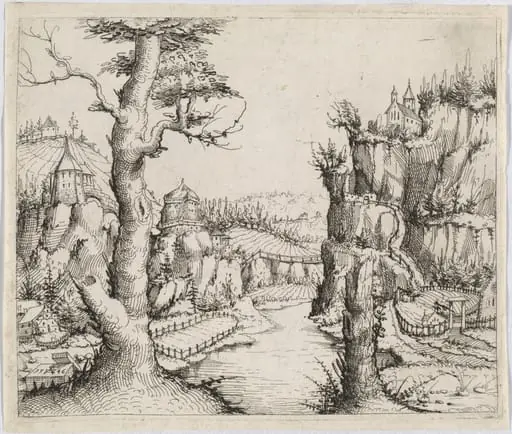
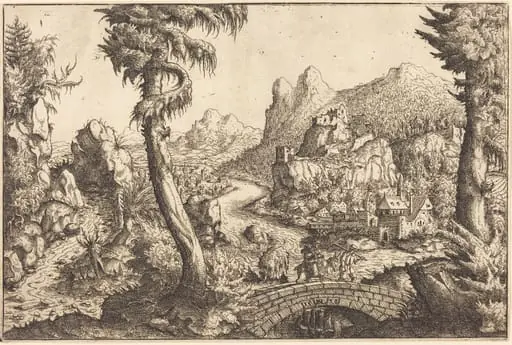
River Landscape with Rocks at Left and Right
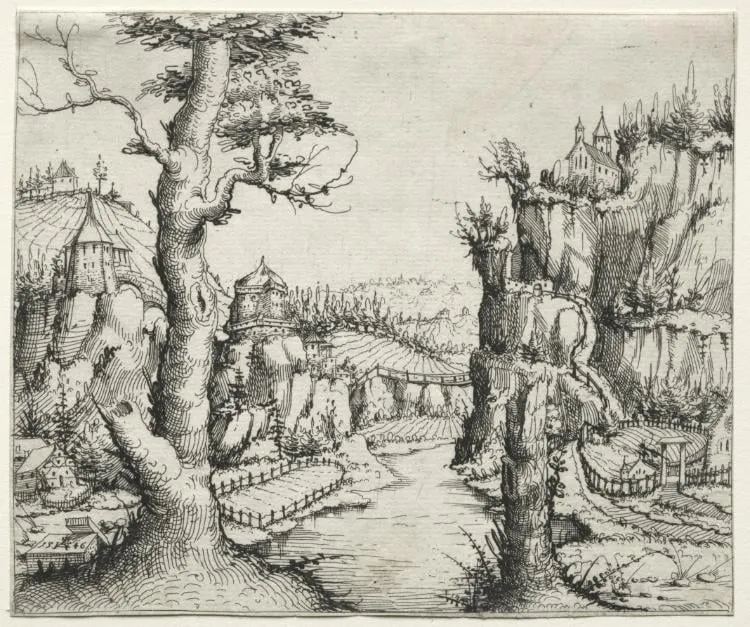
River Landscape with Rocks at Left and Right is a print by the Renaissance artist Augustin Hirschvogel. It dates from 1546 and is held in the collection of the Cleveland Museum of Art.
About this work
Overview
Unlike earlier landscape prints that served as backdrops for religious or historical scenes, this work centers the natural terrain itself.
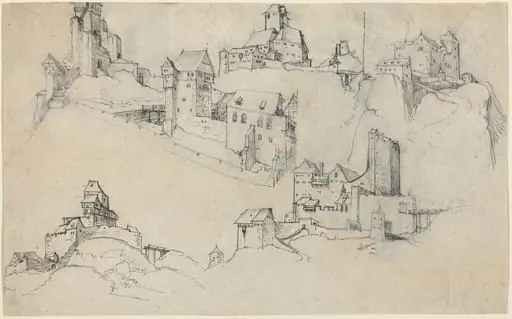
This etching by Augustin Hirschvogel depicts a real stretch of the Danube River, rendered with precise topographical detail. Unlike earlier landscape prints that served as backdrops for religious or historical scenes, this work centers the natural terrain itself. Created after a journey from Nuremberg to Vienna, it reflects direct observation rather than idealized composition, marking a shift toward landscape as an independent subject in Northern printmaking.
Subject & Meaning
The scene captures the Danube Valley’s winding course between rocky cliffs, with scattered farmsteads, cultivated fields, and small vessels suggesting quiet human presence. There is no narrative drama—no saints, battles, or mythological figures. Instead, the focus lies in the arrangement of landforms and built elements, conveying a sense of place as something tangible and lived-in, valued for its own geographic identity rather than symbolic meaning.
Technique & Style
Hirschvogel employed fine, delicate etching lines that mimic the softness of pencil sketches, allowing the paper’s natural tone to suggest light and atmosphere. The ink is sparingly applied, creating a luminous effect that evokes sunlight on water and air. This restrained technique enhances the sense of realism, emphasizing texture and spatial depth without dramatic contrast or heavy shading.
History & Provenance
The print was made shortly after Hirschvogel traveled the Danube route between Nuremberg and Vienna, likely sketching en route. It belongs to a small group of etchings he produced during this period, grounded in firsthand experience of the landscape. These works circulated widely across Europe, influencing landscape artists in Italy and the Netherlands, and helped establish the topographical print as a legitimate artistic form.
Context
In the 1540s, German artists began moving beyond symbolic or allegorical landscapes toward direct representation of real places. Hirschvogel’s work responded to this shift, influenced by contemporaries like Altdorfer and Huber. His etchings contributed to a growing interest in regional geography among educated viewers, aligning with broader Renaissance trends in cartography and natural observation.
Legacy
Hirschvogel’s Danube etchings helped redefine landscape as a subject worthy of independent artistic treatment. Their precision and restraint set a precedent for later topographical prints in Northern Europe. By grounding imagery in actual terrain, he laid groundwork for the development of landscape as a genre distinct from narrative or religious art, influencing generations of printmakers who followed.
Artist & collection
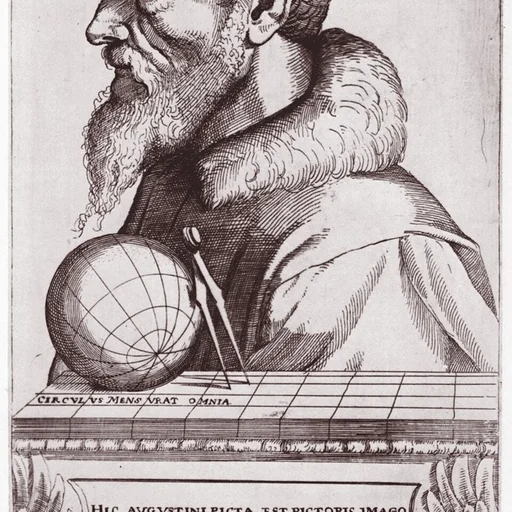
Artist
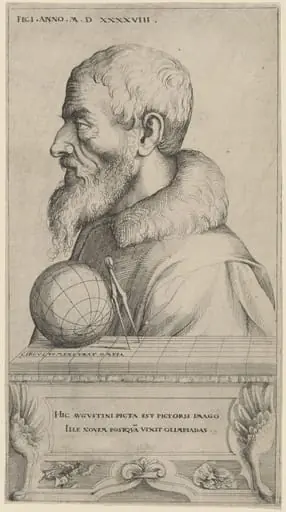
Augustin Hirschvogel (1503 – February 1553) was a German artist, mathematician, and cartographer known primarily for his etchings.