Artwork
The Prophet Jeremiah
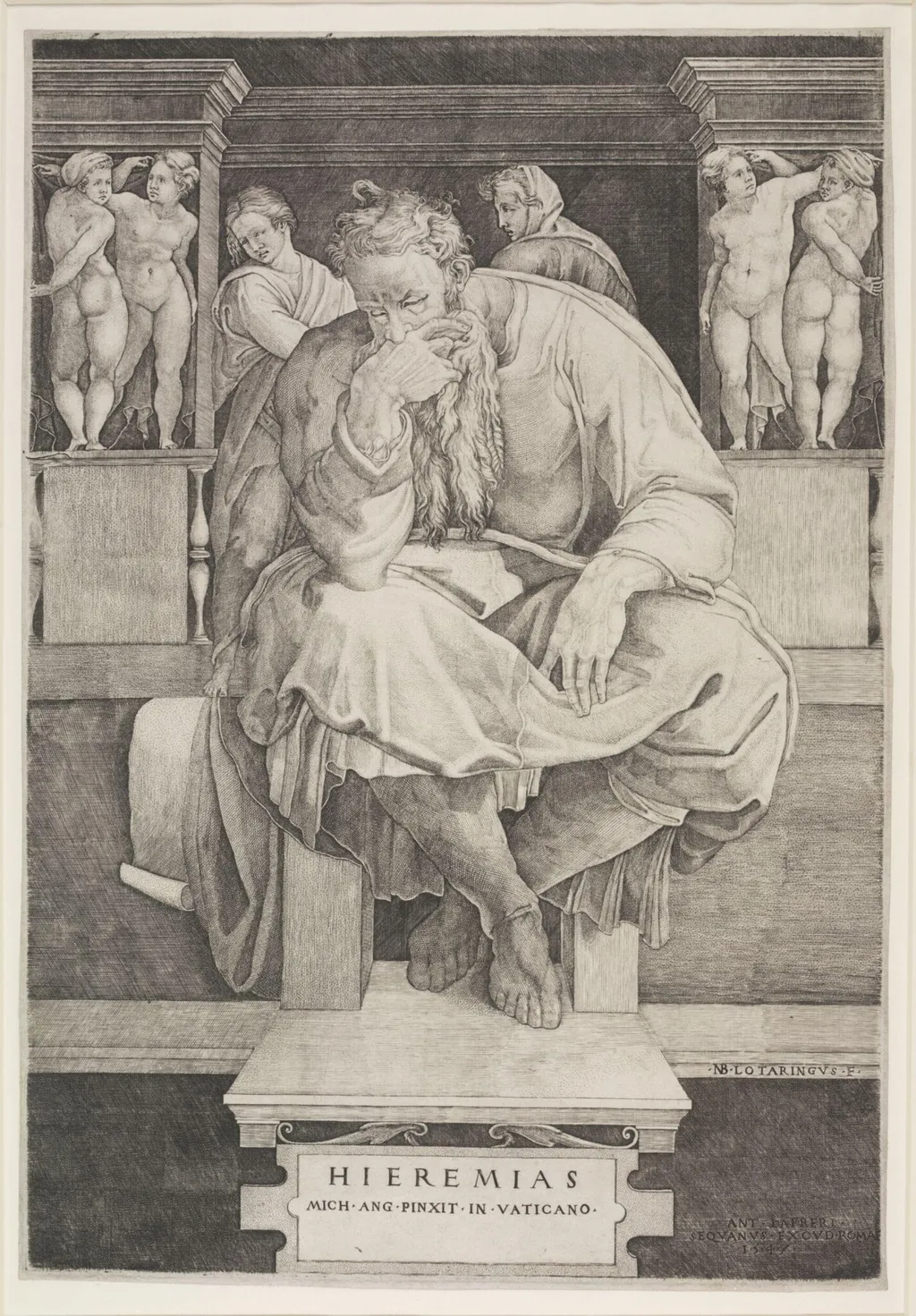
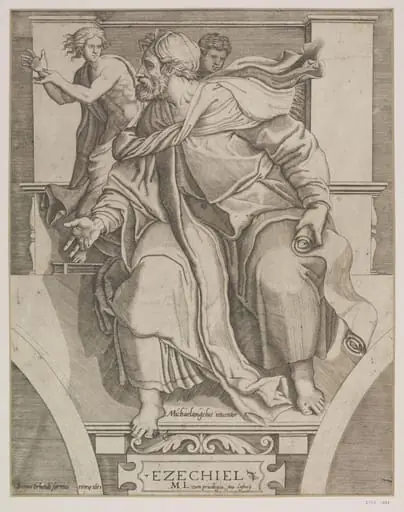
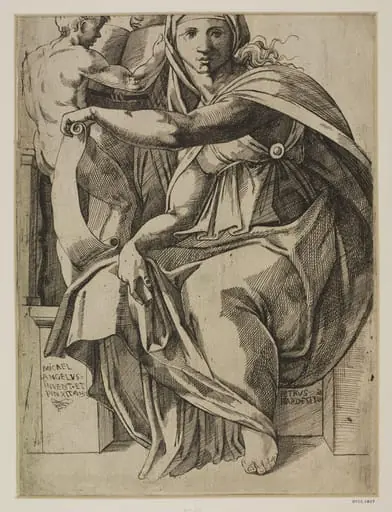
The Prophet Jeremiah is a print by the Renaissance artist Nicolas Beatrizet. It dates from 1520 and is held in the collection of the Victoria and Albert Museum.
About this work
Overview
The composition emphasizes solitude and introspection, with careful attention to light and shadow to model the form against a background of sculpted figures.
This engraving presents the Prophet Jeremiah as rendered by Nicolas Beatrizet, based on Michelangelo’s Sistine Chapel fresco. Executed in the second state of the print, it bears the artist’s signature and captures the figure in a seated, contemplative pose. The composition emphasizes solitude and introspection, with careful attention to light and shadow to model the form against a background of sculpted figures.
Subject & Meaning
Jeremiah, one of the major prophets of the Hebrew Bible, is depicted in a moment of solemn reflection, consistent with his role as a lamenting voice warning of divine judgment. His posture—head resting on hand, gaze lowered—conveys inner turmoil and moral weight. The surrounding statues of nude women may allude to worldly distractions or fallen idolatry, contrasting with his spiritual anguish.
Technique & Style
Beatrizet employed fine, controlled lines to achieve chiaroscuro effects, modeling the prophet’s drapery and anatomy with gradations of tone. The engraving’s precision highlights texture in fabric and stone, while the background figures are rendered with lighter, sparser strokes to recede spatially. The composition directs focus to the central figure through contrast and deliberate framing.
History & Provenance
Created in the mid-16th century, this print is one of several engravings Beatrizet made after Michelangelo’s Sistine Chapel figures. It circulated among collectors and artists in Rome and beyond, serving as a vehicle for disseminating Renaissance imagery. The second state indicates revisions made after the initial impression, reflecting the artist’s refinement of the design.
Context
Beatrizet worked in Rome during a period when engraving was a key medium for reproducing monumental art for a broader audience. His translations of Michelangelo’s figures responded to demand for accessible versions of high art, particularly among educated elites. The choice of Jeremiah reflects contemporary religious interest in prophetic themes during the Counter-Reformation.
Legacy
Beatrizet’s engravings preserved and extended the reach of Michelangelo’s compositions beyond the chapel walls. Though less celebrated than his source, his technical skill ensured these images remained influential in artistic education and print collections. The Jeremiah print exemplifies how Renaissance imagery was reinterpreted through printmaking for wider cultural circulation.
Artist & collection


![Castello S. Angelo di Roma [Castel Sant'Angelo in Rome], by Nicolas Beatrizet](https://artifactworldgallery.com/img/nicolas-beatrizet--castello-s-angelo-di-roma-castel-sant-angelo-in-rome--6c77d3bfe127c436-w320.webp)
![Pantheum Romanum [The Roman Pantheon], by Nicolas Beatrizet](https://artifactworldgallery.com/img/nicolas-beatrizet--pantheum-romanum-the-roman-pantheon--8069db7dd8e6f190-w320.webp)