Artwork
Solar Law
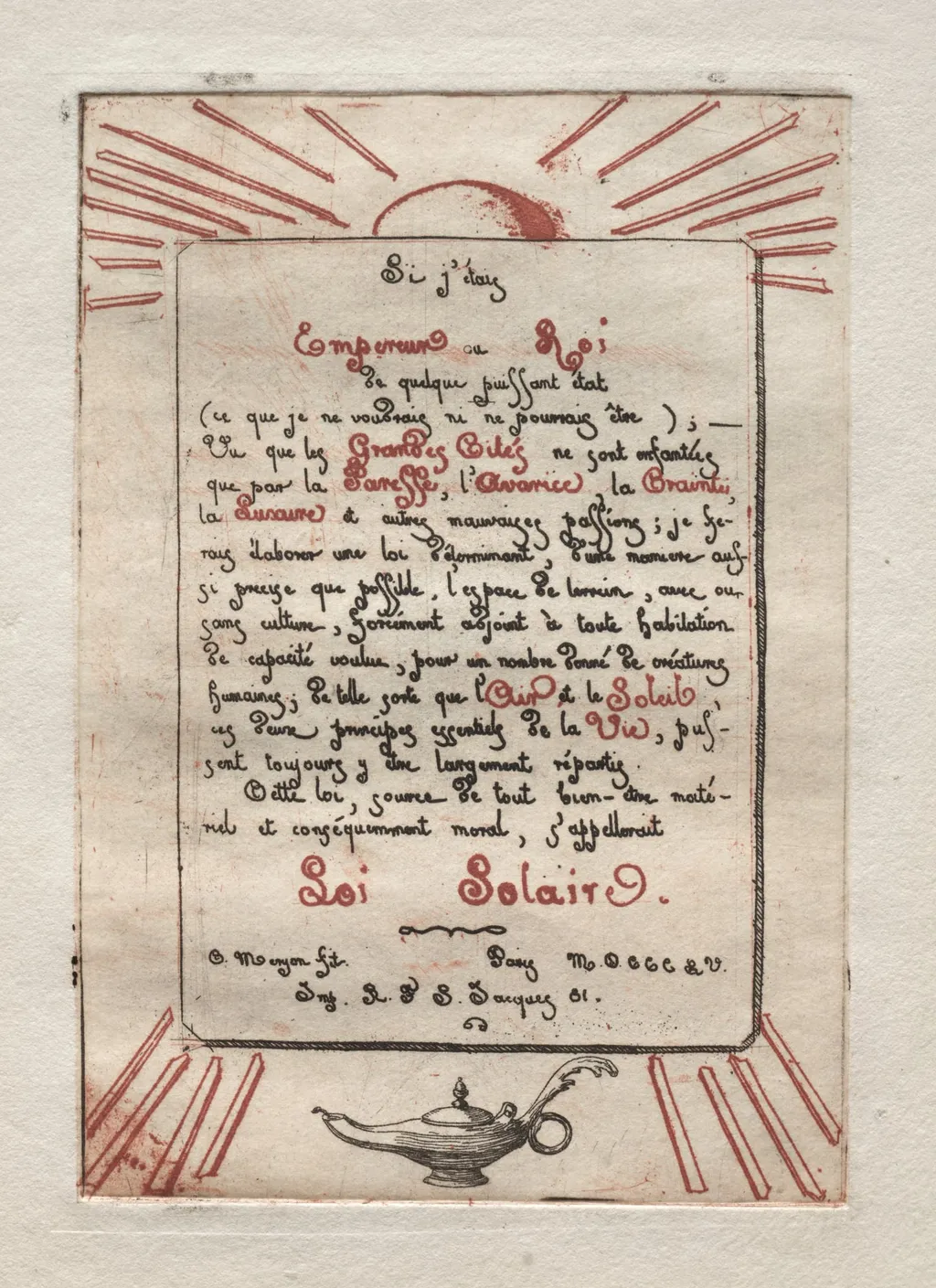
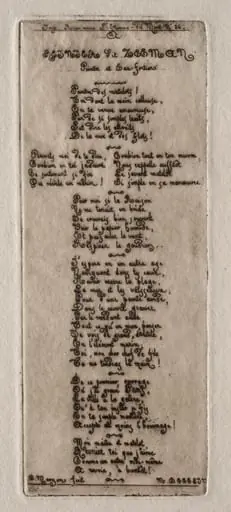
Solar Law is a print by the Impressionist artist Charles Meryon. It dates from 1855 and is held in the collection of the Cleveland Museum of Art.
About this work
Overview
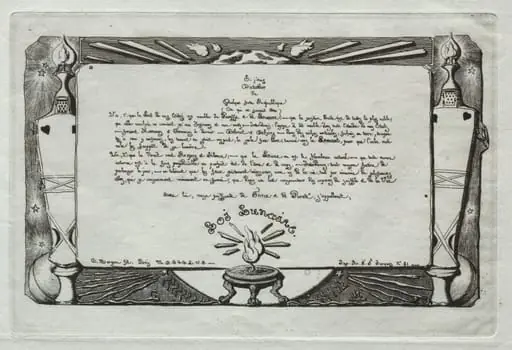
Created in 1855 by French artist Charles Meryon, *Solar Law* is a hand-etched print that blends textual elements with minimalist illustration.
Created in 1855 by French artist Charles Meryon, *Solar Law* is a hand-etched print that blends textual elements with minimalist illustration. Unlike his architectural views of Paris, this piece departs into a more personal, symbolic format. Meryon, who worked almost exclusively in etching due to his color blindness, used the medium’s fine lines to construct a composition that reads like a manuscript fragment, combining poetry, visual metaphor, and domestic imagery.
Subject & Meaning
The text in *Solar Law* presents a brief, lyrical meditation on sunlight and air as vital natural forces, framed as a kind of poetic decree. The inclusion of a simple teapot at the bottom introduces an element of domestic quietude, contrasting with the celestial imagery above. This juxtaposition may reflect Meryon’s interest in the intersection of cosmic order and everyday life, suggesting a personal philosophy encoded in visual and verbal form.
Technique & Style
Meryon employed fine-line etching to render both the handwritten French text and the teapot illustration with precision. The red border frames the composition like a legal document, while ink variations in black and red mimic manuscript annotation. The paper’s aged appearance and subtle fading reinforce the sense of an archival artifact, enhancing the work’s introspective, almost ritualistic tone.
History & Provenance
Produced during a period of increasing psychological strain, *Solar Law* emerged in the mid-1850s, shortly before Meryon’s institutionalization. Its intimate, non-commercial nature suggests it was made for personal reflection rather than public display. The work’s survival and later acquisition by institutions like The Cleveland Museum of Art reflect posthumous recognition of his experimental, lesser-known works beyond his urban etchings.
Context
In 19th-century France, etching was often used for reproductive or topographical purposes. Meryon’s turn toward symbolic, text-based prints like *Solar Law* placed him at the margins of his time’s artistic norms. His work resonates with contemporary literary and philosophical interests in nature, perception, and mental states, offering a quiet counterpoint to the dominant realism and historicism of the era.
Legacy
Though Meryon is primarily remembered for his atmospheric views of Paris, *Solar Law* exemplifies his willingness to explore unconventional formats. The piece has influenced later artists interested in the fusion of text and image, and in the use of printmaking as a vehicle for private expression. Its enduring presence in museum collections underscores its value as a rare, introspective artifact from a complex artistic mind.
Artist & collection
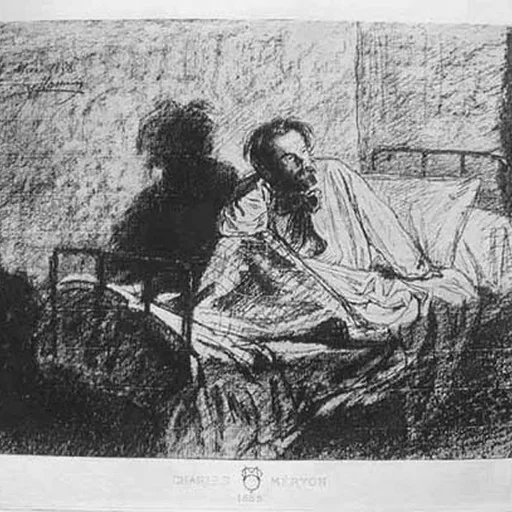
Artist
Charles Meryon (sometimes Méryon, 23 November 1821 – 14 February 1868) was a French artist who worked almost entirely in etching, as he had colour blindness.

 La Loi Lunaire
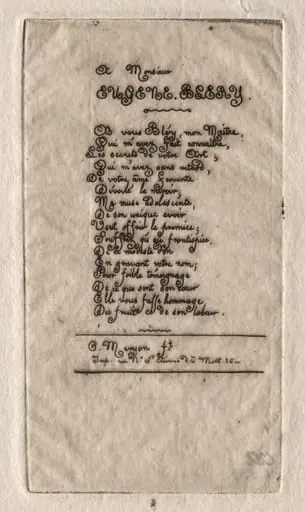 Verses to Eugène Bléry
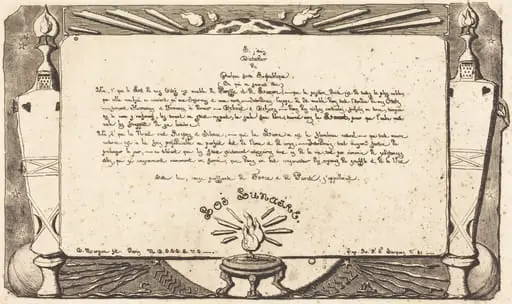 La Loi lunaire, 1er planche ("Lunar" Law, 1st plate)
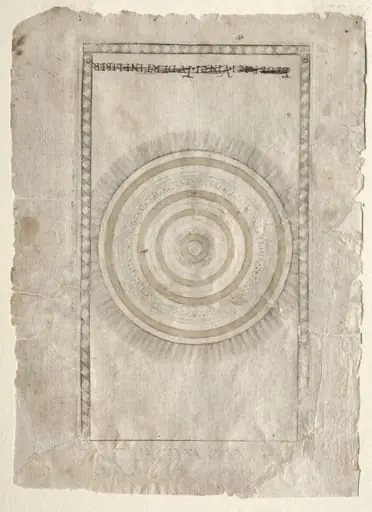 The Empyrean Sphere (from the Tarocchi, series A: Firmaments of the Universe, #50)
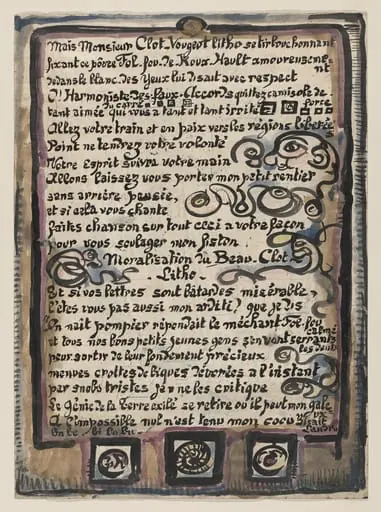 Untitled
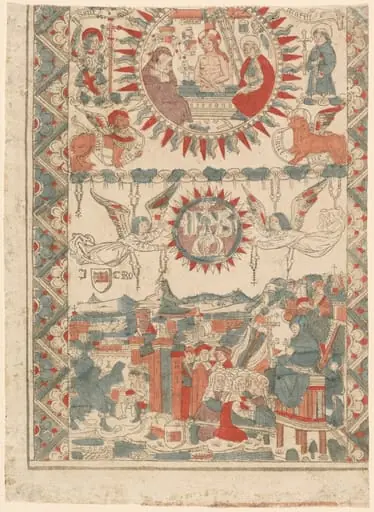 Saint Bonaventure Arriving and Preaching in Lyon
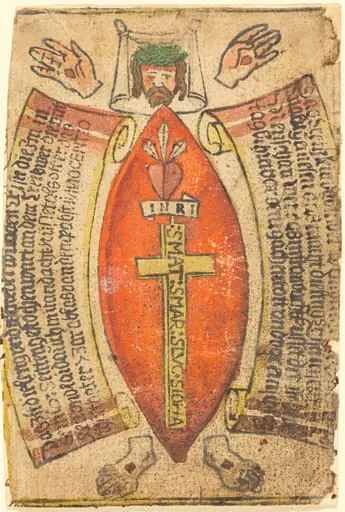 The Measure of the Side Wound and the Body of Christ
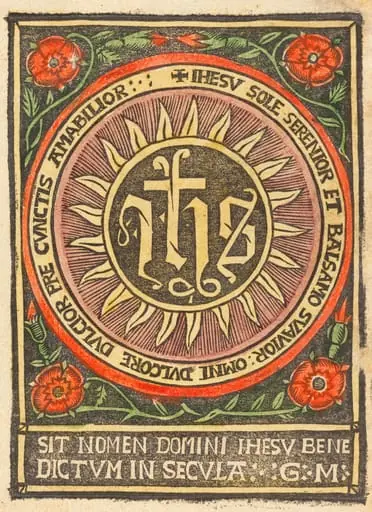 Monogram JHS in a Flaming Circle
![Lettering [bottom half], by Simon van de Passe](https://artifactworldgallery.com/img/simon-van-de-passe--lettering-bottom-half--9f50722d991807f6-w320.webp) Lettering [bottom half]
Lettering [bottom half] Prince and Lady in Palace Scene with Musicians
 Christ Carrying the Cross
 Etchings of Paris: Dedication to Reynier Nooms, called Zeeman