Artwork
Visus (Sight)
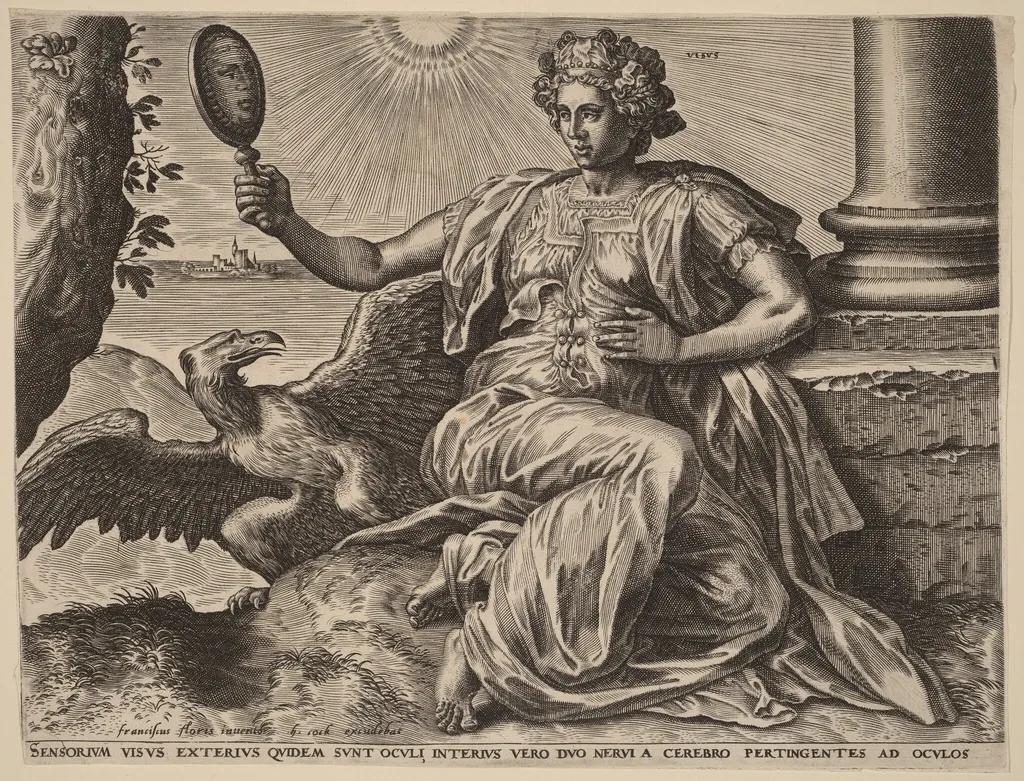
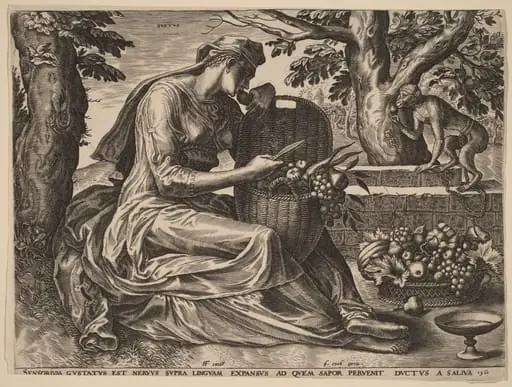
Visus (Sight) is an ink print by the Renaissance artist Cornelis Cort. It dates from 1561 and is held in the collection of the National Gallery of Art.
About this work
Overview
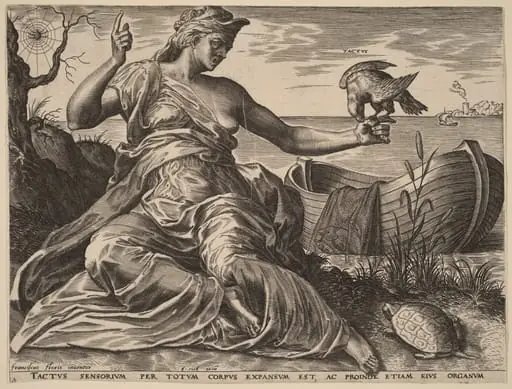
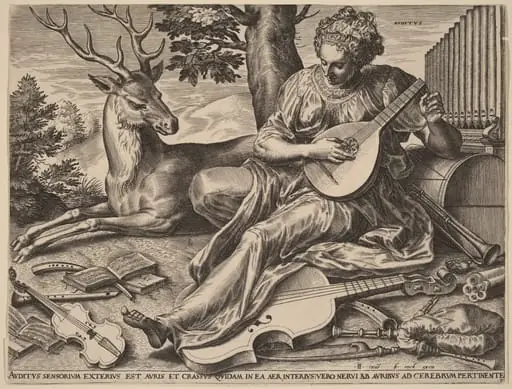
Created in 1561, Visus (Sight) is an engraving on laid paper by the Dutch artist Cornelis Cort, who was active in Italy under the name Cornelio Fiammingo. The print presents a monochrome composition that combines a figurative scene with an instructional text on visual perception, reflecting the interdisciplinary interests of the Renaissance.
Subject & Meaning
The central figure is a woman draped in flowing garments, holding a mirror to her face while a bird rests on her shoulder. Behind her, a modest town rises on a hill. Accompanying the image is a brief treatise on the mechanics of sight, interspersed with Latin terminology and a schematic of the eye, merging visual art with scientific explanation.
Technique & Style
Cort employed the traditional copper engraving method, incising fine lines into a metal plate before transferring the image onto laid paper. The work demonstrates his precise line work, delicate hatching, and careful modulation of tone, hallmarks of mid‑sixteenth‑century Northern European printmaking that were also embraced by Italian workshops.
History & Provenance
During the last dozen years of his career, Cort lived in Italy, where he produced a substantial body of prints for a learned audience. Visus belongs to this period of his output and illustrates the cross‑cultural exchange between Northern and Italian artistic practices that characterized the Renaissance print market.
Artist & collection

Artist
Cornelis Cort (c. 1533 – c. 17 March 1578) was a Dutch engraver and draughtsman. He spent the last 12 years of his life in Italy, where he was known as Cornelio Fiammingo.