Artwork
The Guildhall, Worcester
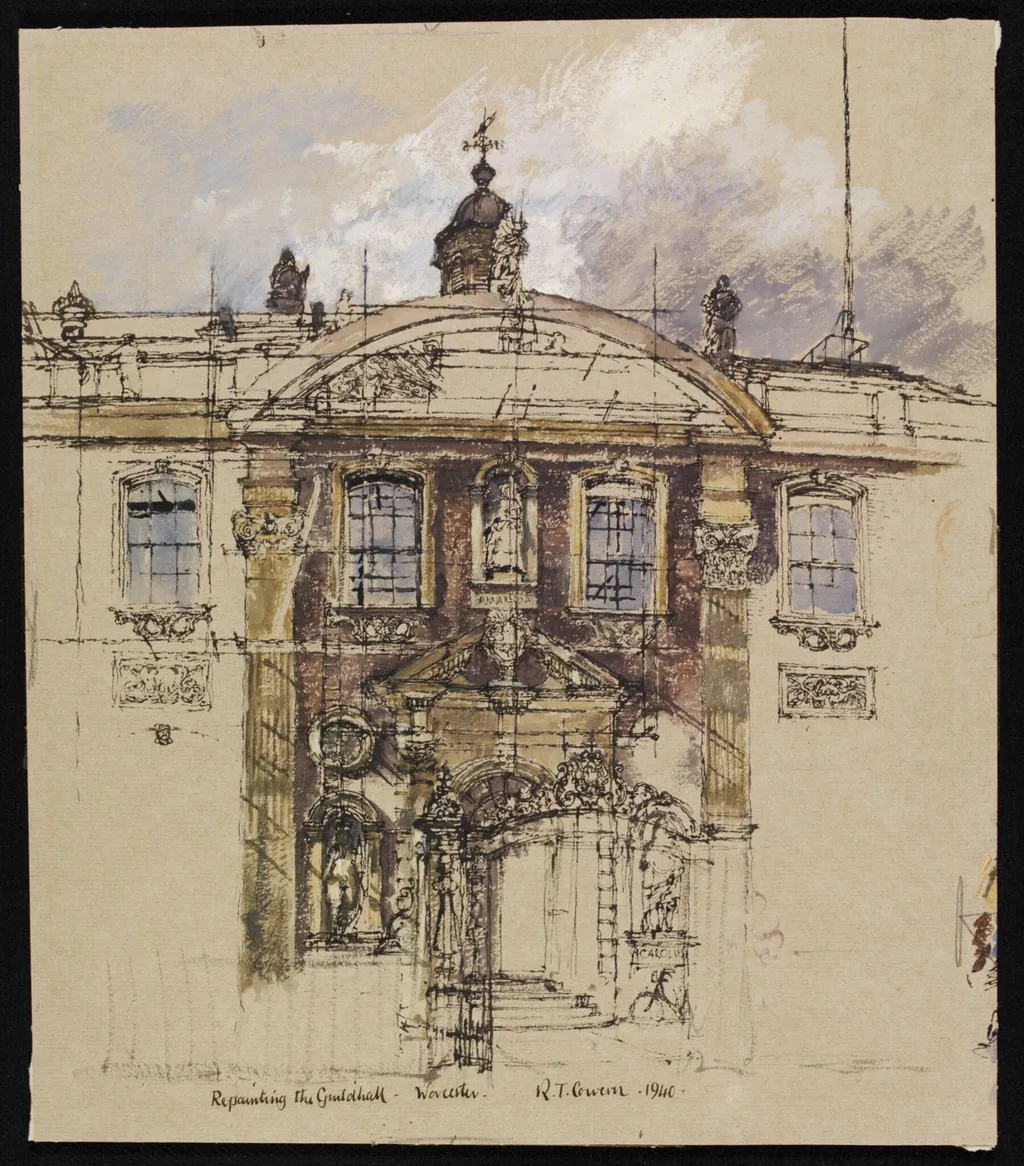
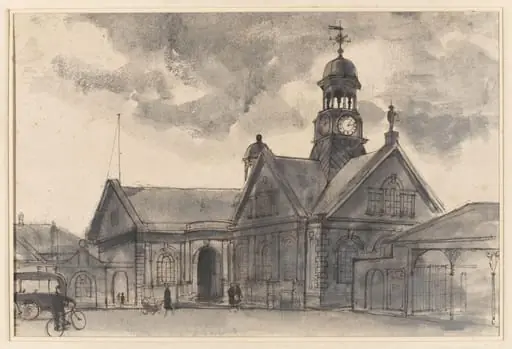
The Guildhall, Worcester is a watercolor work on paper by the Social Realist artist Raymond Teague Cowern. It dates from 1940 and is held in the collection of the Victoria and Albert Museum.
About this work
The paint is loose and sketchy, with quick strokes for the dome and details like the clock face.
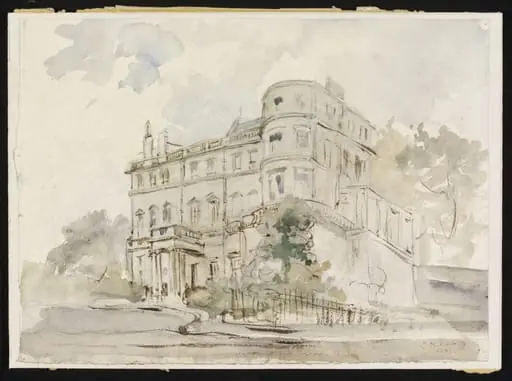
This sketch shows a grand building with tall columns and arched windows. The paint is loose and sketchy, with quick strokes for the dome and details like the clock face. A figure stands on the roof, and the sky is lightly washed in pale blue.
The artist signed it in 1940, calling it *The Guildhall, Worcester*. The watercolor feels quick—like a study, not a finished work.
Next, check out the Victoria and Albert Museum to see more of this artist’s sketches.
Overview
Raymond Teague Cowern created this watercolour in 1940 as part of the Recording Britain project, a government-backed effort to visually archive significant architectural sites during World War II. The work captures Worcester’s Guildhall with a spontaneous, observational approach, reflecting the project’s goal of preserving cultural landmarks at risk from wartime damage. Its sketch-like quality suggests it was made on-site, prioritizing immediacy over polish.
Subject & Meaning
The Guildhall, a civic building with classical features, symbolizes local governance and historical continuity. Its depiction amid wartime uncertainty underscores a broader cultural anxiety over the erosion of traditional urban fabric. The lone figure on the roof hints at human presence within a structure that outlives generations, reinforcing the theme of endurance against disruption.
Technique & Style
Cowern employed loose, fluid washes and rapid brushwork to convey the building’s form without detailed rendering. The dome and clock face are suggested with minimal strokes, while the pale blue sky adds atmospheric depth without definition. The watercolour’s unfinished appearance aligns with the project’s emphasis on swift documentation rather than finished artistry.
History & Provenance
Commissioned by the Ministry of Labour and National Service in 1940, this work was produced under the Recording Britain initiative, which enlisted artists to record vulnerable sites across the country. Signed and dated by the artist, it entered institutional collections as part of this national archive, later held by the Victoria and Albert Museum alongside hundreds of similar works.
Context
During the early years of World War II, Britain faced widespread threats to its architectural heritage from bombing and neglect. The Recording Britain project emerged as a quiet act of cultural preservation, responding to fears of irreversible loss. Cowern’s watercolour is one of many such records, capturing everyday landmarks that defined regional identity beyond major cities.
Legacy
The work remains part of a significant wartime archive that shaped postwar attitudes toward heritage conservation. Cowern’s sketches, including this one, continue to serve as historical references for architectural historians and local communities seeking to understand pre-war urban landscapes. Their modest scale and directness lend them enduring value as documents of place and time.
Artist & collection
Artist
Raymond Teague Cowern painted quiet watercolors of mid-century Worcestershire life during the Second World War.