Artwork
Section of a sailing barge
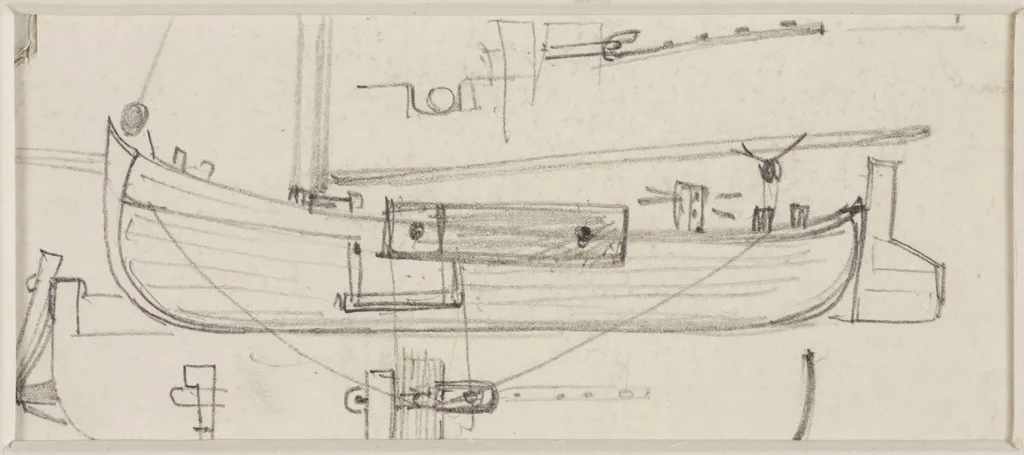
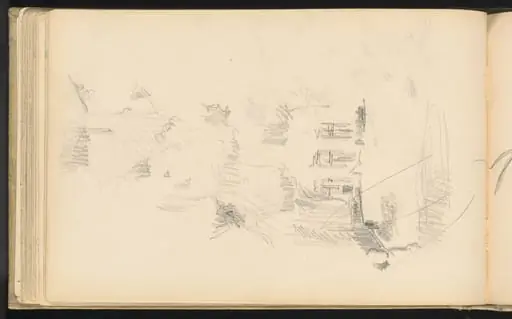
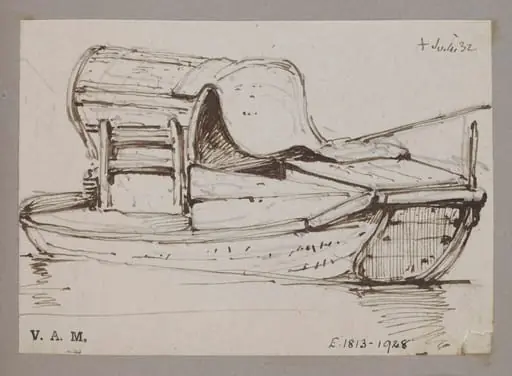
Section of a sailing barge is a drawing by Edward William Cooke. It dates from 1850 and is held in the collection of the Victoria and Albert Museum. A pencil drawing from 1850 by Edward Cooke captures a fragment of a sailing barge, rendered with loose, observational strokes.
About this work
Overview
The composition isolates the vessel’s hull and rigging against a quiet expanse of water, emphasizing structural form over detail.
A pencil drawing from 1850 by Edward Cooke captures a fragment of a sailing barge, rendered with loose, observational strokes. The composition isolates the vessel’s hull and rigging against a quiet expanse of water, emphasizing structural form over detail. Light, tentative lines suggest a working sketch, likely made on-site. The label 'NORTH' in the upper corner indicates the artist’s attention to spatial orientation, reinforcing the drawing’s function as a record rather than a finished piece.
Subject & Meaning
The subject is a utilitarian flat-bottomed barge, typical of inland waterway transport in 19th-century Britain. A solitary figure at the bow, holding an object likely related to mooring or navigation, underscores the vessel’s operational nature. The absence of ornament or narrative context directs focus to the boat’s design and its interaction with water, reflecting an interest in functional architecture rather than romanticized seafaring.
Technique & Style
Cooke employed light, sketchy pencil strokes to convey form without heavy shading. The lines are economical, prioritizing silhouette and proportion over texture. Cross-hatching is minimal, used only where subtle depth is needed, such as along the cabin’s edge or under the mast. The overall approach suggests rapid observation, possibly from a moving vessel or shore, capturing the barge’s geometry in real time.
History & Provenance
Created in 1850, the drawing is part of Edward Cooke’s broader practice of documenting maritime vessels. Though little is known of its immediate provenance, its style aligns with technical sketches made by artists and engineers of the period for navigational or archival purposes. It likely originated as a study, preserved for its documentary value rather than aesthetic ambition.
Context
In mid-19th century Britain, inland waterways were vital for transporting goods, and barges like this one were common on rivers and canals. Artists and surveyors often recorded such vessels as part of industrial documentation. Cooke’s sketch fits within this tradition—neither idealized nor dramatized, but attentive to the practical geometry of working craft.
Legacy
The drawing survives as a quiet testament to the everyday maritime infrastructure of its time. It offers insight into how artists engaged with functional objects outside the realm of fine art. Its simplicity and precision make it a useful reference for historians studying 19th-century vessel design and the role of sketching in technical observation.
Artist & collection

![Study for "Shoeing Calvary Horses at the Front" [verso], by John Singer Sargent](https://artifactworldgallery.com/img/john-singer-sargent--study-for-shoeing-calvary-horses-at-the-front-verso--6f6d1a163e84e9ab-w320.webp)
![A Sailing Ship [verso], by Edward Lear](https://artifactworldgallery.com/img/edward-lear--a-sailing-ship-verso--c9eebd6783d42a3d-w320.webp)