Artwork
Prânz la orezăria Chirnogi
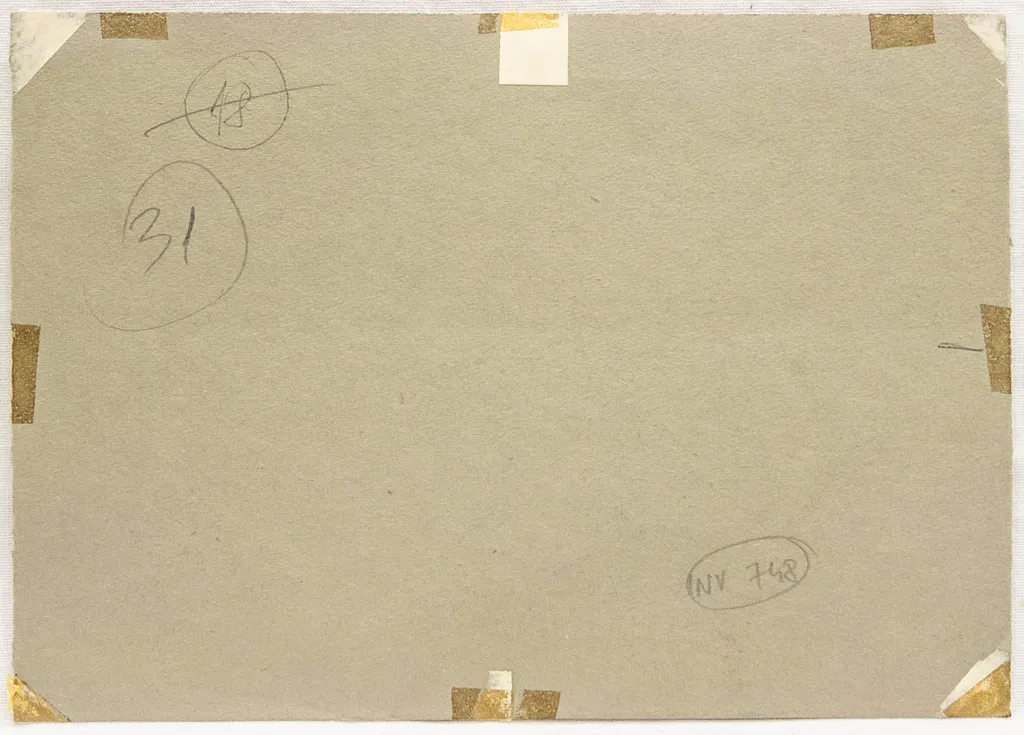
Prânz la orezăria Chirnogi is a drawing by Nicolae Furduescu. It dates from 1950 and is held in the collection of the Gavrila Simion Eco-Museum Research Institute Tulcea.
About this work
Overview
The work exists as a single sheet of light brown, slightly textured paper, bearing visible tape at each corner—evidence of prior handling and display.
Prânz la orezăria Chirnogi is a drawing by Romanian artist Nicolae Furduescu, dated around 1950. It is part of the collection at the Museum of Ethnography. The work exists as a single sheet of light brown, slightly textured paper, bearing visible tape at each corner—evidence of prior handling and display. Handwritten annotations, including '31' and 'NV 748,' suggest cataloging or archival use. The image itself is not visible in the provided reference, but the physical object is recognized as an artwork.
Subject & Meaning
The title translates to 'Lunch at Chirnogi’s Rice Shop,' indicating a scene of everyday life in a modest Romanian eating establishment. Though the drawing is not visible here, the title implies a focus on working-class routines, possibly capturing communal meals or informal social interactions. Furduescu’s interest in vernacular culture suggests the work documents ordinary moments with observational sincerity, avoiding idealization.
Technique & Style
The work is executed in pencil or ink on paper, consistent with Furduescu’s preference for direct, unembellished draftsmanship. The use of a simple, textured sheet and the presence of archival tape point to a functional, non-finished aesthetic. The style aligns with mid-century Romanian ethnographic illustration—precise yet unadorned, prioritizing documentation over artistic flourish.
History & Provenance
The drawing entered the Museum of Ethnography’s collection likely through the artist’s participation in state-sponsored cultural surveys of rural and urban life in postwar Romania. The handwritten codes ('NV 748') indicate institutional cataloging practices of the period. Tape on the corners suggests it was mounted for exhibition or study, reflecting its role as an ethnographic record rather than a decorative object.
Context
Created during a period when Romanian artists were encouraged to depict proletarian and folk life, this work aligns with state-supported ethnographic projects of the early 1950s. Furduescu, like others in his circle, engaged with local communities to record customs and environments. The choice of a humble eatery as subject reflects a broader cultural shift toward valuing everyday experiences over elite or historical themes.
Legacy
Though not widely exhibited outside institutional archives, the drawing contributes to a body of work that preserves visual records of Romania’s postwar social fabric. Furduescu’s approach—unembellished, attentive to detail—offers insight into how artists documented ordinary life under shifting political conditions. The object remains a quiet testament to the value placed on vernacular culture during a time of ideological consolidation.
Artist & collection
Artist
Nicolae Furduescu carved and stitched scenes of everyday life along the Dâmbovița riverbank.
Museum
Gavrila Simion Eco-Museum Research Institute Tulcea
Continue through works from the same source collection.
 Peisaj (cu stradă)
 S 32 - Peisaj la Sulina (Dunăre și maluri pierdute în pete de culoare)
 Peisaj-Casă spre Dobrina
 Canal la Agighiol
 Apus de soare pe Mureș
 La oglindă
 Prin ceață
 S 33 - Peisaj la Sulina (Dunăre și faleză cu tufe de flori grena)
 Peisaj cu copaci printre care se văd acoperișurile gri și roșii. În dreapta, printre copaci, se ridică înalt turnul alb al unei biserici. În plan îndepărtat, blocuri, în spatele cărora se ridică furnale profilate pe un deal înalt albastru. Cerul învolburat albastru-violet. Copacii colorați în culorile toamnei. Semnat și datat cu negru, stânga jos: Craiu (19)70 ?.
 Turc la Sinaia
 În cherhana