Artwork
Justice
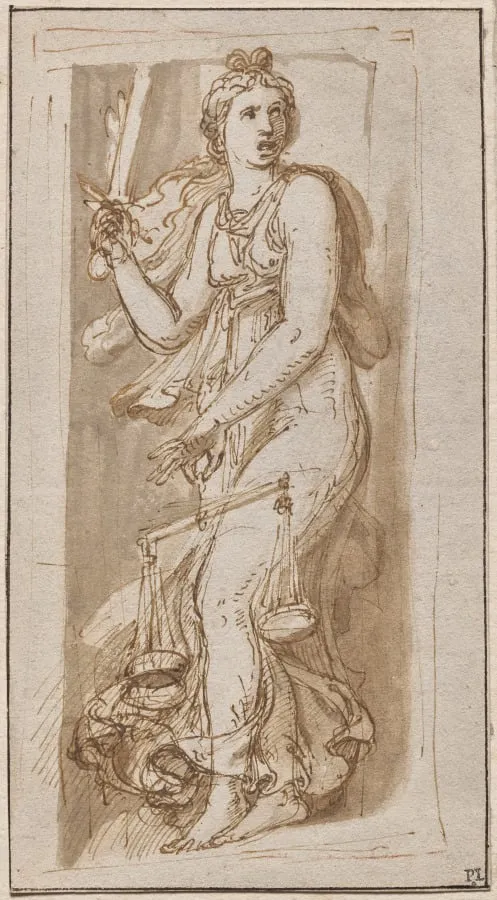
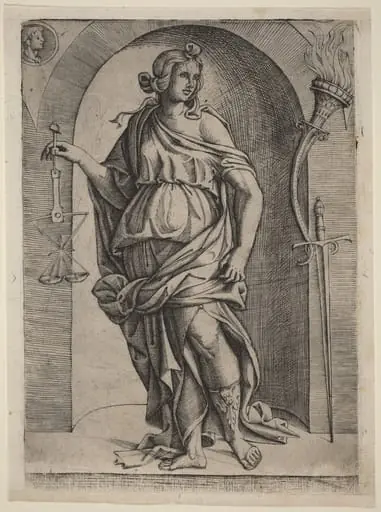
Justice is a drawing by the Renaissance artist Giulio Romano. It dates from 1532 and is held in the collection of the Cleveland Museum of Art.
About this work
Overview
This drawing served as a preparatory study for a frescoed figure of Justice on the ceiling of the Camera di Attilio Regolo, executed between 1530 and 1534.
Giulio Romano, after his time in Rome, became the principal artist for Federico II Gonzaga in Mantua, where he oversaw the artistic transformation of the Palazzo del Te. This drawing served as a preparatory study for a frescoed figure of Justice on the ceiling of the Camera di Attilio Regolo, executed between 1530 and 1534. It reflects Romano’s method of refining every visual element through detailed sketches before final execution.
Subject & Meaning
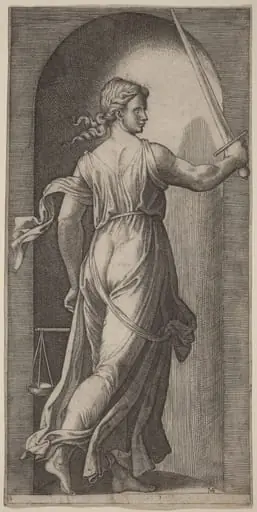
The figure of Justice is depicted as a robed woman, blindfolded, holding a sword and scales. The blindfold signifies impartiality—not ignorance—emphasizing that justice must be administered without regard to appearance, wealth, or power. Positioned among scenes of virtuous ancient leaders, the figure anchors the room’s thematic focus on moral authority and civic virtue as ideals linked to the duke’s rule.
Technique & Style
Romano’s drawing employs fluid, confident linework to define form and drapery, demonstrating his command of classical proportions and expressive gesture. The composition is tightly controlled, with attention to weight and balance in the figure’s posture. Though a sketch, it reveals his ability to convey monumentality and clarity, essential for translating two-dimensional studies into large-scale frescoes.
History & Provenance
Created as part of the decorative program for the Palazzo del Te, this drawing was one of many used to plan the Camera di Attilio Regolo’s ceiling. It remained within the Gonzaga collection until the 17th century, later entering public holdings. Its survival offers rare insight into Romano’s working process, bridging preliminary design and finished mural.
Context
The Palazzo del Te was designed as a retreat for courtly leisure, yet its decoration carried political weight. By placing Justice among scenes of ancient Roman heroism, Romano aligned Federico II with the moral legacy of classical rulers. The fresco cycle reinforced the duke’s claim to enlightened leadership, using myth and allegory to legitimize his authority.
Legacy
Romano’s preparatory drawings for the Palazzo del Te remain key to understanding Renaissance workshop practices. This study exemplifies how conceptual ideas were refined through iterative sketching before monumental execution. His integration of classical symbolism into secular architecture influenced later Mannerist and Baroque decorative programs across Europe.
Artist & collection
Artist
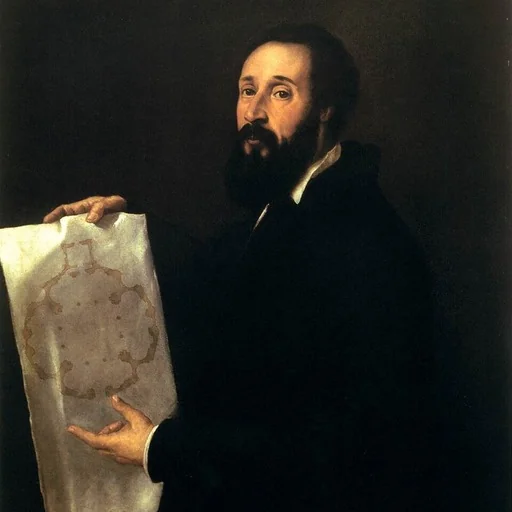
Giulio Pippi (c. 1499 – 1 November 1546), known as Giulio Romano (US: JOOL-yoh rə-MAH-noh( Italian: ) and sometimes known in French as Jules Romain, was an Italian painter and architect. He was a pupil of Raphael, and…

 Justice
 Justice
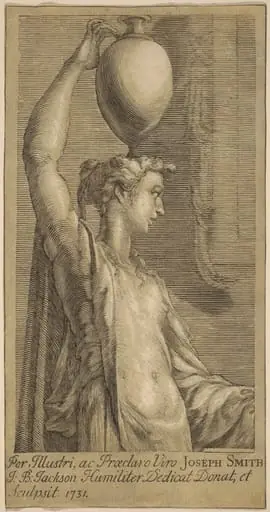 Woman Standing Holding a Jar on the Head
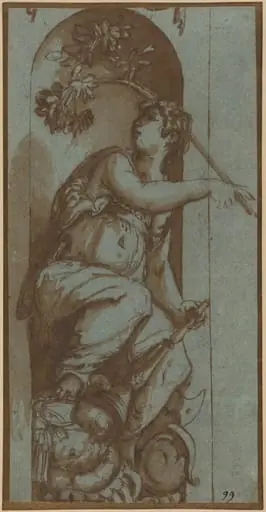 Allegory of Peace
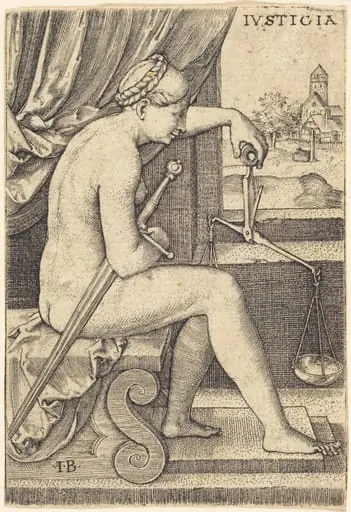 Iusticia (Justice)
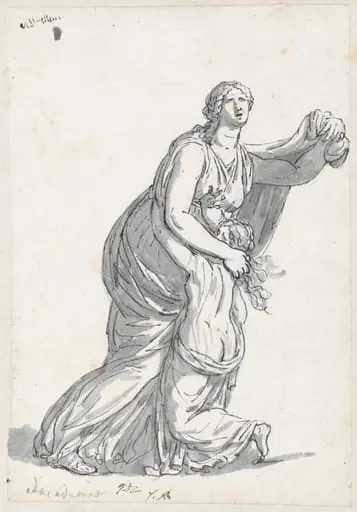 Niobe and Her Daughter
 Woman with Musical Instrument
 Saint Michael with Lucifer
![Statue of Abundance [recto], by Hubert Robert](https://artifactworldgallery.com/img/hubert-robert--statue-of-abundance-recto--af10c767ab97b269-w320.webp) Statue of Abundance [recto]
Statue of Abundance [recto] Allegorical Figure
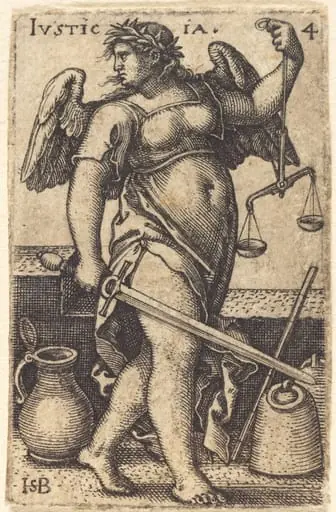 Justicia (Justice)
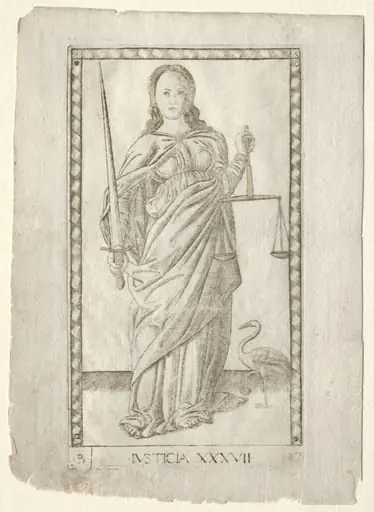 Justice (from the Tarocchi, series B: Cosmic Principles & Virtues, #37)