Artwork
Stage Design of an Ancient Roman Encampment by Night (recto)
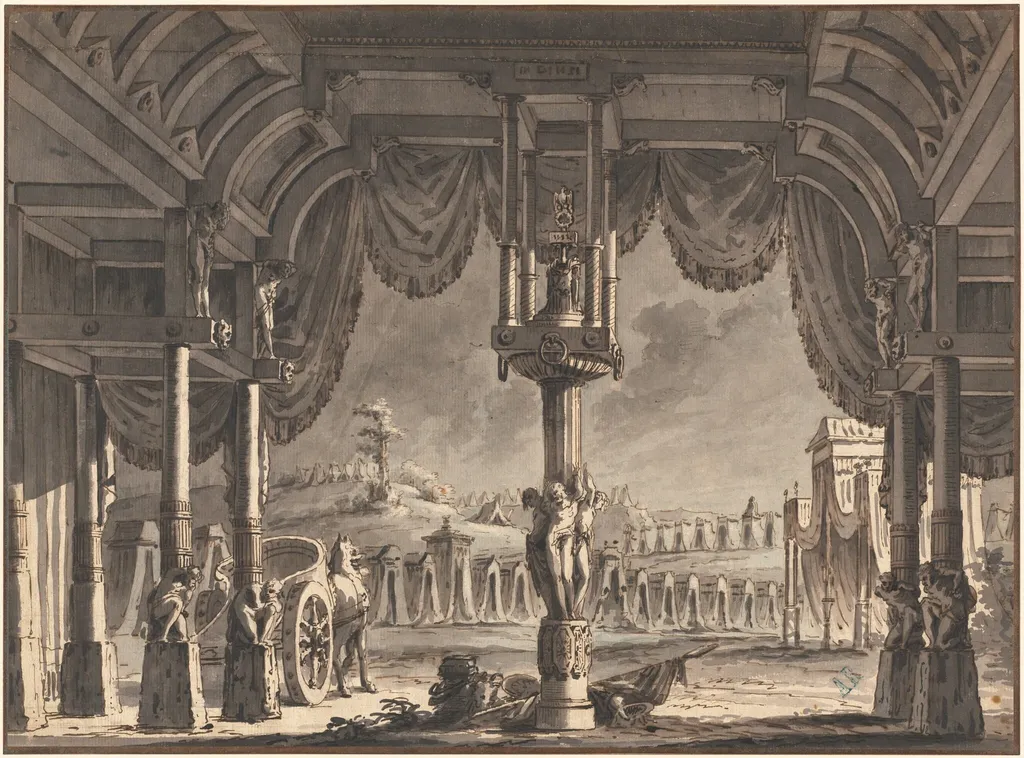
Stage Design of an Ancient Roman Encampment by Night (recto) is an ink drawing by the Romanticist artist Pietro Gonzaga. It dates from 1792 and is held in the collection of the National Gallery of Art.
About this work
The painting is called Stage Design of an Ancient Roman Encampment by Night.
It was made around 1792, a time when artists were exploring new ideas.
The artist used pen, ink, and wash to create the scene, which is a notable aspect of this work.
You can learn more about this style at the National Gallery of Art, Washington, which is associated with the movement: Romanticism.
Overview
The work reflects Gonzaga’s role as a scenic designer for imperial theaters, blending architectural precision with atmospheric lighting.
Created around 1792, this drawing by Pietro Gonzaga depicts a nocturnal Roman military encampment as a theatrical set. Executed in pen and brown ink with gray and black wash over graphite, it spans two joined sheets, suggesting its function as a preparatory design for stage scenery. The work reflects Gonzaga’s role as a scenic designer for imperial theaters, blending architectural precision with atmospheric lighting.
Subject & Meaning
The scene portrays a Roman encampment under moonlight, with tents, watchfires, and distant fortifications arranged for dramatic effect. Rather than a historical record, it evokes the mood of military solitude and order, aligning with late 18th-century theatrical tastes for grand, emotionally resonant settings. The absence of figures heightens the sense of quiet anticipation, characteristic of stage designs meant to support narrative tension.
Technique & Style
Gonzaga employed layered washes to model forms and suggest depth, using pen lines to define architectural details and shadows. The graphite underdrawing guided the composition, while the graded gray and black washes created a chiaroscuro effect, enhancing the illusion of night. The technique balances spontaneity with control, typical of theatrical designers who needed to convey spatial complexity quickly and convincingly.
History & Provenance
The drawing likely originated as a study for a production in Venice or St. Petersburg, where Gonzaga served as chief scenic designer. It entered the collection of the National Gallery of Art, Washington, through the Samuel H. Kress Foundation, which acquired numerous European drawings in the mid-20th century. Its survival as a standalone work reflects its artistic merit beyond its utilitarian purpose.
Context
In the 1790s, theatrical design was evolving toward greater realism and emotional atmosphere, influenced by Enlightenment ideals and emerging Romantic sensibilities. Gonzaga’s work responded to this shift, moving away from rigid symmetry toward dynamic lighting and immersive environments. His designs helped bridge neoclassical architecture with the expressive potential of night scenes in performance.
Legacy
Though primarily known for his stage work, Gonzaga’s drawings like this one are valued for their technical finesse and atmospheric insight. They document a transitional moment in theater design, where scenic art gained recognition as a distinct visual discipline. The drawing remains a key example of how theatrical imagination shaped perceptions of antiquity in the late Enlightenment.
Artist & collection


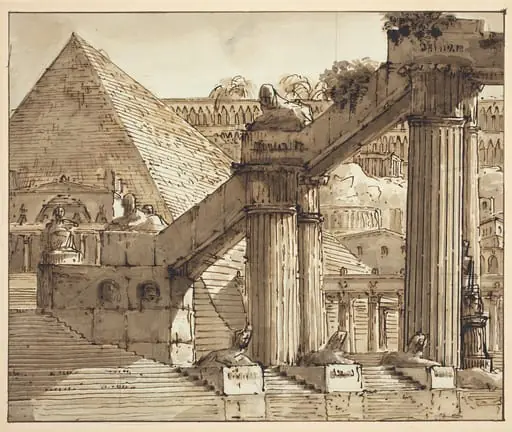 Egyptian Stage Design
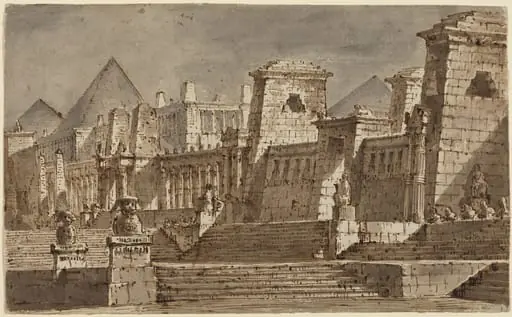 An Egyptian Stage Design
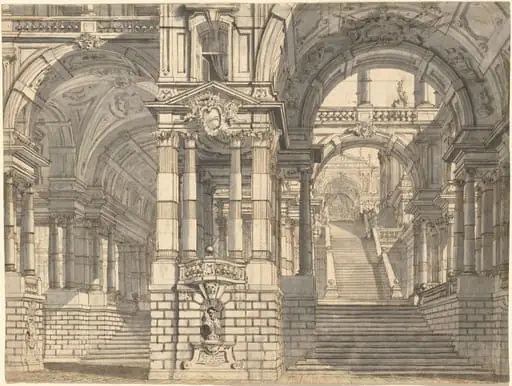 Fantasy of Magnificent Courtyards and Loggie with a Monumental Staircase
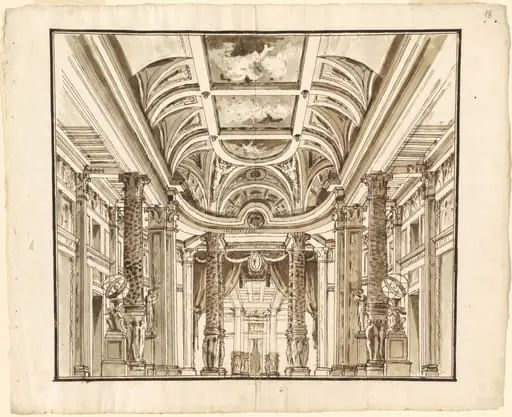 Fantasy of a Great Hall with Basketweave Columns
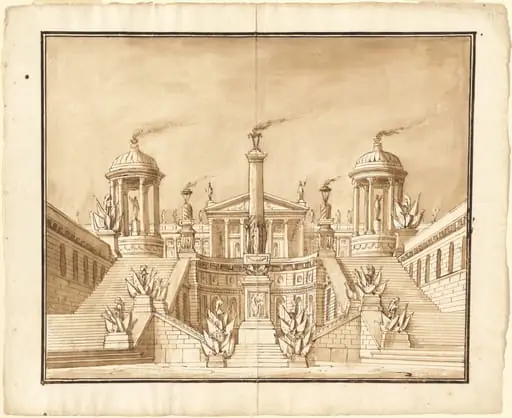 Fantasy of an Ancient Capitol with Trophies and Grand Staircases
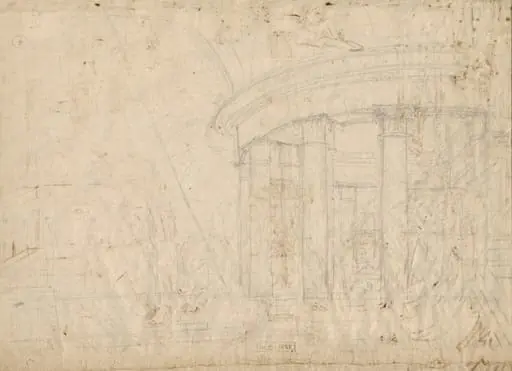 Architectural Fantasy on a Round Temple Enclosed with an Ambulatory (verso)
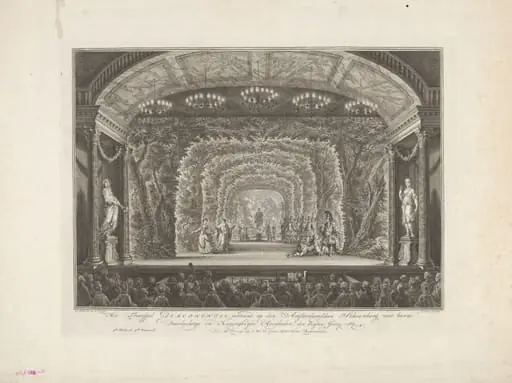 H Beard Print Collection
 Il Greco in Troia: Plate 1
 The Seconda Macchina for the Chinea of 1769: A Building for Public Entertainment
 The Seconda Macchina for the Chinea of 1771: A Pleasure Palace Dedicated to Bacchus
 The Prima Macchina for the Chinea of 1761: The Salubrious Baths
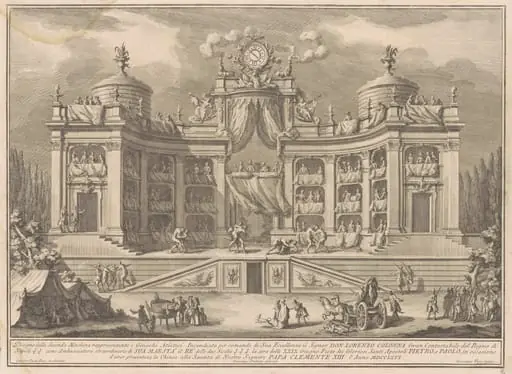 The Seconda Macchina for the Chinea of 1766: A Theater for Athletic Games
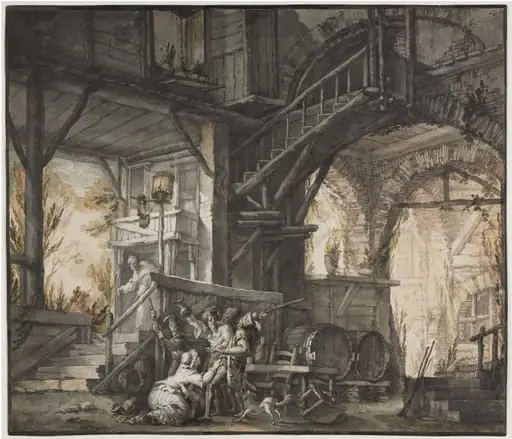 Theater Scene
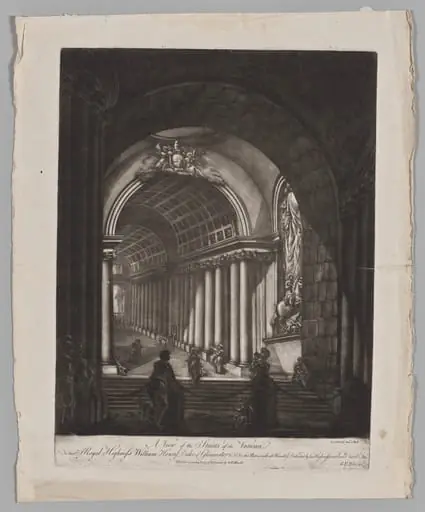 A View of the Stairs of the Vatican
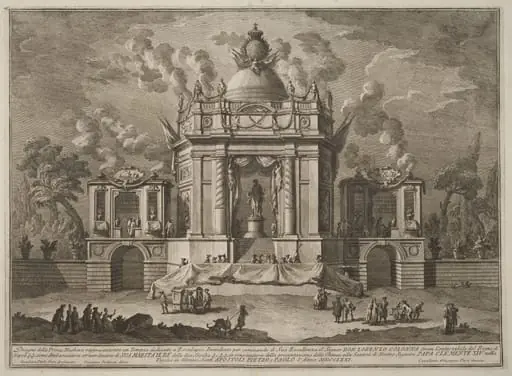 The Prima Macchina for the Chinea of 1771: The Temple of Asclepius
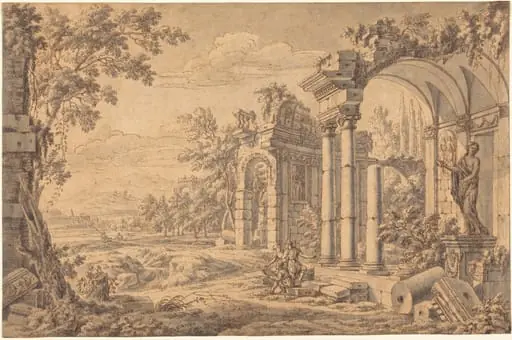 Landscape with a Draftsman among Ancient Ruins