Artwork
Brown Pelican
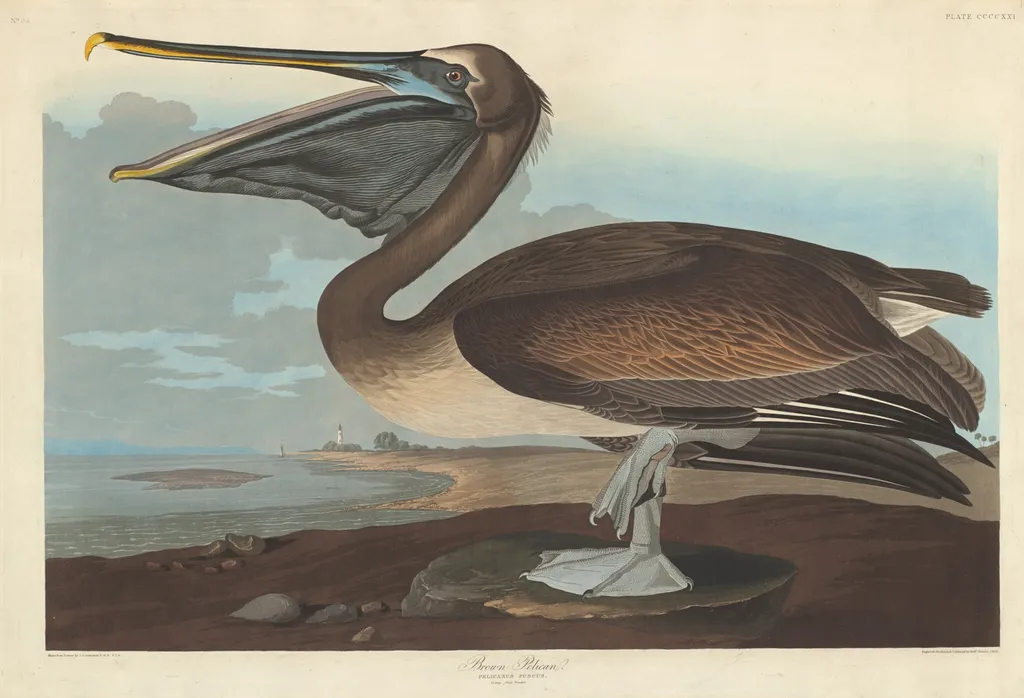
Brown Pelican is an ink print by the Romanticist artist Robert Havell Jr.. It dates from 1838 and is held in the collection of the National Gallery of Art.
About this work
Overview
The work exemplifies the Havell family’s technical mastery in printmaking, particularly their refined use of aquatint to achieve subtle tonal gradations.
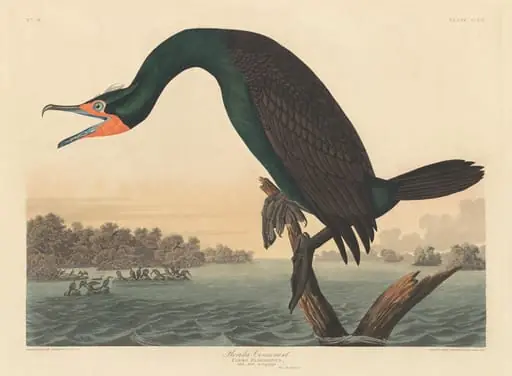
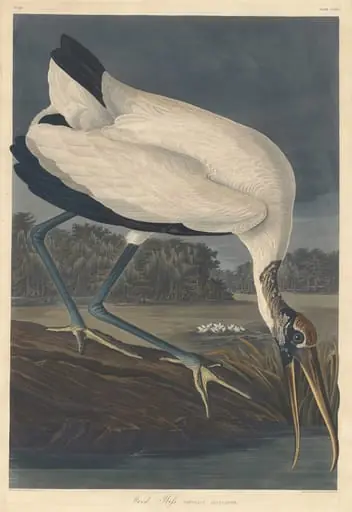
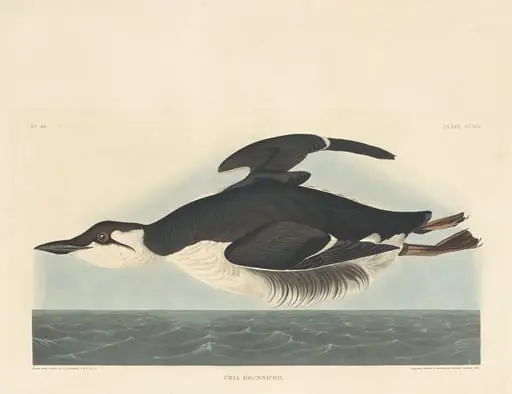
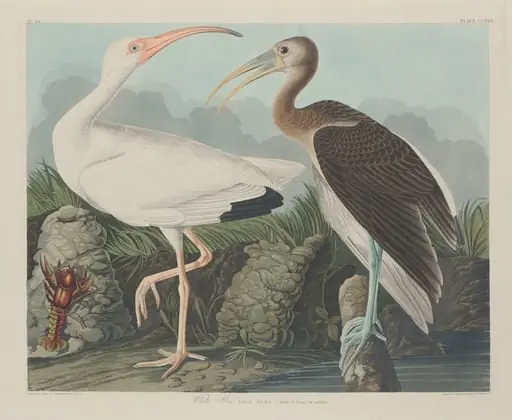
Robert Havell Jr. produced this hand-colored engraving and aquatint in 1838 on Whatman wove paper, part of a larger ornithological series. The work exemplifies the Havell family’s technical mastery in printmaking, particularly their refined use of aquatint to achieve subtle tonal gradations. As a print rather than a painting, it was intended for reproduction and distribution, aligning with scientific and natural history publishing practices of the era.
Subject & Meaning
The image depicts a brown pelican standing on a coastal rock, beak slightly open, facing left. Its plumage—layered in browns, whites, and blacks—is rendered with precision, emphasizing anatomical detail over symbolic meaning. The calm sea, distant trees, and lone lighthouse frame the bird within a quiet, undisturbed habitat, suggesting observation rather than narrative. The focus remains on the species as a specimen of natural order, consistent with early 19th-century scientific illustration.
Technique & Style
Havell employed engraving and aquatint to build depth and texture, hand-coloring each impression with water-based pigments to mimic natural hues. The aquatint’s soft tonal transitions capture the feather’s fine gradations and the atmospheric haze of the horizon. Whatman paper, prized for its durability and smooth surface, allowed for precise ink hold and delicate color application. The style is methodical, prioritizing accuracy over expressive flourish, reflecting the conventions of natural history documentation.
History & Provenance
Created during Havell Jr.’s collaboration on John James Audubon’s 'The Birds of America,' this print was one of many produced under his direction in London. The Havell family, established engravers since the late 18th century, had a workshop renowned for its technical rigor. Robert Havell Jr. inherited and expanded this legacy, overseeing the coloring and printing of hundreds of plates, ensuring consistency across the series despite the labor-intensive process.
Context
In the 1830s, illustrated natural history publications were vital to scientific communication, bridging amateur naturalists and academic institutions. Audubon’s project, with Havell’s prints, sought to document North American bird species with unprecedented detail. The inclusion of coastal landmarks like the lighthouse situates the pelican within a specific ecological zone, reinforcing the project’s geographic and biological aims amid growing interest in American fauna.
Legacy
Havell’s prints, including this one, remain key references in the study of 19th-century scientific illustration. Though overshadowed in popular memory by Audubon’s name, Havell’s technical contributions were essential to the project’s success. His work influenced later natural history publishing and is now preserved in major institutional collections as a benchmark for precision in hand-colored printmaking.
Artist & collection

Artist
The Havell family of Reading, Berkshire, England, included a number of notable engravers, etchers and painters, as well as writers, publishers, educators, and musicians.