Artwork
Golden-Crested Wren
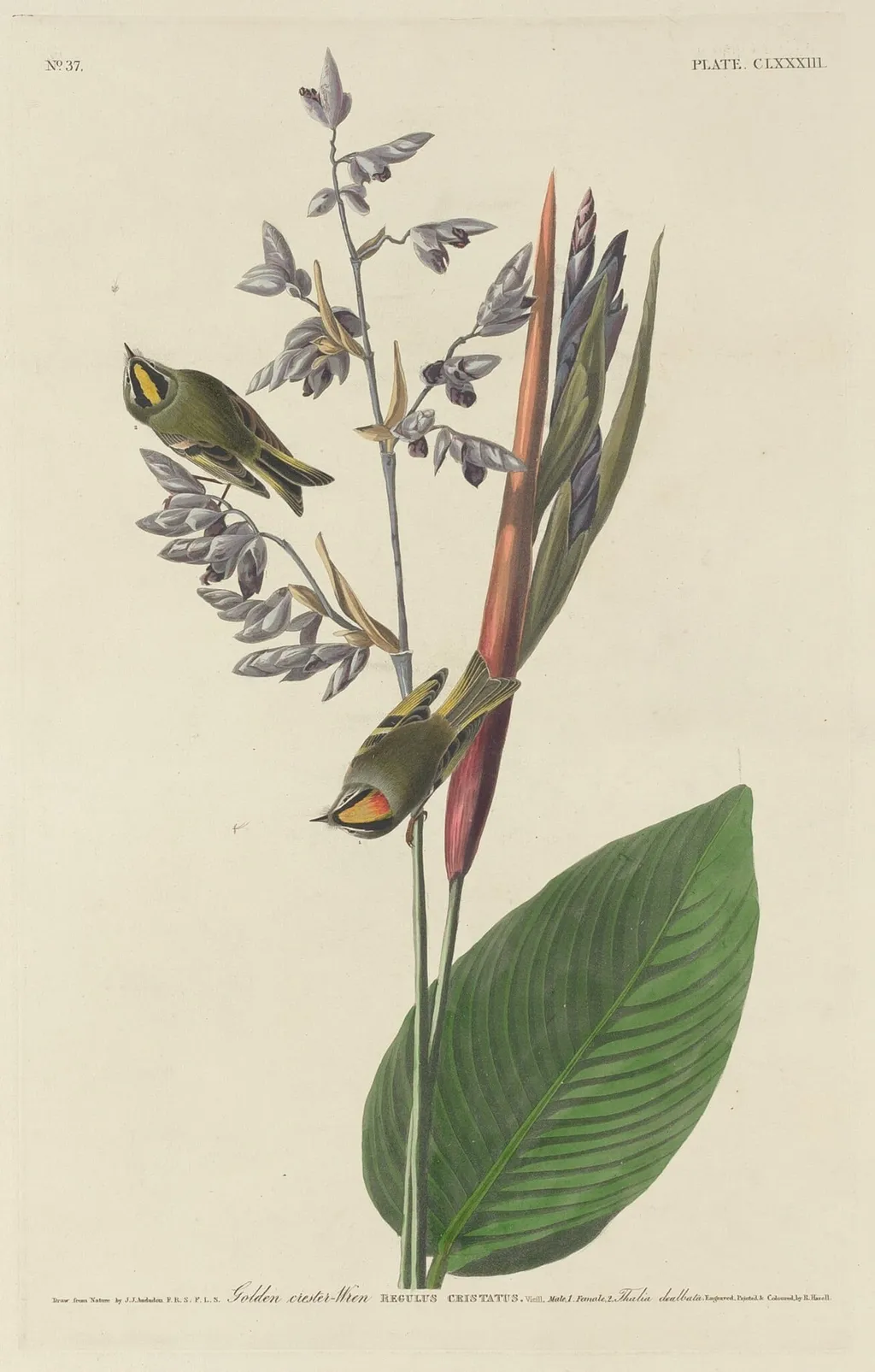
Golden-Crested Wren is an ink print by the Romanticist artist Robert Havell Jr.. It dates from 1833 and is held in the collection of the National Gallery of Art.
About this work
Overview
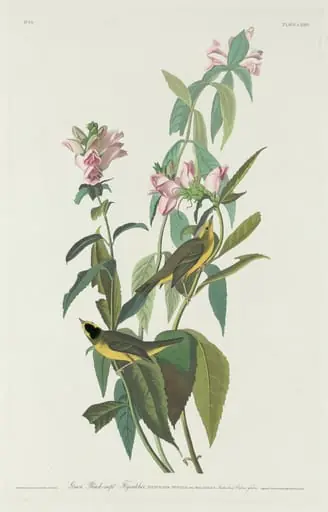
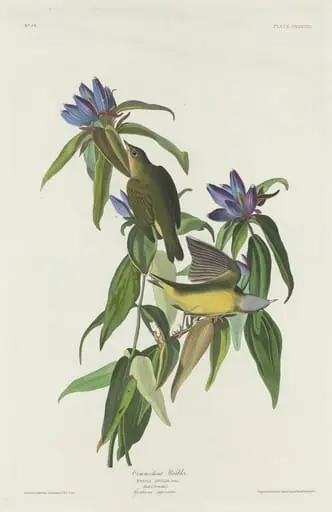
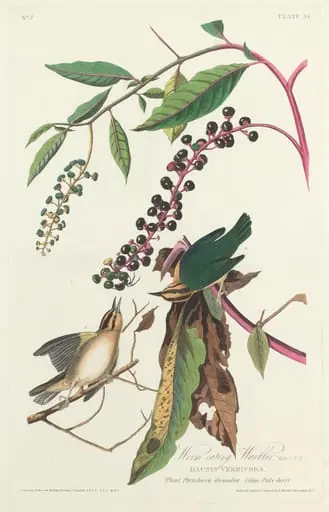
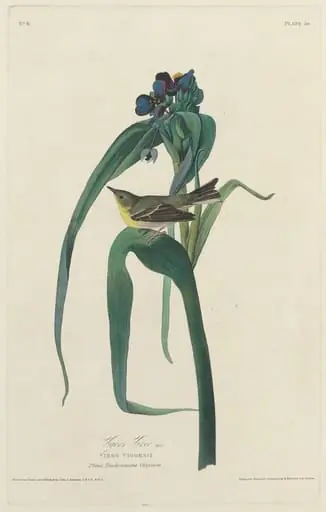
Created in 1833, the hand‑colored engraving and aquatint titled *Golden‑Crested Wren* presents a close‑up study of two small birds perched amid a stylized plant. Executed on smooth Whatman wove paper, the composition isolates the subjects against an unadorned white background, directing the viewer’s eye to the delicate interplay of line, tone, and applied color.
Subject & Meaning
The work portrays a pair of diminutive wren‑type birds, one distinguished by a vivid yellow crest and the other by a striking red eye, settled on a stem bearing elongated purple blossoms and broad green foliage. The precise rendering emphasizes natural observation, inviting contemplation of avian form and the subtle variations of plumage within a quiet, almost scientific tableau.
Technique & Style
The image combines traditional copper engraving with aquatint, a method the Havell workshop refined to achieve tonal gradations resembling watercolor washes.
The image combines traditional copper engraving with aquatint, a method the Havell workshop refined to achieve tonal gradations resembling watercolor washes. Fine incised lines define feather texture and leaf venation, while the aquatint provides soft shadows. After printing, selective hand‑coloring adds saturated hues to the crest, eyes, and floral elements, enhancing realism without overwhelming the monochrome foundation.
History & Provenance
Robert Havell Jr., a member of the renowned Havell family of printmakers, produced the piece during a period when the workshop was celebrated for its expertise in aquatint and its engagement with Indian artistic motifs. The print reflects the family’s broader involvement in cross‑cultural exchange and was likely circulated among collectors interested in natural history illustration in the early nineteenth century.
Context
The early 1830s saw a surge in scientific illustration and the popularization of ornithological studies in Britain. Prints such as this served both aesthetic and educational purposes, aligning with contemporary interests in cataloguing flora and fauna. The use of high‑quality Whatman paper underscores the era’s emphasis on durability and fine detail in printed works.
Legacy
While not as widely reproduced as later photographic studies, the *Golden‑Crested Wren* exemplifies the Havell family’s contribution to the development of color‑enhanced printmaking. Its meticulous technique and naturalistic approach continue to inform assessments of early nineteenth‑century illustration practices and the evolution of hand‑colored engraving.
Artist & collection

Artist
The Havell family of Reading, Berkshire, England, included a number of notable engravers, etchers and painters, as well as writers, publishers, educators, and musicians.