Artwork
Mottled Owl
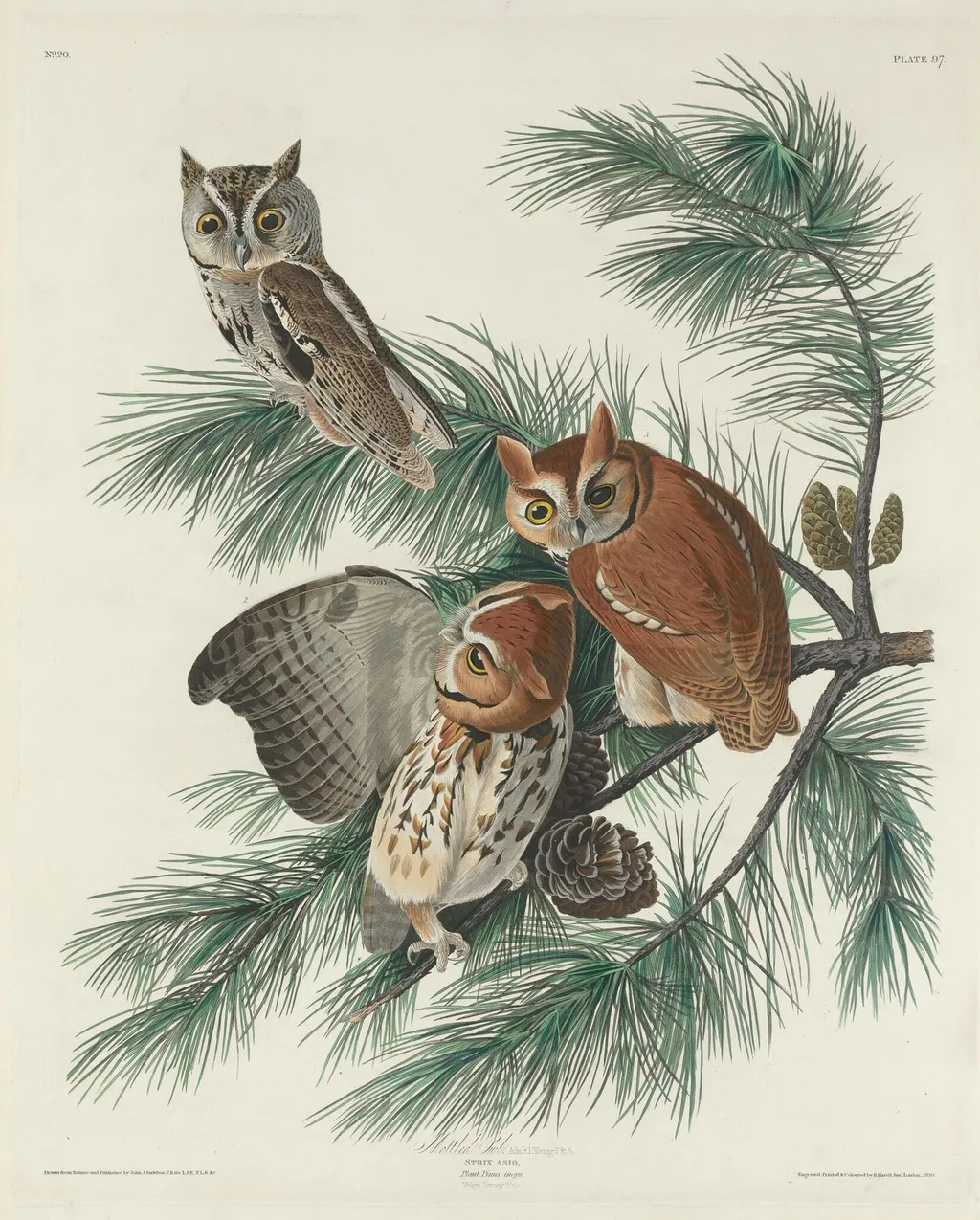
Mottled Owl is an ink print by the Romanticist artist Robert Havell Jr.. It dates from 1830 and is held in the collection of the National Gallery of Art.
About this work
Overview
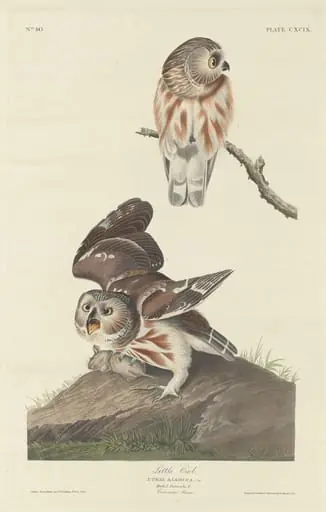
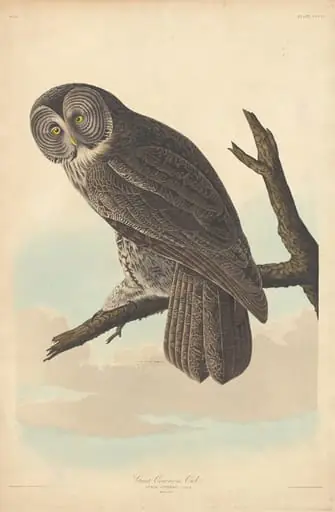
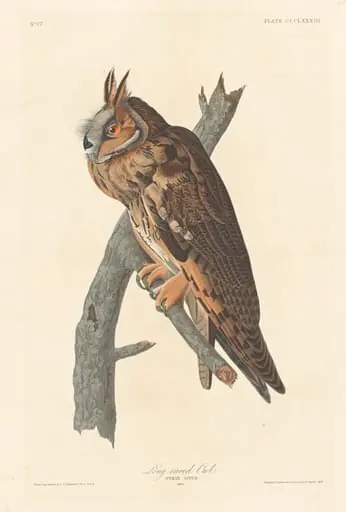
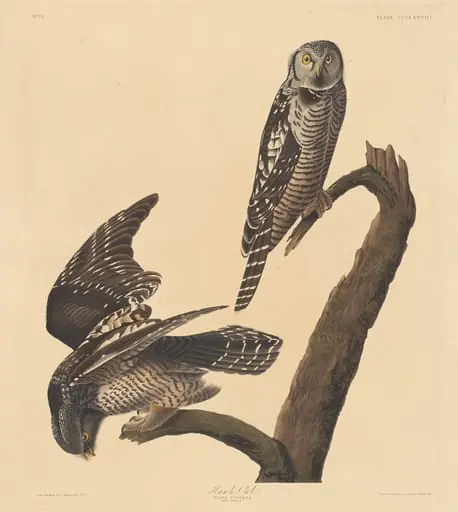
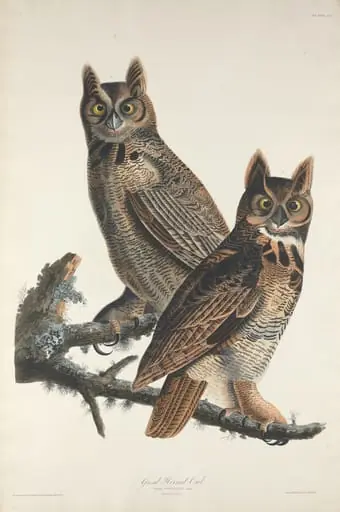
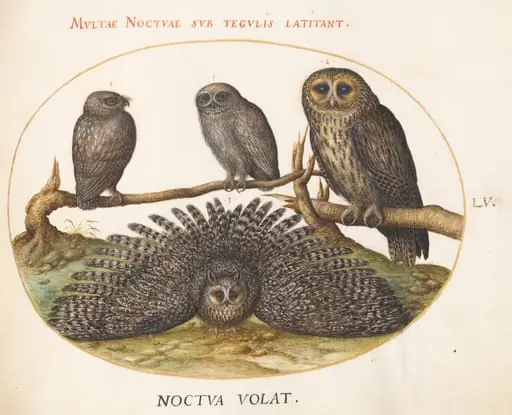
The image presents three owls perched on pine branches, each rendered with subtle variations of gray, brown and white, and highlighted by bright yellow eyes.
Created in 1830, *Mottled Owl* is a hand‑colored engraving combined with aquatint, printed on smooth Whatman wove paper. The image presents three owls perched on pine branches, each rendered with subtle variations of gray, brown and white, and highlighted by bright yellow eyes. The composition is framed by pinecones and delicate bark details, characteristic of natural‑history illustration of the period.
Subject & Meaning
The work offers a close study of a mottled owl, emphasizing the bird’s plumage texture and anatomical features. By presenting the owl in a natural setting, the print serves both as a visual record of the species and as an example of the 19th‑century interest in documenting wildlife with scientific precision.
Technique & Style
Havell employed a combination of fine line engraving for feather and bark texture and aquatint to achieve soft tonal washes. Hand‑coloring was applied after printing, allowing nuanced hues to differentiate the owls’ plumage. This layered approach reflects the Havell family’s reputation for meticulous reproductive engraving, especially in natural‑history subjects.
History & Provenance
Robert Havell Jr., son of the noted engraver and publisher Robert Havell Sr., produced the print in Reading, Berkshire, where the Havell family operated a prominent workshop. Their studio was known for collaborations with naturalists and for disseminating Indian artistic influences, though this particular piece focuses on a European bird.
Context
During the early 19th century, scientific illustration was a vital conduit between emerging zoological research and the public. Prints like *Mottled Owl* were often used in journals and books to accompany descriptive texts, aligning with the era’s emphasis on accurate visual documentation of flora and fauna.
Legacy
The print exemplifies the Havell workshop’s contribution to the development of detailed, colored natural‑history prints. Its combination of engraving, aquatint, and hand‑coloring influenced later illustrators who sought to balance artistic quality with scientific exactness.
Artist & collection

Artist
The Havell family of Reading, Berkshire, England, included a number of notable engravers, etchers and painters, as well as writers, publishers, educators, and musicians.