Artwork
Wood Thrush
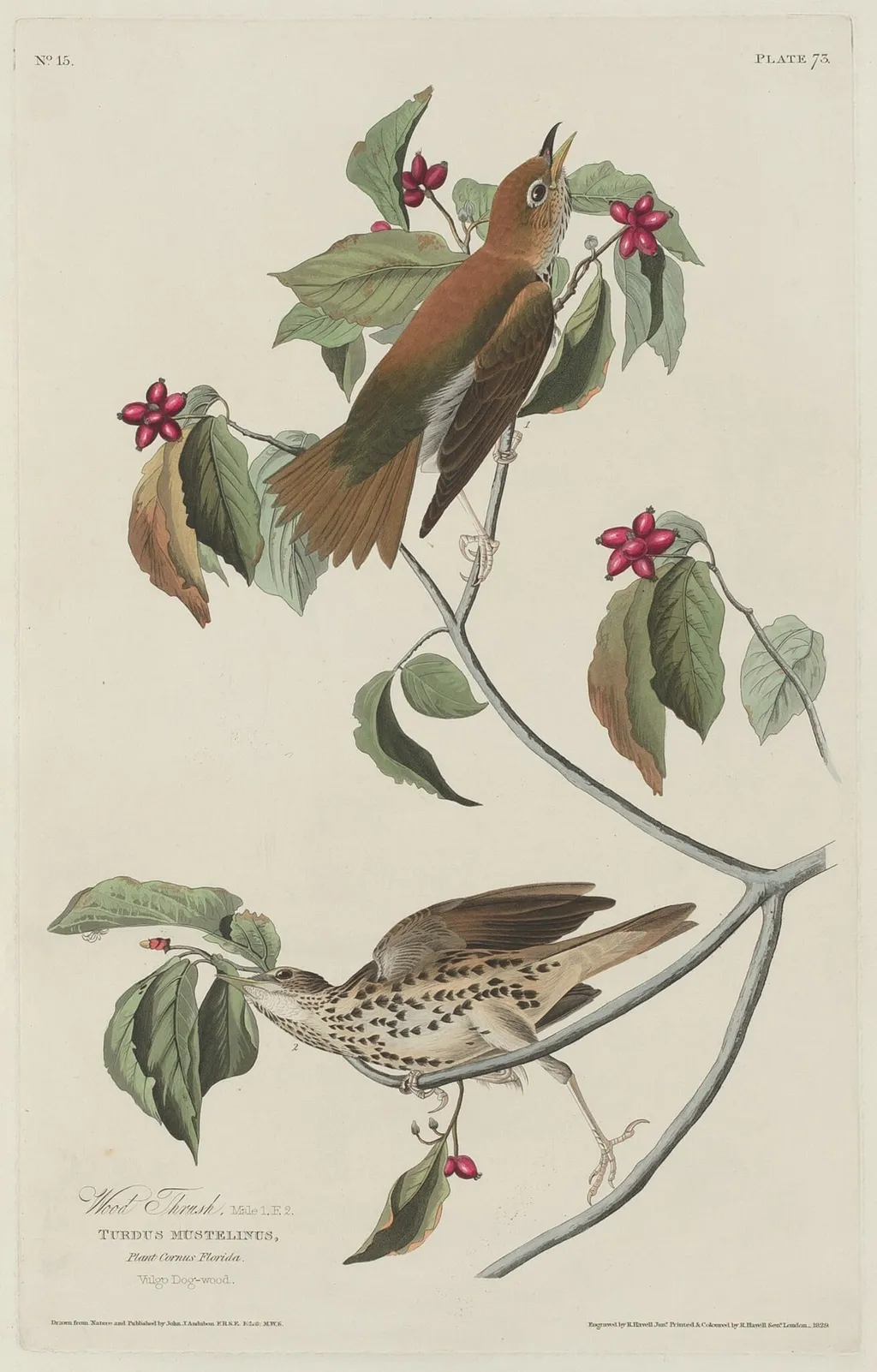
Wood Thrush is an ink print by the Romanticist artist Robert Havell Jr.. It dates from 1829 and is held in the collection of the National Gallery of Art.
About this work
Overview
Their technical mastery in aquatint allowed for subtle tonal gradations, essential for capturing the delicate textures of plumage and foliage with precision.
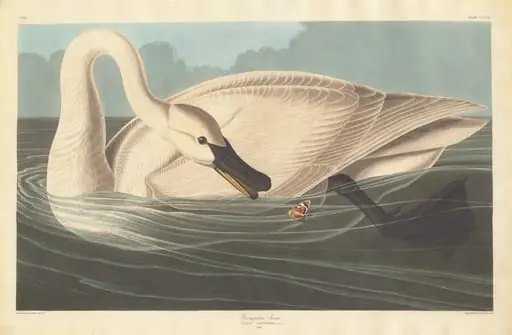
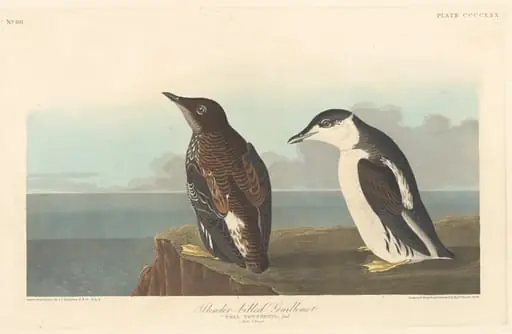
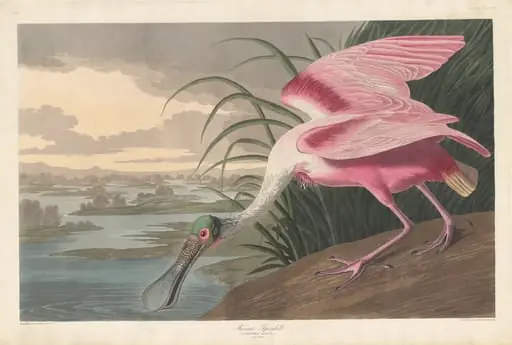
Robert Havell Jr. produced this hand-colored engraving and aquatint in 1829 on Whatman wove paper, a high-quality support favored for its durability and fine texture. The work is part of a broader series documenting North American birds, reflecting the Havell family’s established role in scientific illustration. Their technical mastery in aquatint allowed for subtle tonal gradations, essential for capturing the delicate textures of plumage and foliage with precision.
Subject & Meaning
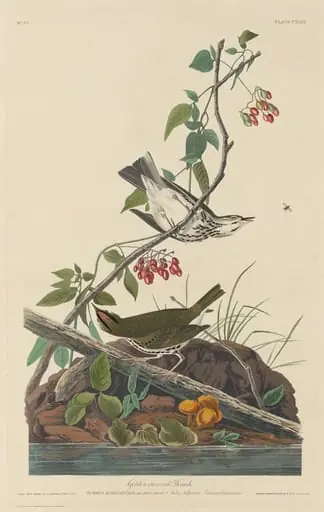
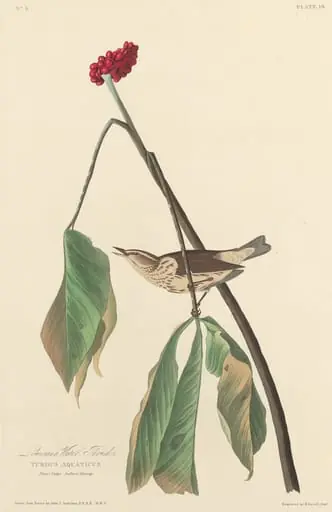
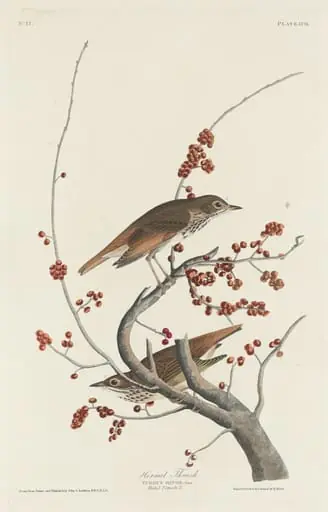
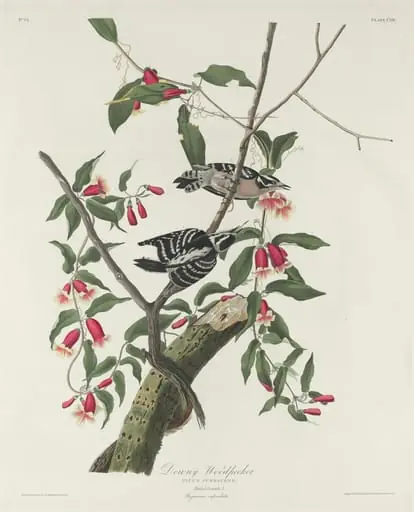
The print portrays two wood thrushes perched among branches adorned with green leaves and red dogwood berries. One bird displays speckled brown feathers, the other a uniform reddish-brown hue, both rendered with quiet stillness. The inclusion of dogwood, a native shrub, anchors the scene in its natural habitat. The image serves not as ornamentation but as a record of avian life, aligning with early 19th-century efforts to document American wildlife through visual accuracy.
Technique & Style
Havell employed engraving and aquatint to achieve fine detail and atmospheric depth. Engraved lines defined the birds’ forms and branch structures, while aquatint provided soft, graduated tones for feather texture and shadow. Hand-coloring, applied with care, enhanced realism without overwhelming the underlying line work. The result is a balanced synthesis of scientific observation and artisanal craftsmanship, typical of natural history prints of the period.
History & Provenance
Robert Havell Jr. belonged to a multi-generational family of printmakers based in London, known for their work on natural history publications. He collaborated closely with John James Audubon, producing plates for *The Birds of America*. This print likely originated from that project, though it was issued separately. The use of Whatman paper and the precision of execution reflect the high standards of the Havell workshop during its peak in the 1820s and 1830s.
Context
In the early 1800s, illustrated natural history texts were vital tools for scientific study and public education. European and American audiences increasingly valued accurate depictions of native species. Havell’s work emerged within this context, bridging artistic tradition and emerging biological classification. His family’s prior engagement with Indian art and printmaking informed their technical approach, blending global practices with local subject matter.
Legacy
Havell’s prints remain significant as primary visual records of North American birds before widespread photography. His technique influenced subsequent generations of natural history illustrators, emphasizing fidelity to form and environment. Though overshadowed in popular memory by Audubon’s name, Havell’s craftsmanship ensured the longevity and scientific credibility of the plates, securing his role as a quiet but essential contributor to ornithological documentation.
Artist & collection

Artist
The Havell family of Reading, Berkshire, England, included a number of notable engravers, etchers and painters, as well as writers, publishers, educators, and musicians.