Artwork
Pride
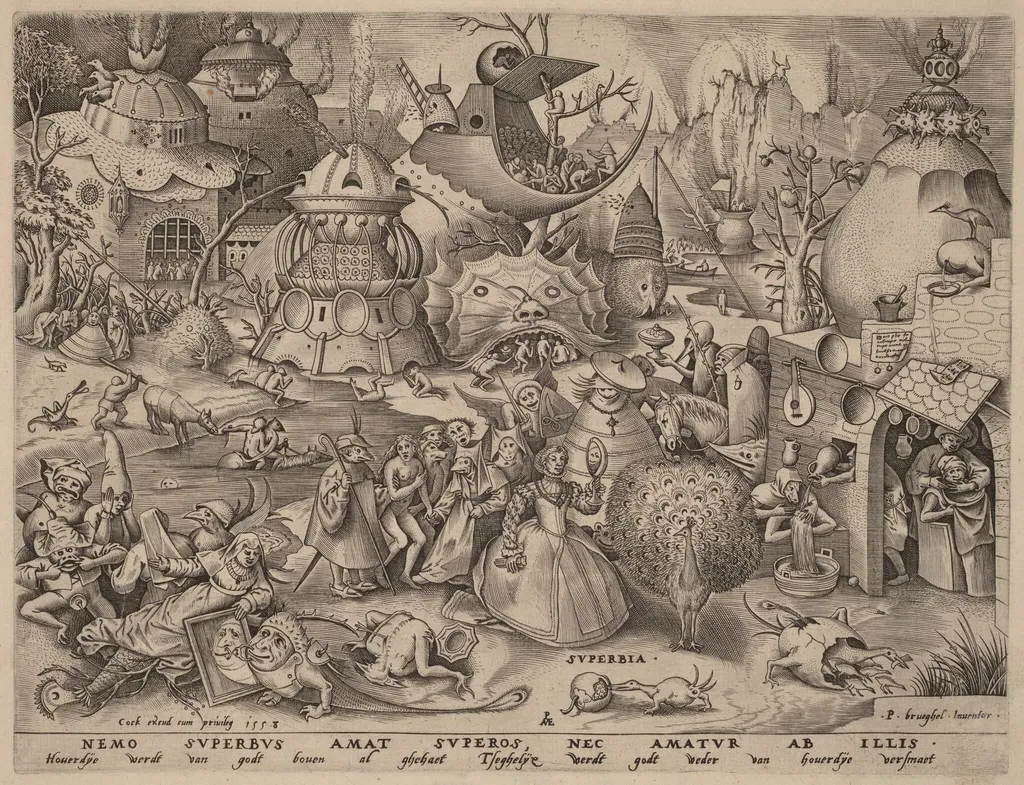
Pride is an ink print by the Renaissance artist Pieter van der Heyden. It dates from 1558 and is held in the collection of the National Gallery of Art.
About this work
Overview
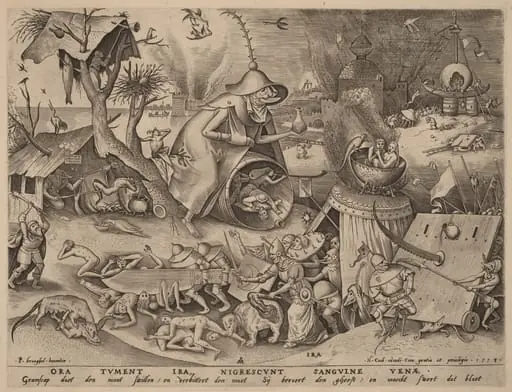
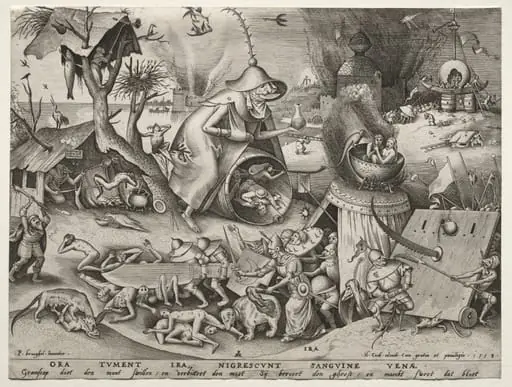
Created in 1558, *Pride* is an engraving on laid paper by the Flemish printmaker Pieter van der Heyden. The work measures roughly a single sheet and presents a densely populated tableau that intertwines human figures, fantastical creatures, and floating objects. The Latin term *SUPERBIA* appears near the bottom, linking the central, elaborately dressed woman to the theme of pride.
Subject & Meaning
At the composition’s heart, a group of oddly formed figures circles a richly attired woman, whose prominence is underscored by the inscription.
At the composition’s heart, a group of oddly formed figures circles a richly attired woman, whose prominence is underscored by the inscription. Above them, ships, architectural fragments, and tools descend from the sky, while the margins teem with hybrid beings—part human, part animal—entwined in a chaotic dance. The assemblage functions as a visual allegory of the vice of pride, juxtaposing worldly excess with grotesque distortion.
Technique & Style
Van der Heyden employed the fine lines of copper engraving to achieve a high degree of detail across the crowded scene. The use of laid paper, with its characteristic ribbed texture, enhances the contrast between delicate hatching and bold outlines. The work exemplifies the meticulous draftsmanship and compositional complexity typical of mid‑sixteenth‑century Flemish printmaking.
History & Provenance
Pieter van der Heyden was active in the mid‑1500s, primarily known for reproducing the designs of leading Flemish painters. *Pride* was produced during a flourishing period for print culture in the Low Countries, when such images circulated widely among collectors and scholars. The print’s later ownership records are sparse, but it has appeared in several European collections of early modern prints.
Context
The engraving emerges from a tradition of moralizing allegories popular in Renaissance Flanders, where prints served both decorative and didactic purposes. By integrating symbolic objects—ships representing ambition, tools suggesting labor, and hybrid monsters embodying moral corruption—van der Heyden aligns his work with contemporary visual sermons on the seven deadly sins, specifically the sin of pride.
Artist & collection

Artist
Pieter van der Heyden (c. 1530 - after March 1572) was a Flemish printmaker who is known for his reproductive engravings after works by leading Flemish painters and designers of the 16th century.