Artwork
The Passion: The Agony in the Garden
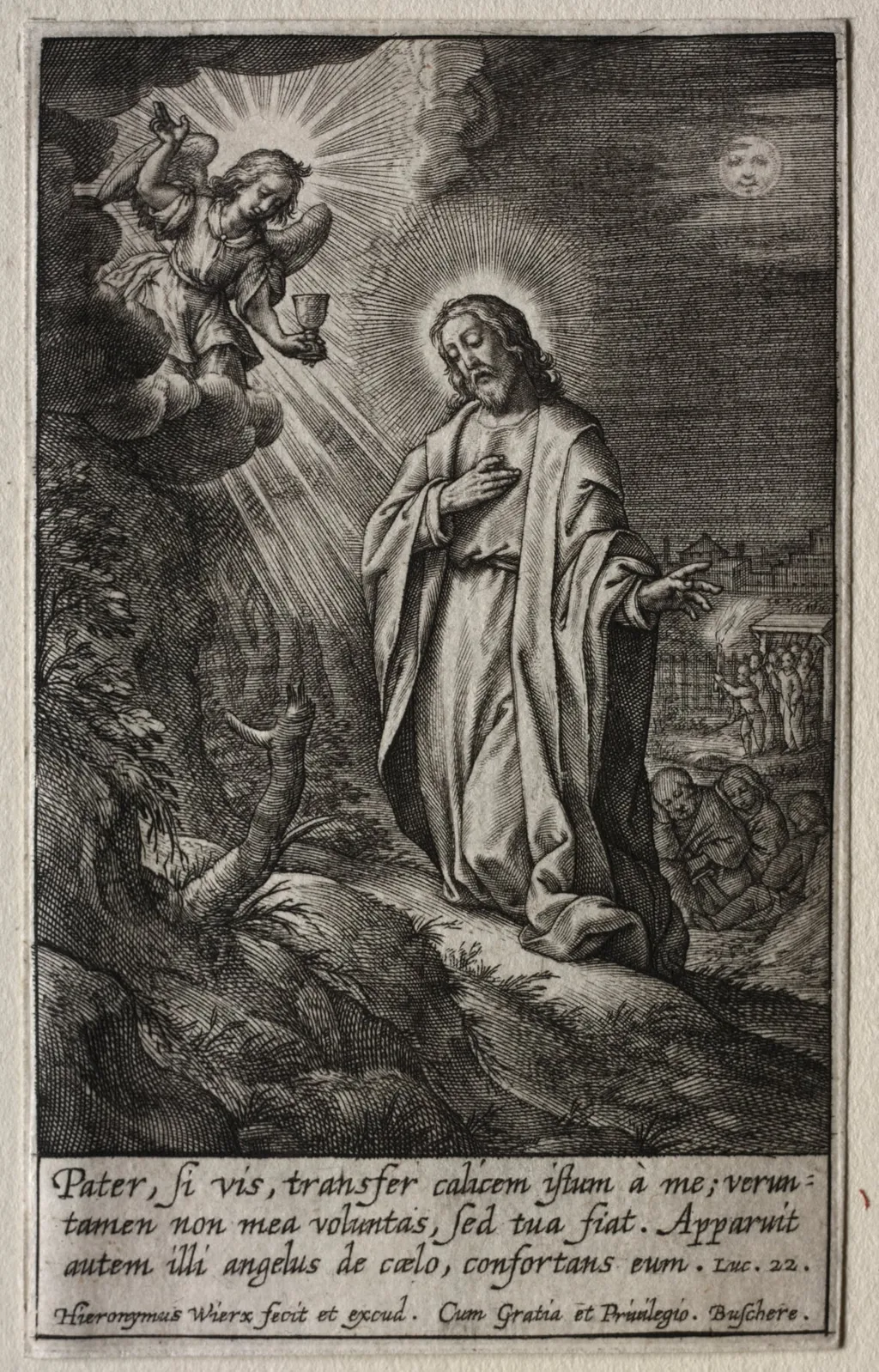
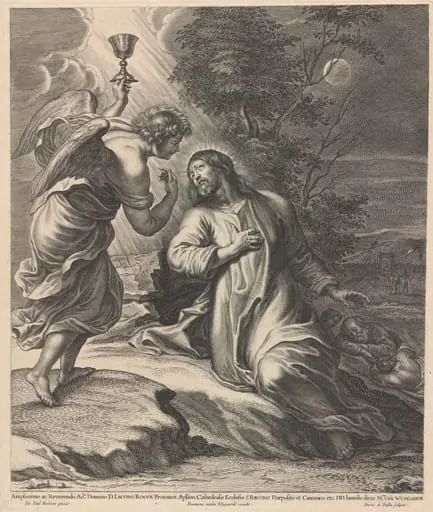
The Passion: The Agony in the Garden is a print by the Baroque artist Hieronymus Wierix. It dates from 1619 and is held in the collection of the Cleveland Museum of Art.
About this work
Overview
The composition centers on Christ’s moment of prayer in Gethsemane, rendered with precise line work and careful tonal gradation.
Created in 1619 by Hieronymus Wierix, this print is part of a series illustrating the Passion of Christ. It belongs to the collection of The Cleveland Museum of Art and is executed in engraving, a technique common in Northern European religious prints of the early 17th century. The composition centers on Christ’s moment of prayer in Gethsemane, rendered with precise line work and careful tonal gradation.
Subject & Meaning
The scene captures Jesus in prayer before his arrest, as described in the Gospels. An angel descends, offering a chalice symbolizing the suffering he must endure, while a cloth suggests preparation for burial. Behind him, the three apostles sleep, illustrating their failure to stay vigilant. The quiet tension between divine resolve and human frailty underscores the spiritual weight of the moment.
Technique & Style
Wierix employed fine-line engraving to achieve subtle contrasts of light and shadow, enhancing the nocturnal atmosphere. The halo around Christ’s head is suggested through negative space rather than direct marking, a refined approach that directs focus without overt symbolism. The distant cityscape and moonlit sky are rendered with delicate hatching, contributing to spatial depth while maintaining the print’s intimate scale.
History & Provenance
The print was produced during Wierix’s later years, when he was active in Antwerp as part of a family workshop known for religious imagery. It was likely made for private devotion or as part of a devotional set. The Cleveland Museum of Art acquired it in the 20th century, where it remains among its holdings of Northern Renaissance and Baroque prints.
Context
Produced in the wake of the Protestant Reformation, such prints served Catholic audiences seeking visual aids for meditation. Wierix’s work reflects the Counter-Reformation emphasis on emotional engagement with sacred narratives. His style, rooted in the detailed tradition of Flemish engraving, bridges late Mannerism and early Baroque sensibilities without adopting the dramatic dynamism of Italian contemporaries.
Legacy
Wierix’s prints circulated widely across Europe, influencing devotional imagery well into the 17th century. Though less celebrated than painters of his era, his technical precision and quiet emotional depth contributed to the enduring appeal of printed religious scenes. This work exemplifies how printmaking could convey spiritual gravity with restraint, sustaining its relevance beyond its immediate religious context.
Artist & collection

Artist
Hieronymus Wierix (1553–1619) was a Flemish engraver, draughtsman and publisher. He is known for his reproductive engravings after the work of well-known local and foreign artists including Albrecht Dürer. Together with…