Artwork
Frontispiece to Drayton's Poly-olbion
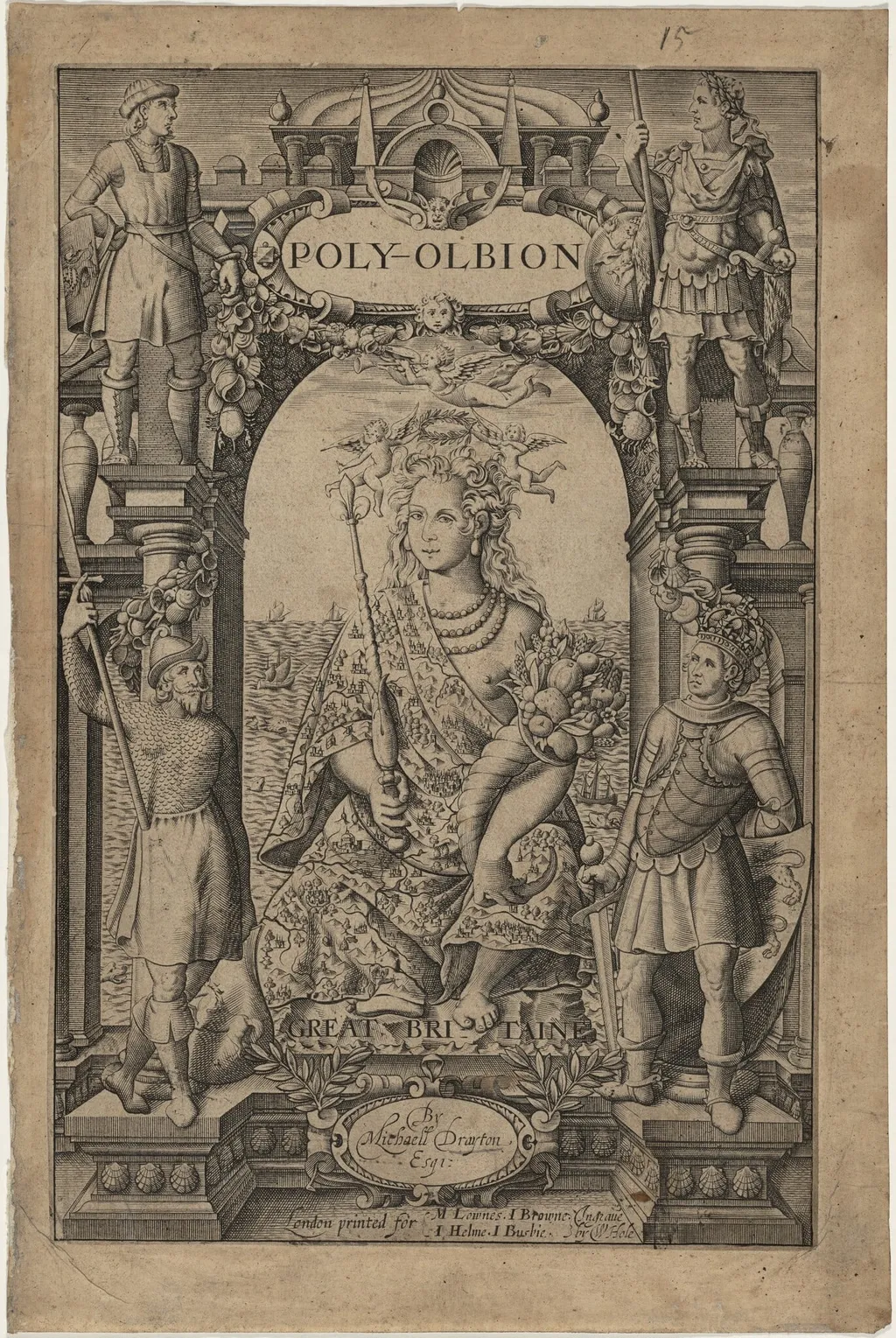
Frontispiece to Drayton's Poly-olbion is an ink print by the Renaissance artist William Hole. It dates from 1606 and is held in the collection of the National Gallery of Art.
About this work
Overview
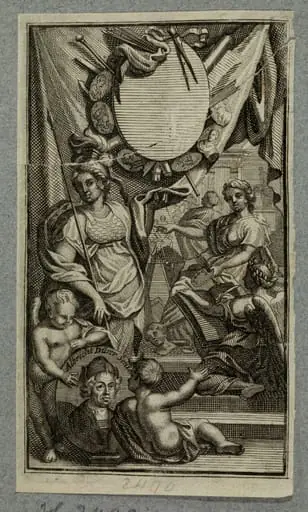
William Hole’s 1606 engraving serves as the frontispiece for Michael Drayton’s topographical poem *Poly-Olbion*. Executed as a copper plate print, the image introduces the work with an allegorical tableau that combines personifications, heraldic figures, and cartographic motifs, framing the literary celebration of Britain’s landscape and history.
Subject & Meaning
An arch above bears the title *Poly-Olbion*, while a decorative banner below spells *Great Britaine*, reinforcing the work’s patriotic theme.
At the center stands a female figure with flowing hair, clutching a staff and a fruit, embodying the personified nation of Britain. Flanking her are two armored men—one scholarly, the other regal—suggesting the union of learned antiquity and royal authority. An arch above bears the title *Poly-Olbion*, while a decorative banner below spells *Great Britaine*, reinforcing the work’s patriotic theme.
Technique & Style
Hole employed the fine line engraving method, incising intricate details into a copper plate. The print displays a dense network of hatching and cross‑hatching to render texture, from the rocky terrain to the delicate cherubs and distant ships. Such precision allowed for reproducible images that could convey complex allegorical programs to a wide readership.
History & Provenance
Created in the early seventeenth century, the frontispiece accompanied the first editions of Drayton’s ambitious poetic survey of England and Wales. Copies of the engraving appear in surviving 1606 and later print runs, and the plate was likely retained by the publisher for subsequent reissues, reflecting the commercial practice of reusing frontispieces for popular works.
Context
The image reflects a broader trend in early modern England of linking literary projects with visual symbolism to assert national identity. By merging cartographic elements—such as scroll‑like maps and miniature ships—with classical allegory, Hole’s engraving anticipates later emblematic prints that blend geography, history, and myth to celebrate the nation.
Artist & collection