Artwork
Juno
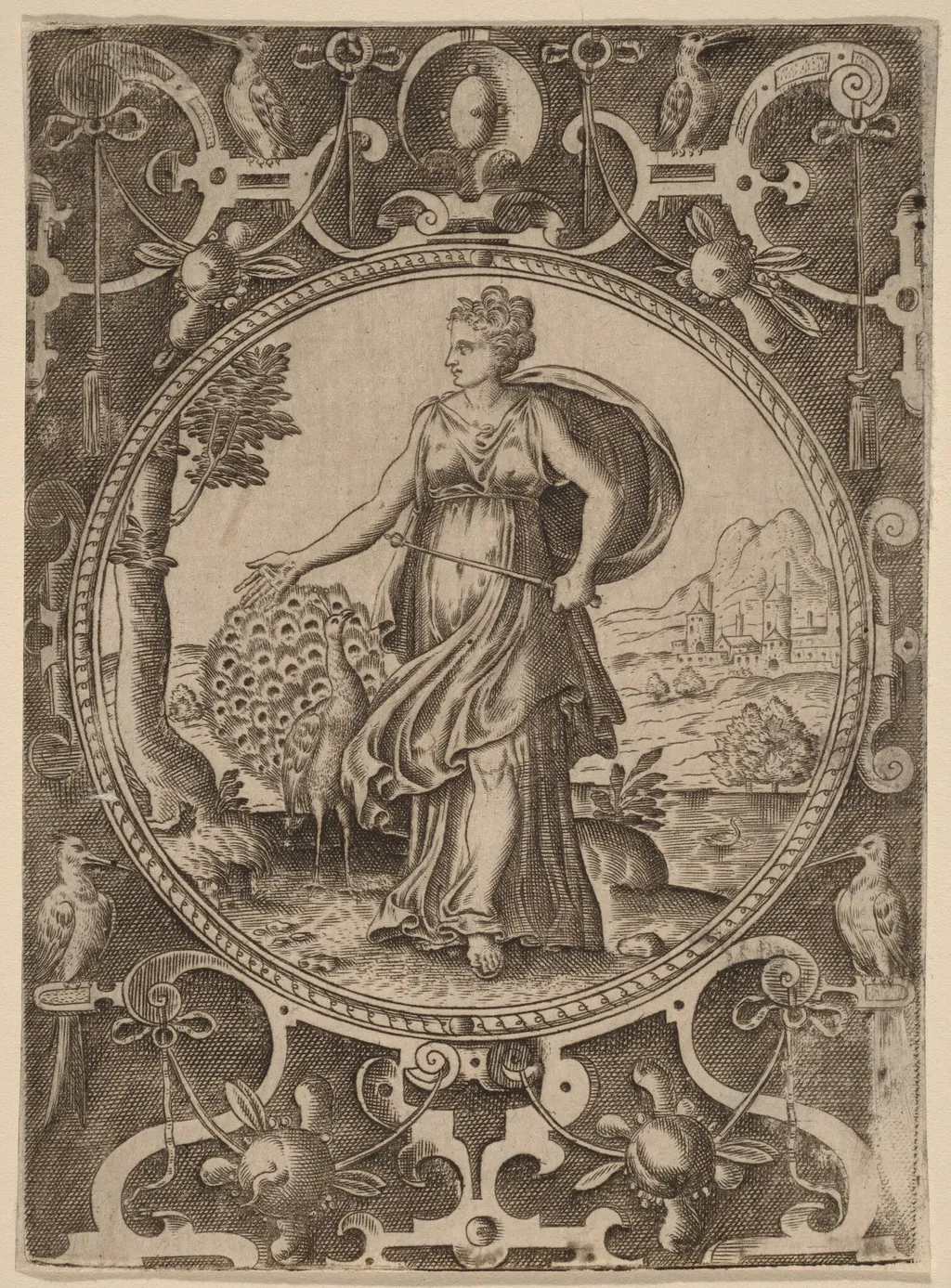
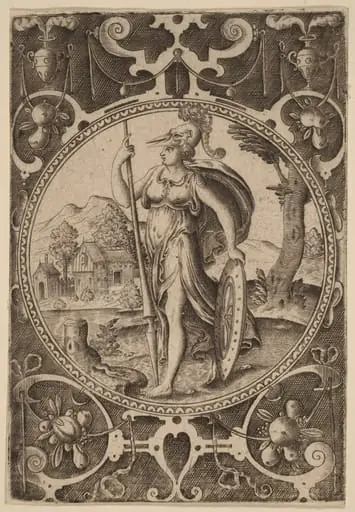
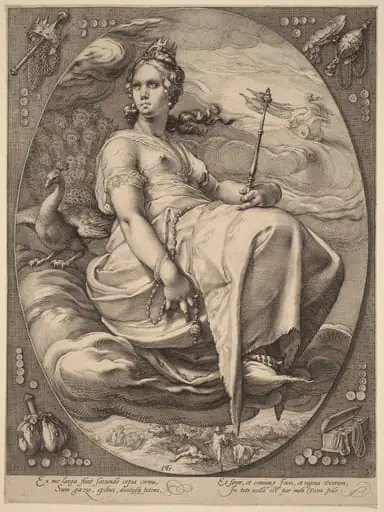
Juno is an ink print by the Renaissance artist Netherlandish 16th Century. It dates from 1564 and is held in the collection of the National Gallery of Art. The print is an engraving executed on laid paper, depicting a solitary female figure set against a modest landscape.
About this work
Overview
The print is an engraving executed on laid paper, depicting a solitary female figure set against a modest landscape. She holds a staff and a feathered bundle, wears a draped robe, and is crowned with a leafy wreath. Behind her, a small town and rolling hills appear, while the surrounding border is filled with elaborate swirls, foliage, and diminutive figures, all incised into the paper.
Subject & Meaning
The central woman is presented in a manner reminiscent of a deity, though her precise mythological identity is not specified within the image. The inclusion of a staff and feathered bundle, along with the leafy crown, suggests attributes associated with fertility or protection, inviting viewers to interpret her as a symbolic or allegorical figure rather than a specific goddess.
Technique & Style
The intricate border demonstrates a high level of detail, with repeated ornamental motifs and tiny figurative elements that require close observation.
The work employs traditional engraving methods, using a burin to cut fine lines into the laid paper surface. The intricate border demonstrates a high level of detail, with repeated ornamental motifs and tiny figurative elements that require close observation. The contrast between the bold outlines of the central figure and the delicate, densely packed decorative frame exemplifies the precision characteristic of early printmaking.
History & Provenance
The print is catalogued under the title "Juno," indicating a possible association with the Roman goddess, though the image itself does not confirm this identification. No further information about the artist, date of execution, or ownership history is provided in the available description.
Context
Engravings of mythological or allegorical subjects were common in the Renaissance and Baroque periods, serving both decorative and instructional purposes. The elaborate border aligns with contemporary practices of framing central images with ornamental designs that enhance the narrative and visual impact.
Artist & collection

Artist
This artist carved scenes with fine lines, mostly religious and mythological ones.