Artwork
The Brahman gives an account of his falling in love with the king of Babylon’s daughter to his friend, the magician, from a Tuti-nama (Tales of a Parrot): Thirty-fifth Night
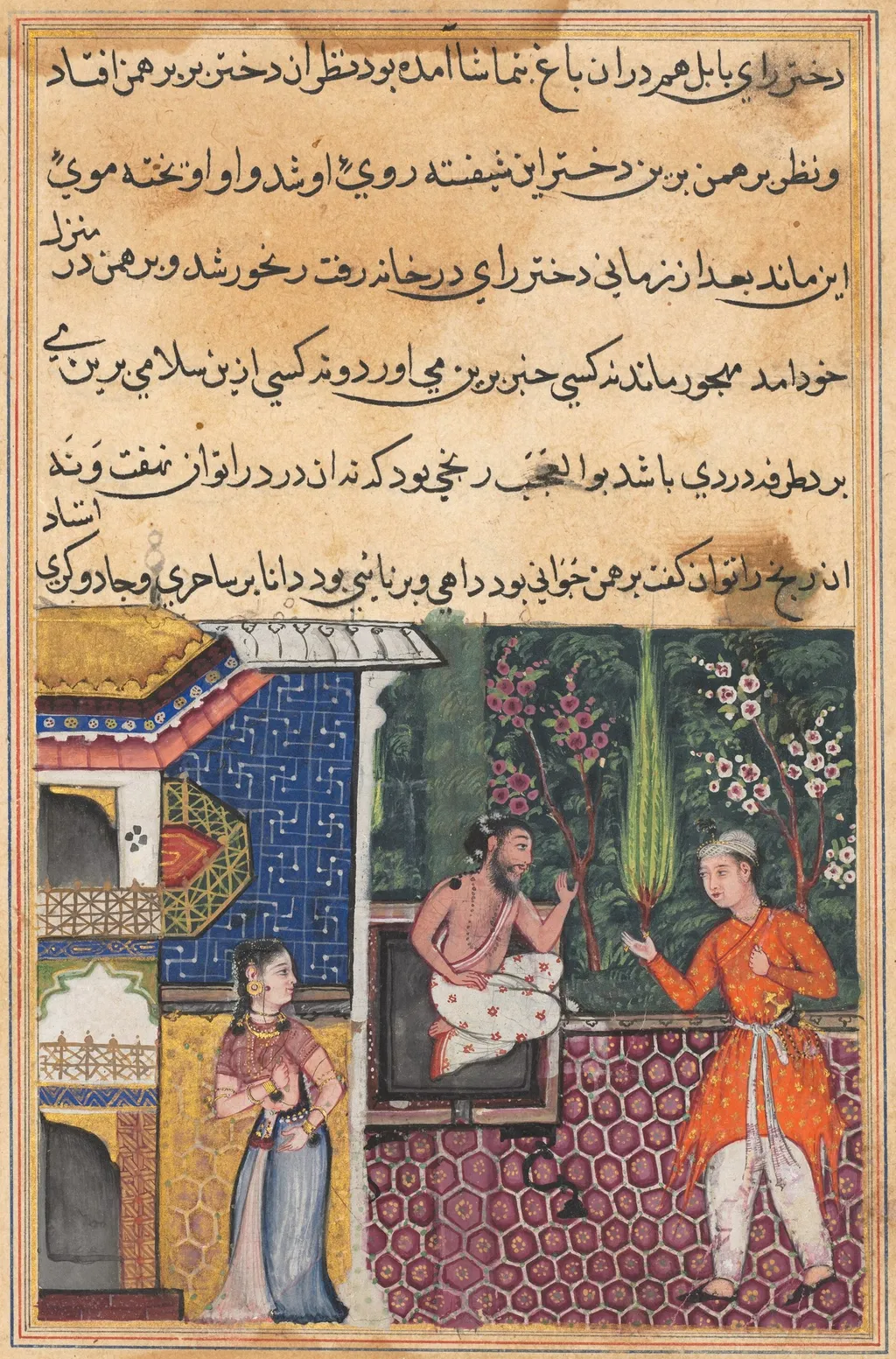
The Brahman gives an account of his falling in love with the king of Babylon’s daughter to his friend, the magician, from a Tuti-nama (Tales of a Parrot): Thirty-fifth Night is an unspecified painting. It dates from 1560 and is held in the collection of the Cleveland Museum of Art. The work depicts a narrative scene set within an opulently adorned interior.
About this work
Overview
Three figures occupy the space: a man in a vivid orange garment holding a fan near a window, a seated figure in white, and a woman in a blue‑gray dress.
The work depicts a narrative scene set within an opulently adorned interior. Three figures occupy the space: a man in a vivid orange garment holding a fan near a window, a seated figure in white, and a woman in a blue‑gray dress. The surrounding walls are tiled in blue with gold motifs, while the floor is patterned with red hexagons, and a view beyond the window reveals verdant foliage and pink blossoms.
Subject & Meaning
The painting illustrates a moment from a Tuti‑nama, a collection of parrot tales, in which a Brahman recounts his love for the Babylonian king’s daughter to a magician friend. The composition suggests a storytelling atmosphere, emphasizing themes of romance and cultural exchange across distant lands.
Technique & Style
Executed with a rich palette, the artist employs bold, saturated hues—particularly orange, blue, and red—to accentuate the figures and decorative elements. Intricate detailing in the tiled walls and patterned floor reflects a meticulous approach to surface ornamentation, while the inclusion of an external garden view adds depth to the interior space.
Context
The scene draws on literary sources that blend Indian and Mesopotamian motifs, reflecting a broader fascination with exotic narratives in the period’s visual culture. The inclusion of a magician as a confidant underscores the era’s interest in mystical and courtly intrigue.
Artist & collection

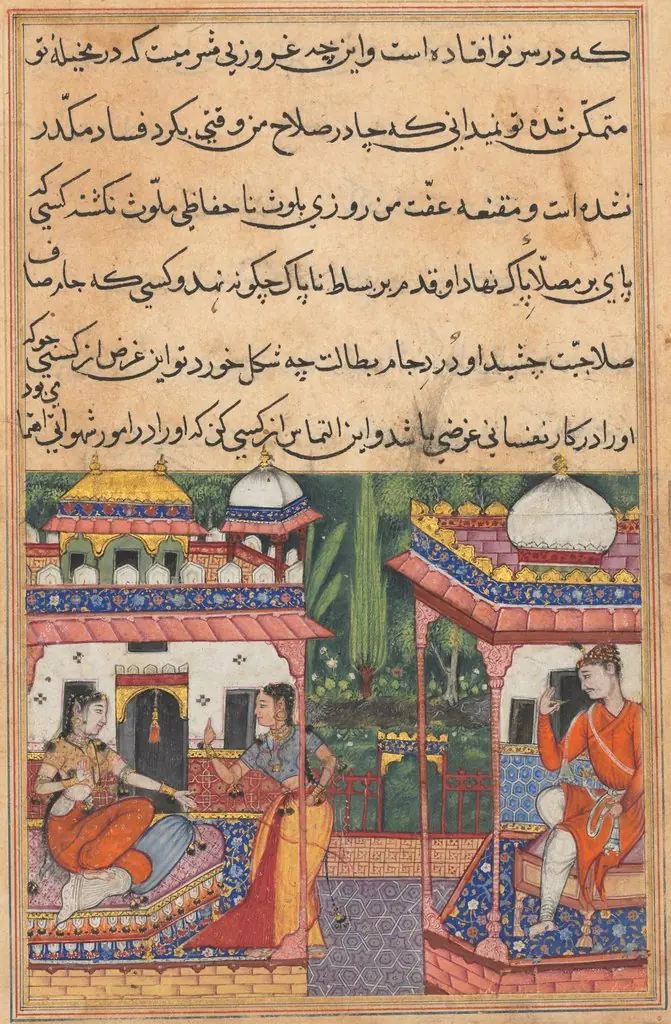 Kaiwan sends a message of love to Khurshid, wife of his brother Utarid who is away on a journey, from a Tuti-nama (Tales of a Parrot): Thirty-second Night
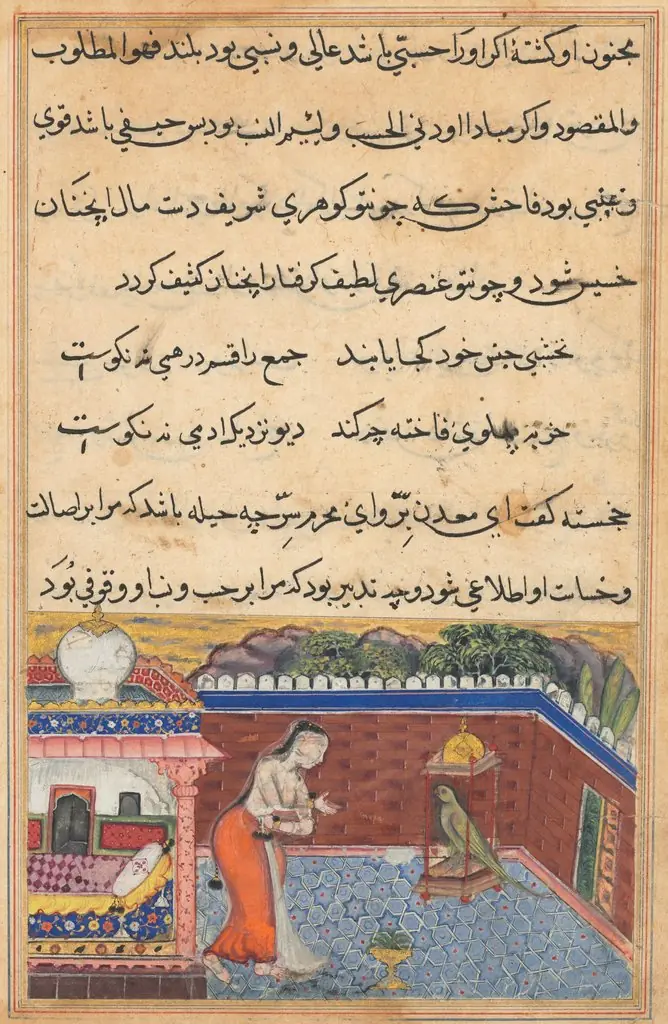 The parrot addresses Khujasta at the beginning of the thirty-first night, from a Tuti-nama (Tales of a Parrot)
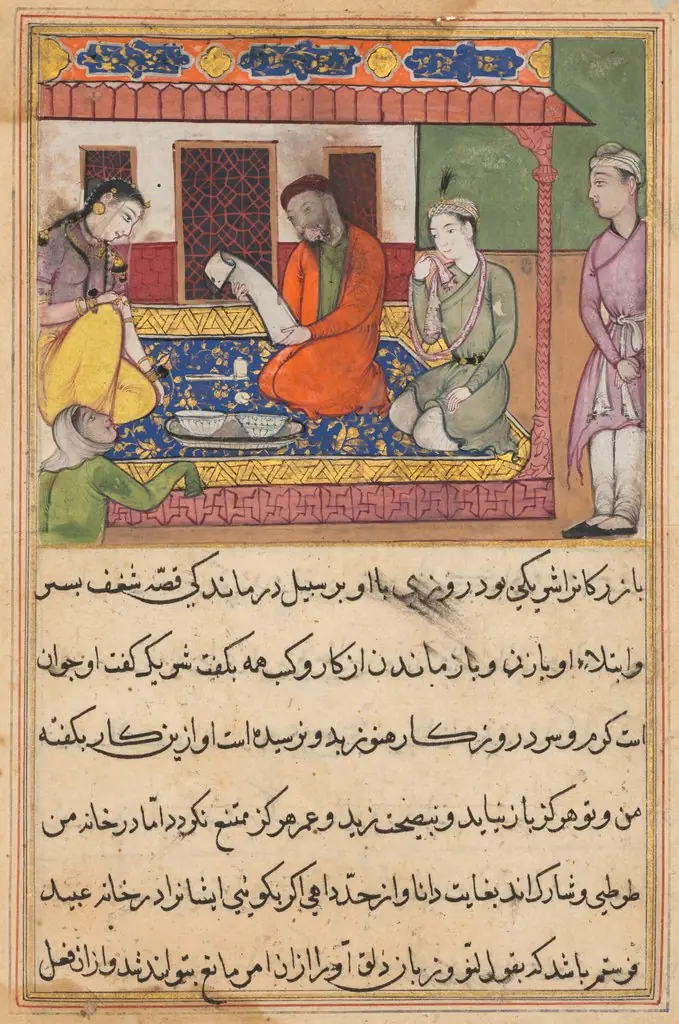 The marriage of ‘Ubaid, son of a merchant of Tirmiz, from a Tuti-nama (Tales of a Parrot): Forty-second Night
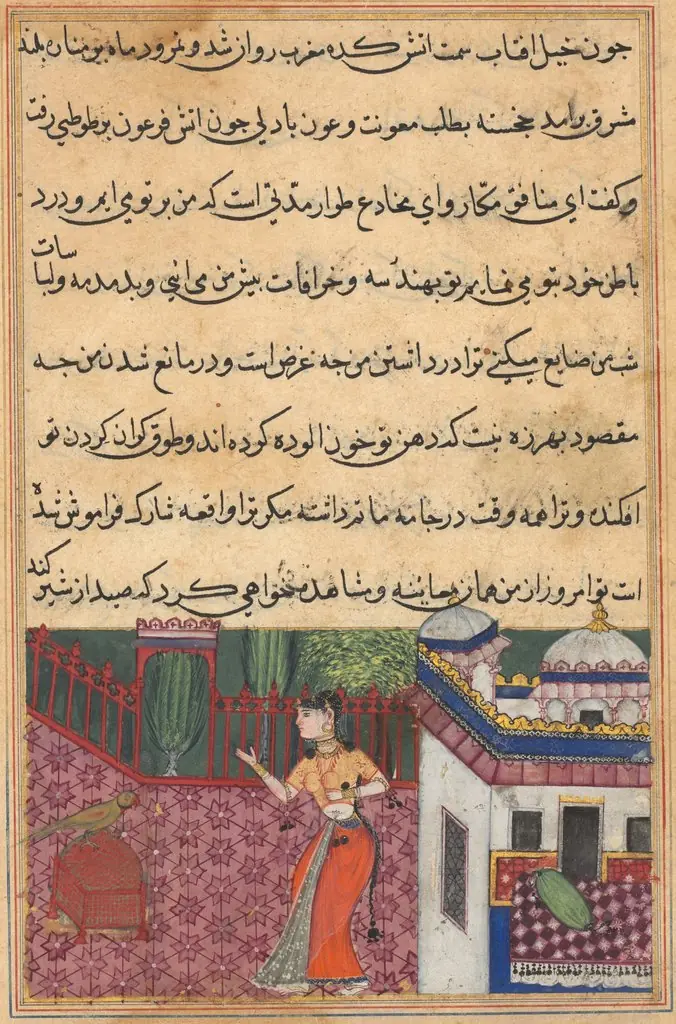 The parrot addresses Khujasta at the beginning of the thirty-third night, from a Tuti-nama (Tales of a Parrot)
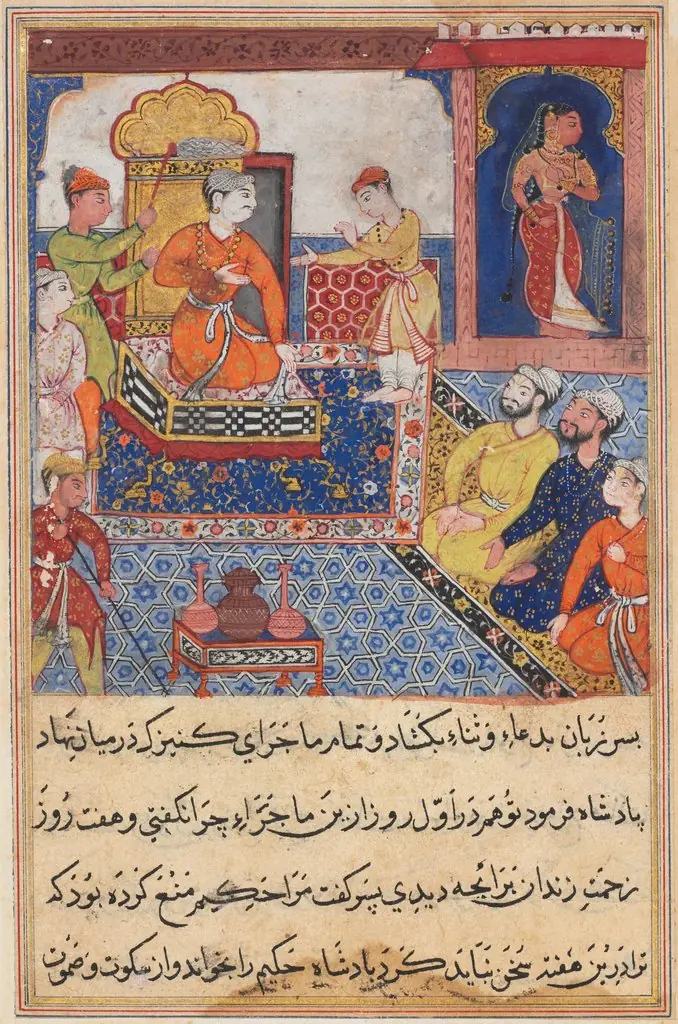 The young prince recounts his experiences to his father, the king, from a Tuti-nama (Tales of a Parrot): Eighth Night
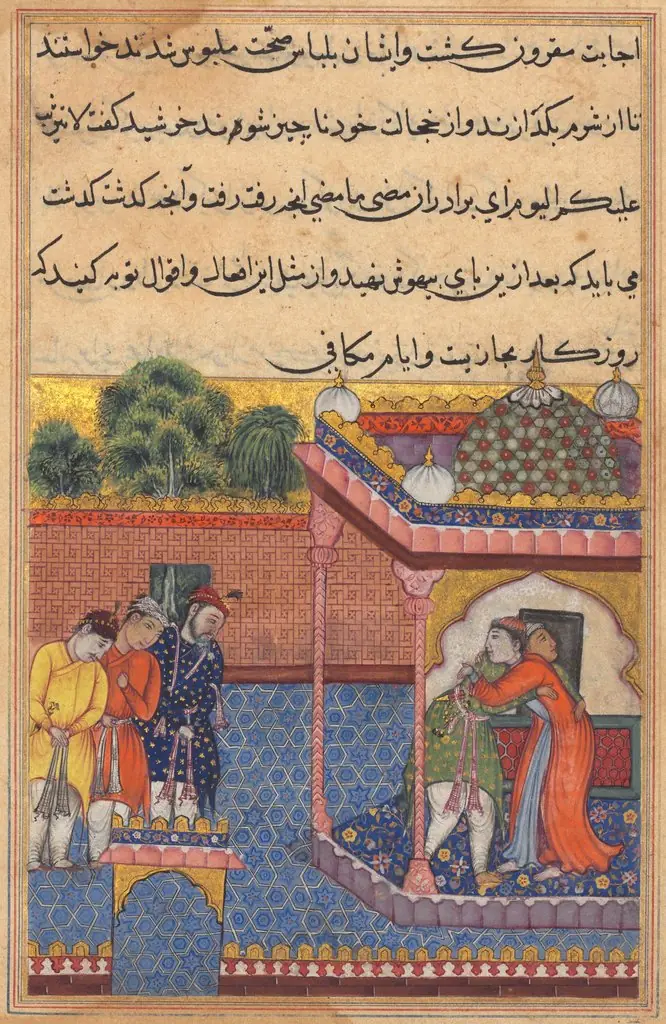 Khurshid reunited with her husband Utarid, from a Tuti-nama (Tales of a Parrot): Thirty-second Night
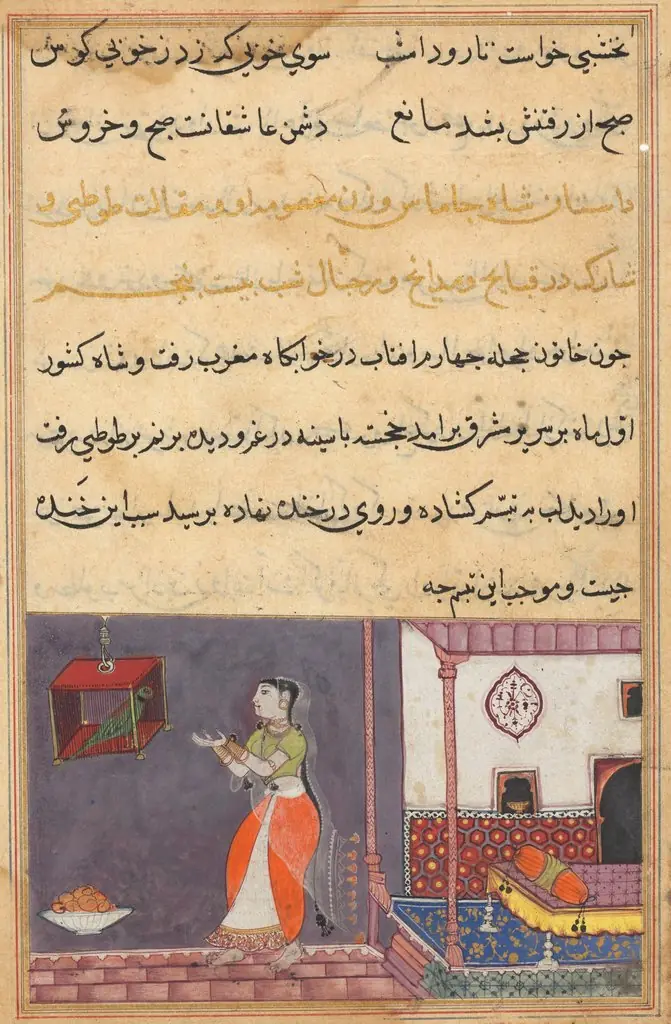 The Parrot Addresses Khujasta at the Beginning of the Twenty-fifth Night, from a Tuti-nama (Tales of a Parrot)
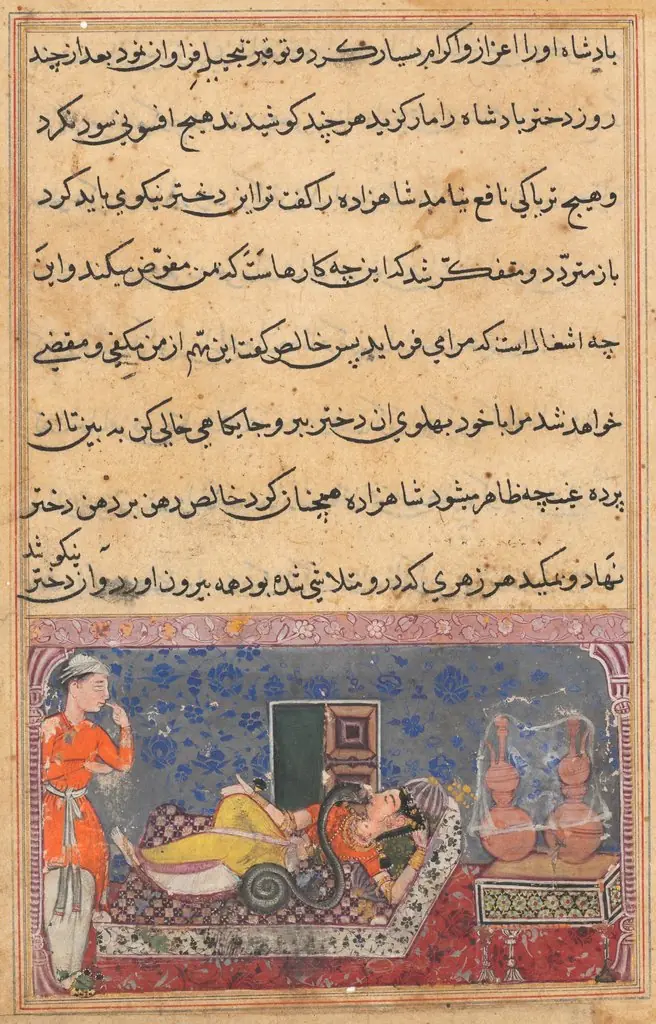 Khalis repays the prince for his kindness by changing into a snake and sucking the poison from the king’s daughter, from a Tuti-nama (Tales of a Parrot): Eighteenth Night
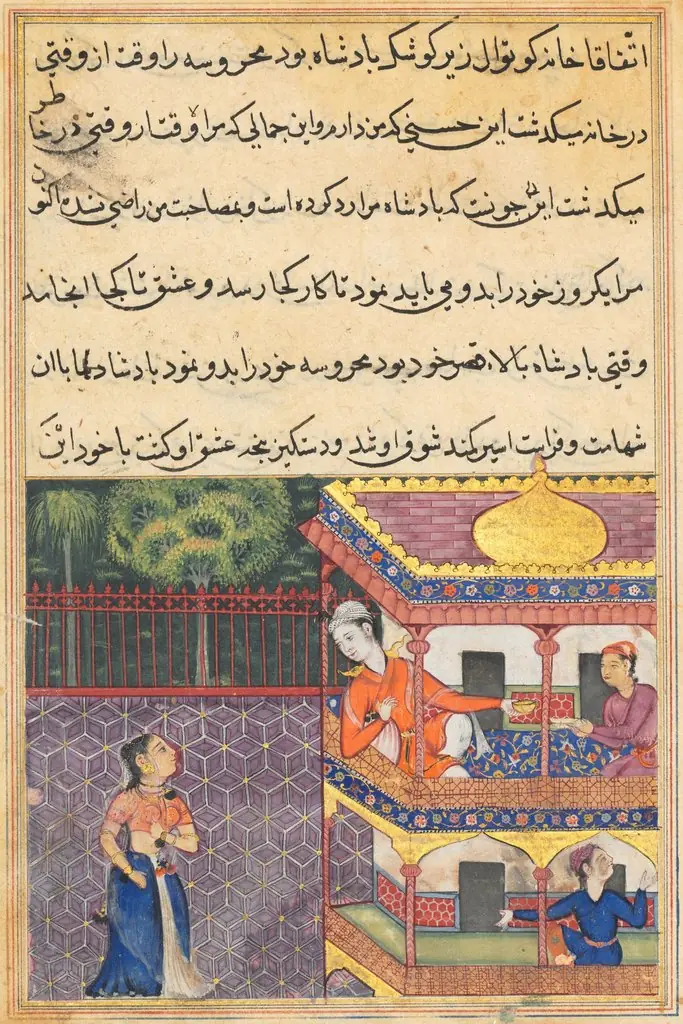 The king of Zabul sees Mahrusa from his palace balcony, from a Tuti-nama (Tales of a Parrot): Thirty-sixth Night
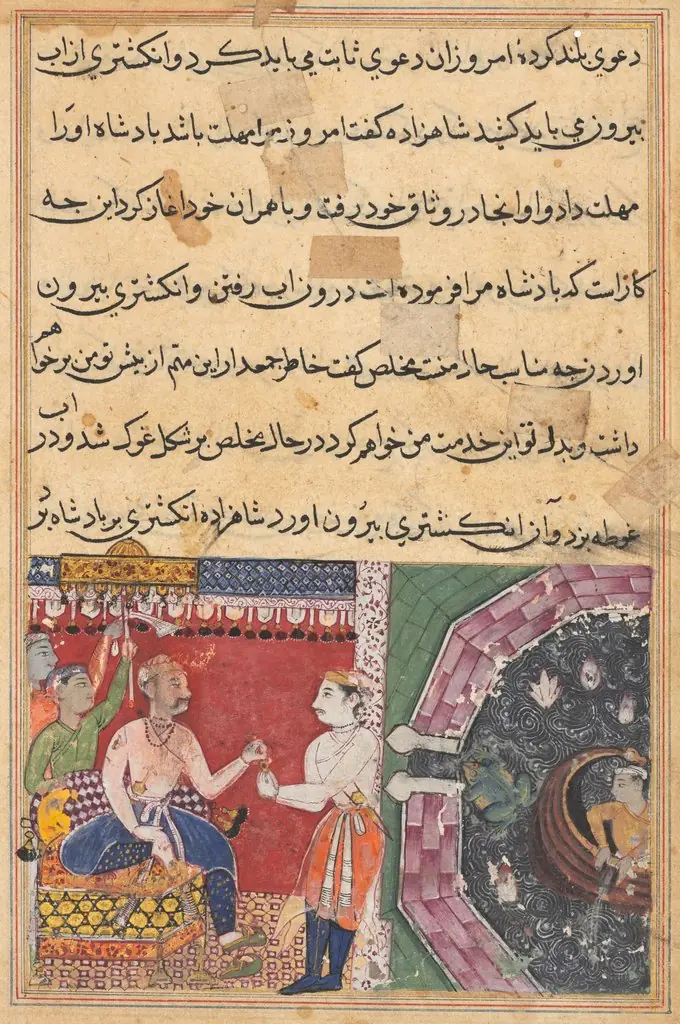 The prince, with the help of Mukhlis who changes into a frog, recovers the ring lost in the sea, and returns it to the king, from a Tuti-nama (Tales of a Parrot): Eighteenth Night
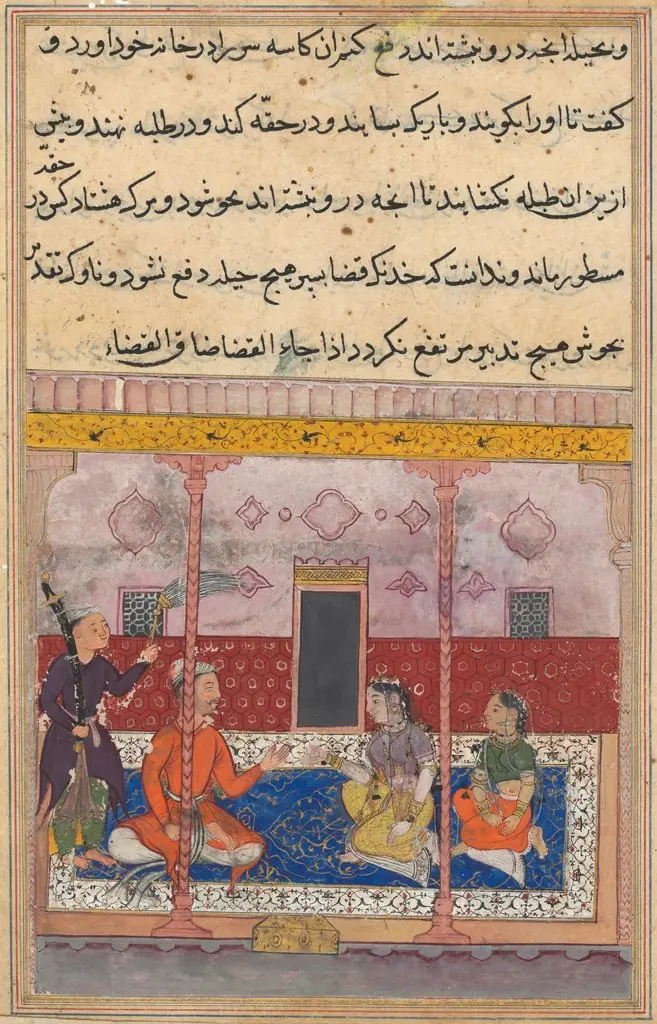 The merchant has the hateful skull ground and put into a box, from a Tuti-nama (Tales of a Parrot): Twenty-third Night
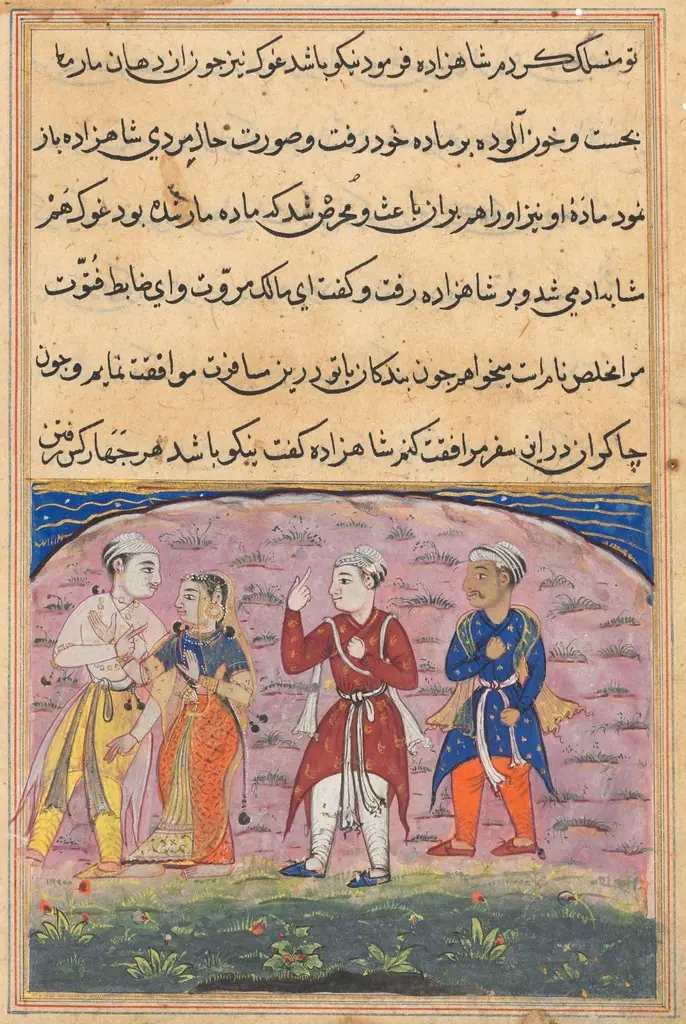 The prince and Nikfal are joined by Khalis and the Mukhlis who are the grateful snake and frog in human form, from a Tuti-nama (Tales of a Parrot): Eighteenth Night
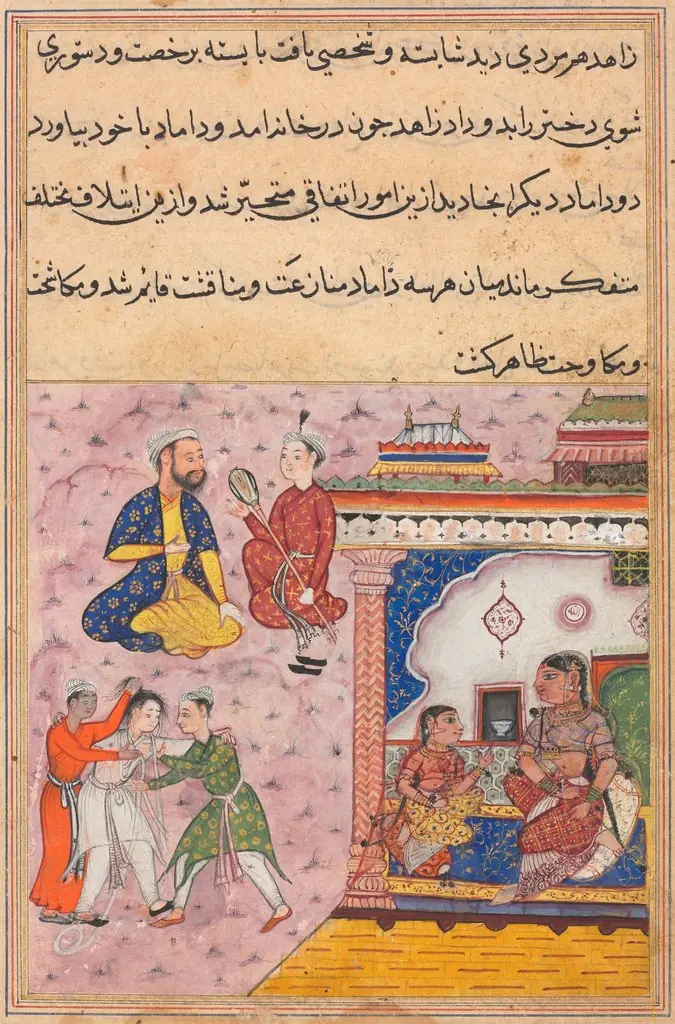 Three suitors fight amongst themselves for the hand of the devotee’s daughter, from a Tuti-nama (Tales of a Parrot): Twentieth Night