Artwork
Armed Three-Master with Daedalus and Icarus in the Sky
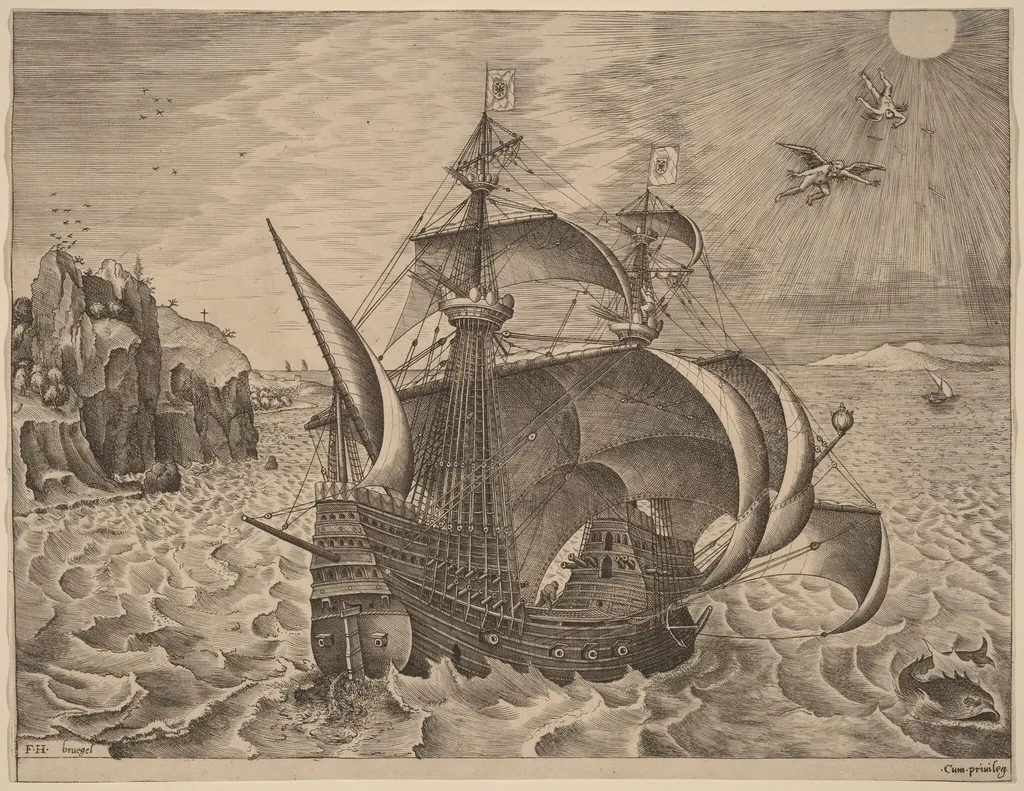
Armed Three-Master with Daedalus and Icarus in the Sky is an ink print by the Renaissance artist Frans Huys. It dates from 1542 and is held in the collection of the National Gallery of Art.
About this work
Overview
The composition merges maritime disaster with mythological imagery, placing the figures of Daedalus and Icarus in the upper sky.
Created in 1542 by Frans Huys, this engraving on laid paper depicts a merchant vessel overwhelmed by a violent sea. The composition merges maritime disaster with mythological imagery, placing the figures of Daedalus and Icarus in the upper sky. Fine, precise lines define the ship’s rigging, the turbulent waves, and the atmospheric clouds, demonstrating the technical precision characteristic of 16th-century Northern European printmaking.
Subject & Meaning
The sinking ship symbolizes human vulnerability to nature’s forces, while the mythological figures above—Daedalus, the inventor, and his son Icarus, who flew too close to the sun—introduce themes of ambition and downfall. The birdlike creature may represent the consequences of overreaching. Together, the scenes suggest a moral parallel: earthly endeavors, like flight, risk destruction when hubris overrides caution.
Technique & Style
Huys employed fine, controlled engraving lines to render texture and movement: the ship’s wooden planks, tangled ropes, and churning waves are defined by dense cross-hatching and delicate etched strokes. The sky contrasts sharply, with lighter areas around the sun and darker, swirling clouds above. The layered composition—ship below, myth above—creates spatial depth, typical of Northern Renaissance prints that fused realism with allegory.
History & Provenance
The print was produced in the Low Countries during a period of flourishing print culture, where engravings circulated as both art and information. Though specific early ownership records are sparse, similar works by Huys appear in collections linked to maritime merchants and humanist scholars. Its survival suggests it was valued for its technical skill and layered symbolism, rather than as a mere decorative piece.
Context
In mid-16th-century Europe, maritime trade expanded rapidly, making shipwrecks both common and culturally resonant. At the same time, classical myths were being revived in art and literature. Huys’s work reflects this convergence: a contemporary naval scene is framed by ancient myth, appealing to an audience familiar with both the dangers of seafaring and the moral lessons of Ovid’s Metamorphoses.
Legacy
Though Huys is less known than contemporaries like Dürer, this engraving exemplifies how Northern artists used printmaking to explore complex narratives. The fusion of naturalism and allegory influenced later generations of printmakers who sought to encode moral or philosophical ideas within detailed, realistic scenes. It remains a rare example of mythological imagery integrated into a maritime setting of its time.
Artist & collection


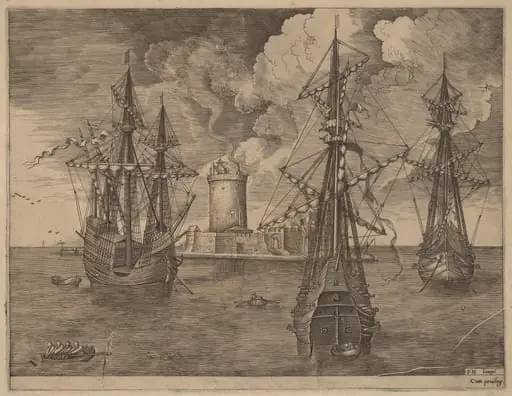 Four-Master (Left) and Two Three-Masters Ancored Near a Fortified Island with a Lighthouse
 Armed Three-Master with Daedalus and Icarus in the Sky
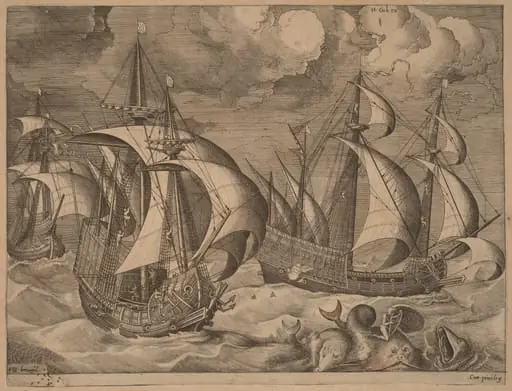 Three Caravels in a Rising Squall with Adrion on a Dolphin
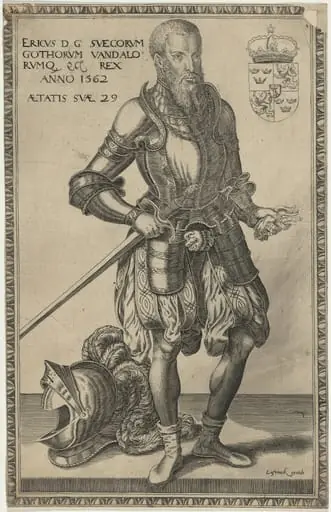 Eric XIV, King of Sweden
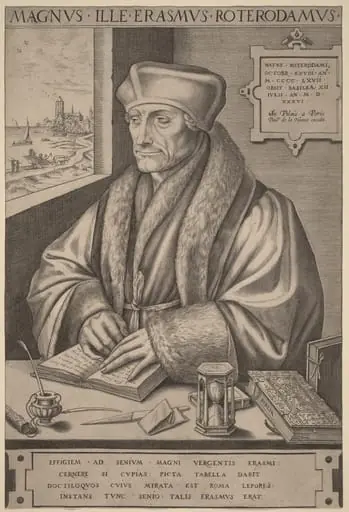 Erasmus of Rotterdam
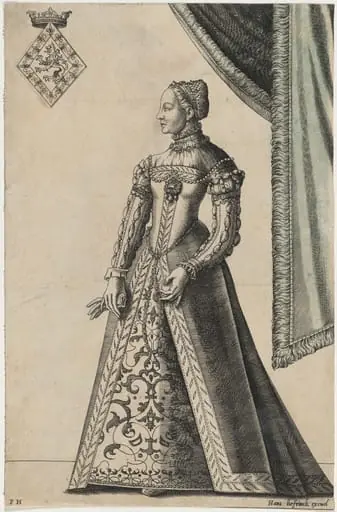 Mary, Queen of Scots
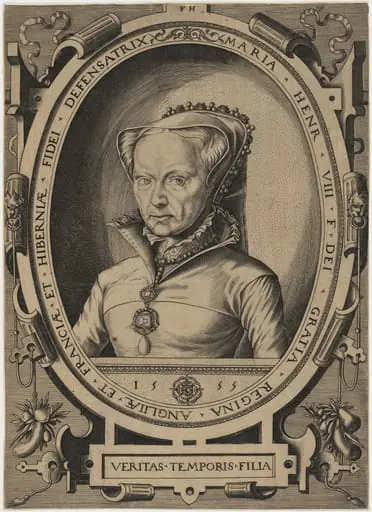 Queen Mary of England
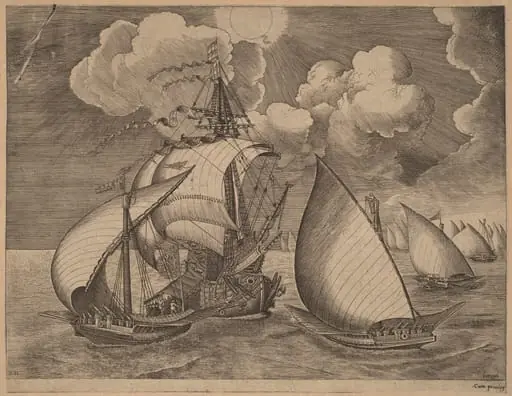 A Fleet of Galleys Escorted by a Caravel
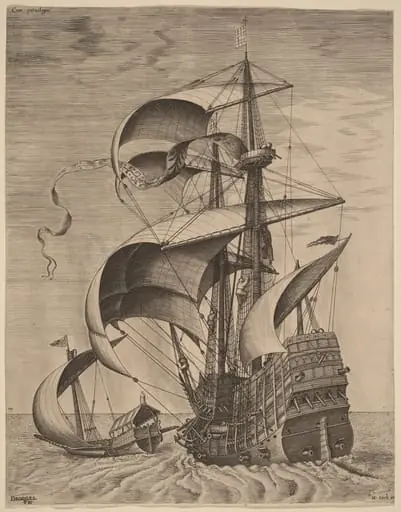 Armed Three-Master on the Open Sea, Accompanied by a Galley
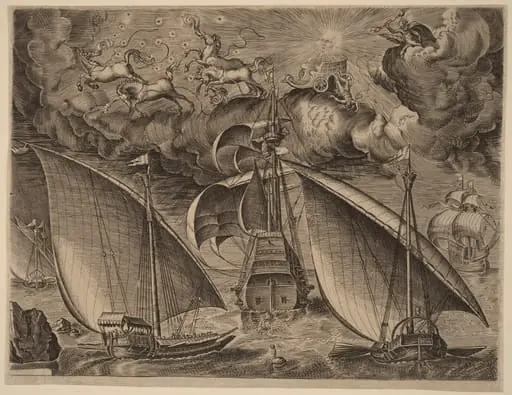 Two Galleys behind an Armed Three-Master with Phaethon and Jupiter in the Sky
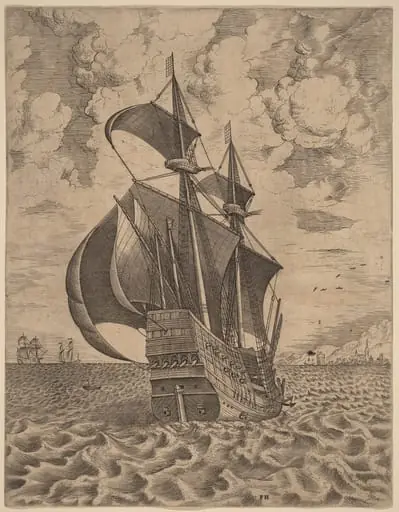 Armed Four-Master Sailing towards a Port
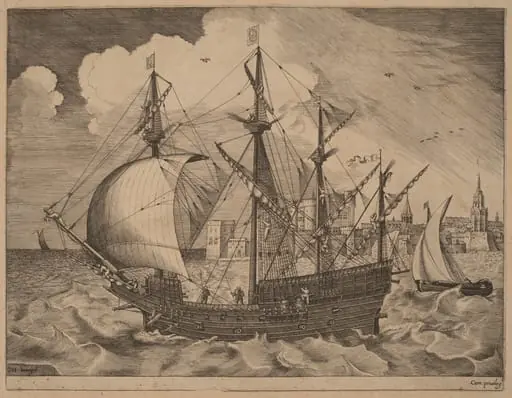 Armed Four-Master Putting Out to Sea
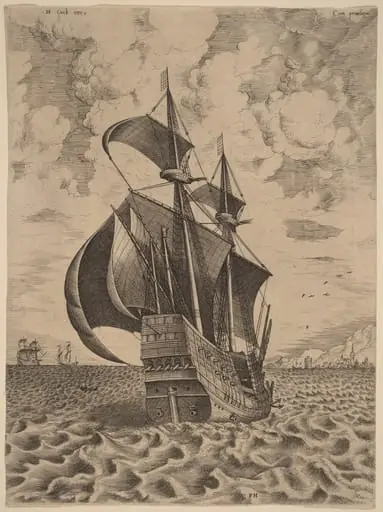 Armed Four-Master Sailing towards a Port
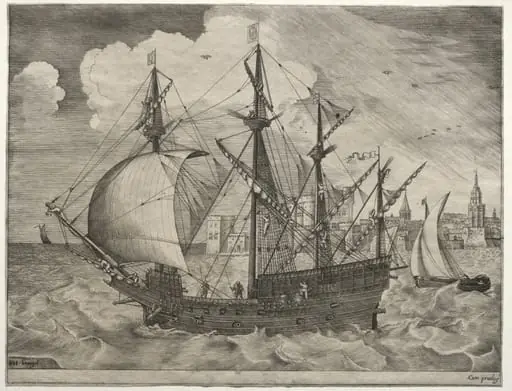 Sailing Vessels: Armed Four-Master Putting Out to Sea
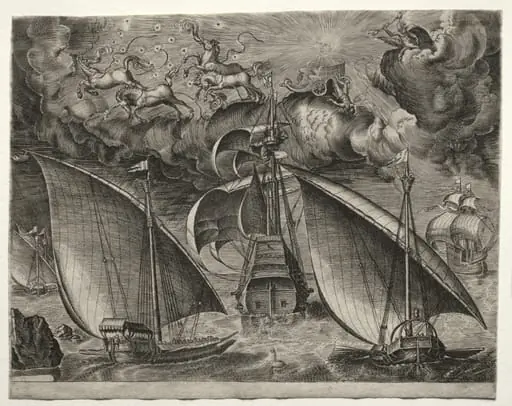 Sailing Vessels: Two Galleys Sailing Behind an Armed Three-Master with Phaeton and Jupiter in the Sky
 Armed Three-Master Anchored near a City
 Armed Three-Master Anchored Near a City
 Two Three-Master Ships off a Coastline