Artwork
Ritual pentru încolțirea ierbii
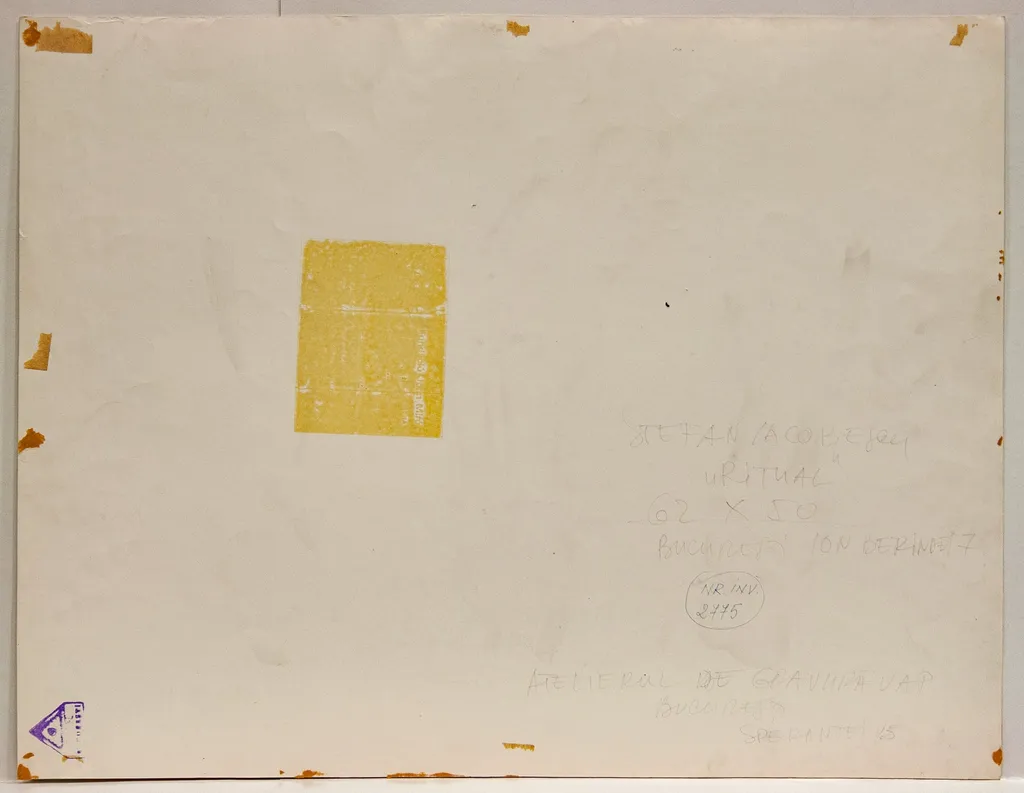
Ritual pentru încolțirea ierbii is a print by Ștefan Iacobescu. It is held in the collection of the Gavrila Simion Eco-Museum Research Institute Tulcea.
About this work
Overview
The work’s meaning hinges on its title, which evokes a ceremonial act tied to the sprouting of grass, transforming simplicity into a symbolic gesture.
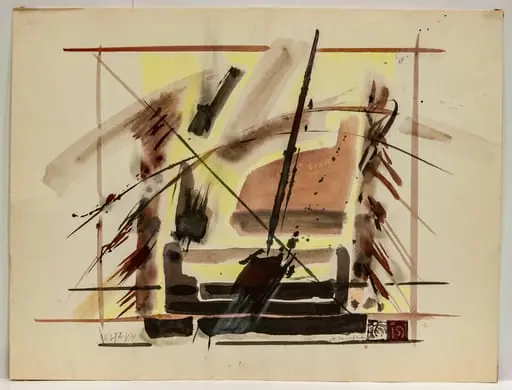
A small, minimally marked print titled 'Ritual pentru încolțirea ierbii' presents a single yellow rectangle on an otherwise blank surface. The color is faded, the edges irregular, suggesting prolonged handling or exposure. Sparse handwritten notes in the margins include dimensions and a location, but the image offers little visual detail. The work’s meaning hinges on its title, which evokes a ceremonial act tied to the sprouting of grass, transforming simplicity into a symbolic gesture.
Subject & Meaning
The title suggests a ritual meant to encourage the growth of grass, possibly rooted in folk or agricultural traditions. The lone yellow shape may symbolize a seed, a sun, or a marked offering—its emptiness inviting interpretation rather than depicting a scene. The absence of imagery emphasizes the act of ritual itself, positioning the viewer to contemplate unseen processes: renewal, patience, or the quiet persistence of nature.
Technique & Style
The work is rendered in a subdued, almost accidental aesthetic: a flat, worn yellow form applied with no clear tool, likely by hand. The paper bears signs of age and use—fading, creasing, marginal scribbles. There is no attempt at composition or detail; the style is deliberately reductive. This minimalism aligns with practices where the object serves as a vessel for meaning, not a representation of it.
History & Provenance
The print’s origin is undocumented beyond marginal notations referencing size and place. Its condition suggests it was carried, stored, or used over time, possibly in a domestic or communal setting. Its current association with the Museum of Ethnography implies it was collected as an artifact of vernacular belief, though its maker and exact context remain unknown.
Context
In rural Eastern European traditions, rituals for soil fertility and plant growth were often performed with symbolic objects, chants, or marked surfaces. This print may have functioned as a talisman or record of such a practice—its simplicity reflecting the everyday nature of these customs. The lack of elaborate imagery aligns with oral and performative traditions where meaning resided in action, not depiction.
Legacy
As a fragment preserved in an ethnographic collection, the print endures not for its visual impact but for its quiet testimony to overlooked rituals. It invites reflection on how meaning is embedded in humble, transient objects. Its preservation signals an interest in the intangible—customs that left little trace beyond a faded rectangle and a few handwritten words.
Artist & collection
Artist
Ștefan Iacobescu’s prints and mixed works blend quiet observation with playful rhythm.
Museum
Gavrila Simion Eco-Museum Research Institute Tulcea
Continue through works from the same source collection.

 Cabana Calica
 S 25 - Pe Dunăre la Sulina (Ponton și vapor pierdut în ceață pe Dunăre)
 Înserare pe Dunăre
 Păpușarii
 Mila 23
 S 35 - Peisaj la Sulina (Maluri de Dunăre la răsărit)
 Compoziție
 Balcic
 Întreprinderea de prelucrarea marmurei Tulcea
 S 28 - Peisaj la Sulina (Intrare de casă cu flori)
 Peisaj
 La noi are doar 1/2 normă