Artwork
Upright Ornament with Eight Naked Men
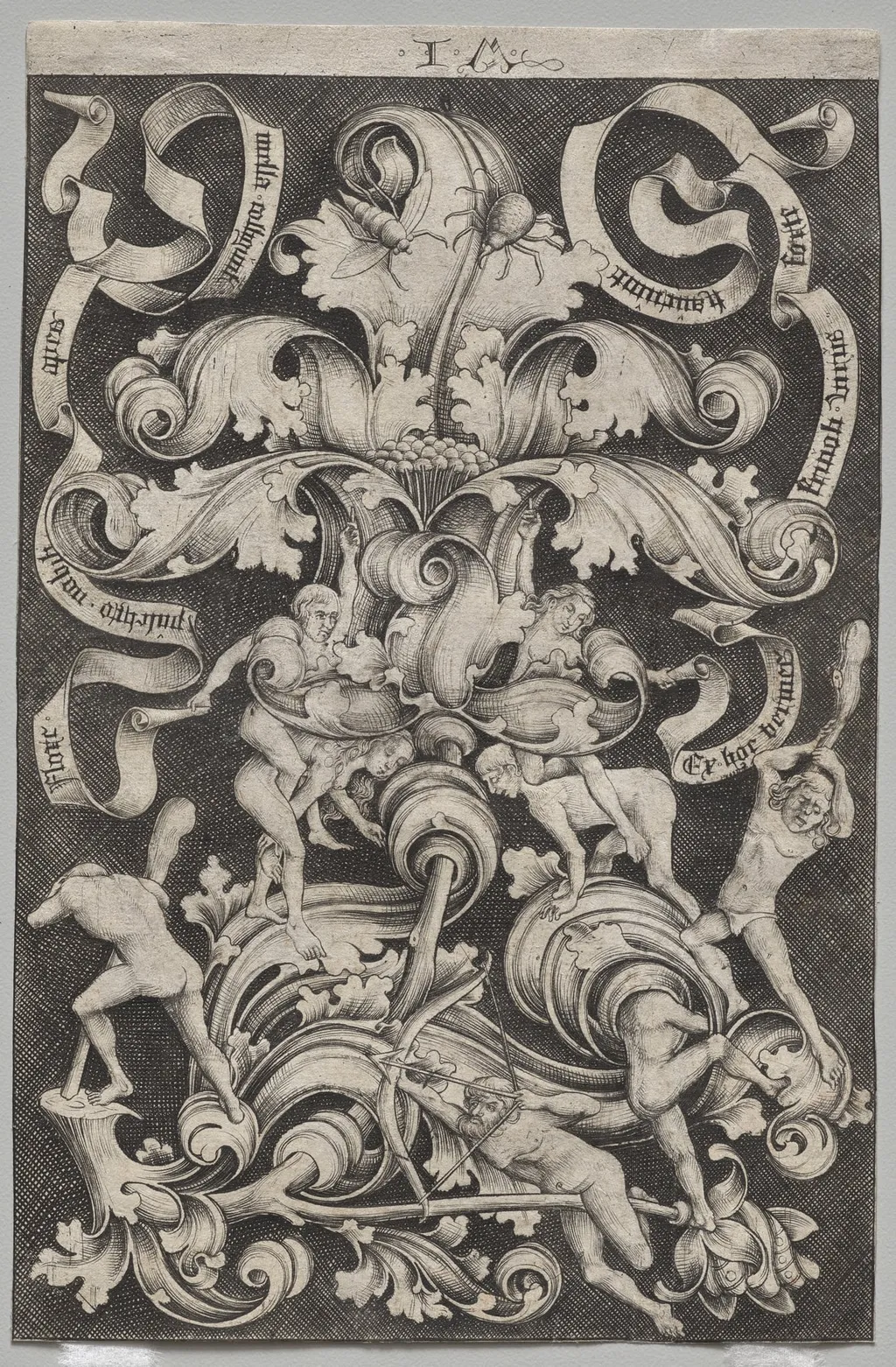
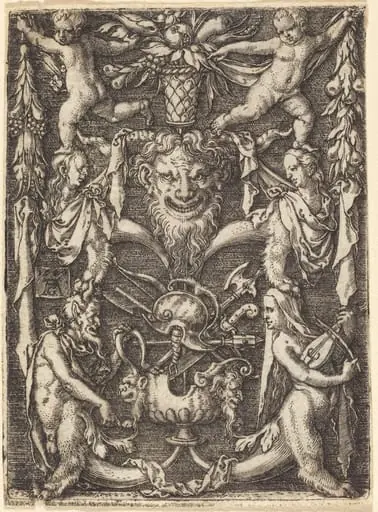
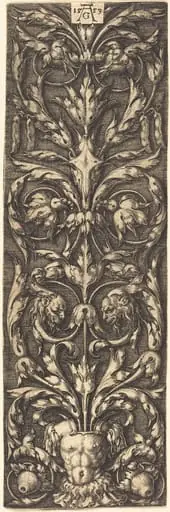
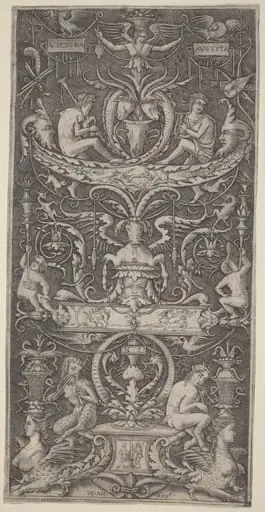
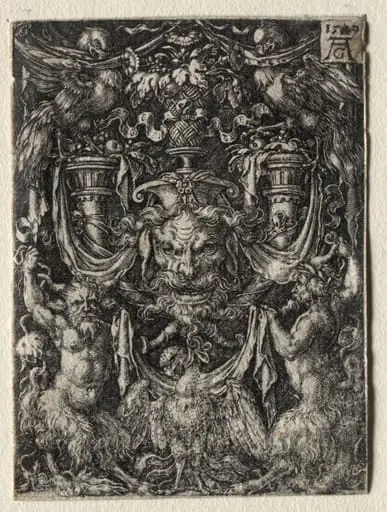
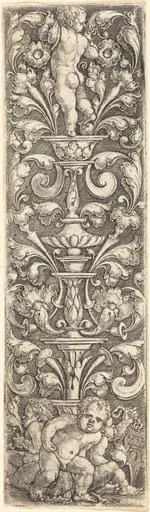
Upright Ornament with Eight Naked Men is a print by the Renaissance artist Israhel van Meckenem. It dates from 1495 and is held in the collection of the Cleveland Museum of Art.
About this work
Overview
The composition is entirely composed of engraved lines, with no color or tonal gradation, relying on contrast and density to create visual impact.
Created around 1495 by Israhel van Meckenem, a German engraver and goldsmith, this vertical print is one of over six hundred works he produced during his career. It exemplifies the Northern Renaissance emphasis on intricate detail and technical precision in printmaking. The composition is entirely composed of engraved lines, with no color or tonal gradation, relying on contrast and density to create visual impact.
Subject & Meaning
Eight nude male figures are interwoven with dense foliage, vines, and abstract swirls, forming a decorative pattern rather than a narrative scene. Their poses suggest movement or support, as if sustaining the ornamental structure. The figures lack individual identity or mythological context, implying the work’s purpose was ornamental—perhaps intended as a model for decorative arts or a display of technical skill.
Technique & Style
Van Meckenem used fine, controlled engraving lines to render every element with uniform precision. The background is uniformly black, achieved by densely packed incised lines, which sharply isolates the white, uninked figures and foliage. The composition is densely packed, with no empty space; even small faces and hidden forms emerge within the vegetation, demonstrating meticulous craftsmanship and a fascination with surface complexity.
History & Provenance
The print was made during the height of van Meckenem’s career, when he was among the most productive engravers in Europe. His workshop produced numerous copies and adaptations of works by other artists, often for commercial distribution. This piece likely circulated as a pattern sheet, used by artisans in metalwork, textiles, or architecture, reflecting the era’s demand for reusable decorative motifs.
Context
In late 15th-century Northern Europe, engraved ornaments were widely used in craft and design, bridging fine art and applied arts. Van Meckenem’s work reflects the period’s interest in classical themes reinterpreted through local traditions. The nude figures, though stylized, echo Renaissance humanism, while the ornamental structure aligns with Gothic and early Mannerist decorative sensibilities common in German artistic circles.
Legacy
Van Meckenem’s prints, including this one, influenced later generations of engravers and designers through their widespread circulation. His ability to compress complex forms into compact, repeatable patterns helped standardize ornamental vocabularies in Northern Europe. Though not widely studied today, his work remains a key example of how printmaking functioned as both art and industrial design in the pre-industrial era.
Artist & collection
Artist
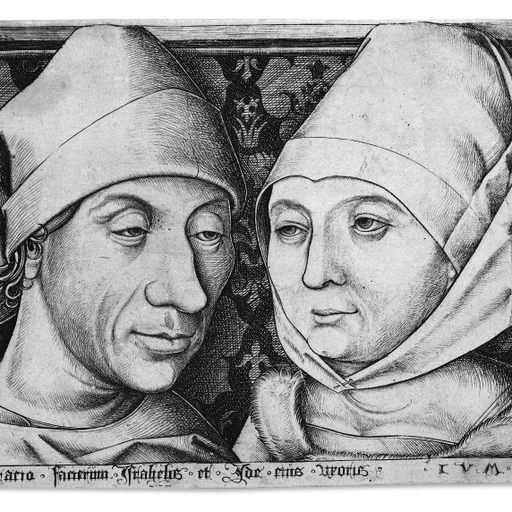
Israhel van Meckenem (c. 1445 – 10 November 1503), also known as Israhel van Meckenem the Younger, was a German printmaker and goldsmith, perhaps of a Dutch family origin. He was the most prolific engraver of the…