Artwork
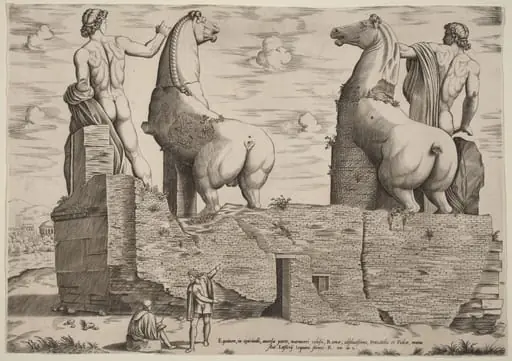
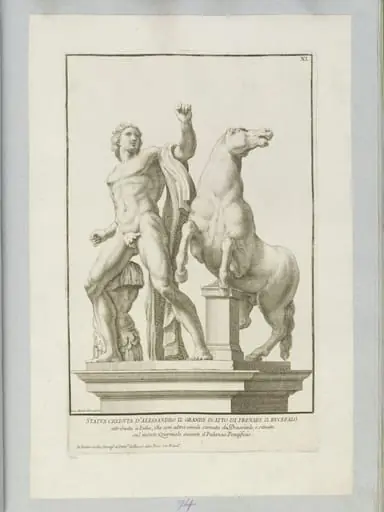
The Dioscuri [Frontal View]
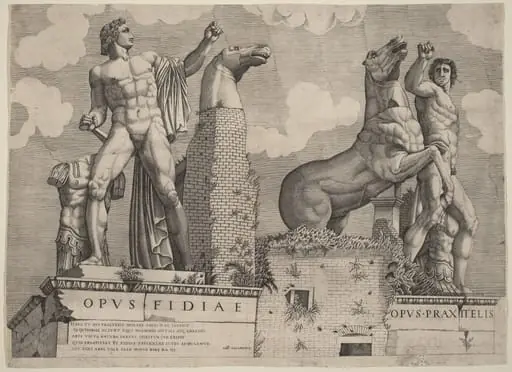
![The Dioscuri [Frontal View], by Italian 16th Century, ink, 1546](https://artifactworldgallery.com/img/italian-16th-century--the-dioscuri-frontal-view--240168a96b76ef0b-w1024.webp)
The Dioscuri [Frontal View] is an ink print by the Renaissance artist Italian 16th Century. It dates from 1546 and is held in the collection of the National Gallery of Art.
About this work
Overview
The Dioscuri [Frontal View] is a 16th-century Italian engraving by Antonio Lafreri, portraying the mythical twin brothers Castor and Pollux. The work depicts the duo in ancient attire, standing side by side, with distinguishing attributes: one holds a spear, the other a palm branch.
Subject & Meaning
Castor and Pollux, known as the Dioscuri, are mythological figures associated with horses and the protection of sailors. Their representation in this engraving highlights their revered status in Renaissance cultural heritage, also echoed in sculptural form on Michelangelo's Capitoline Hill steps in Rome.
Technique & Style
Lafreri employs cross-hatching, a technique utilizing layered lines to achieve depth and texture, accentuating the muscularity and armor details of the twins. This method creates a stark, high-contrast visual effect, characteristic of detailed Renaissance engravings.
History & Provenance
Created in the 16th century, specific historical ownership or exhibition details of 'The Dioscuri [Frontal View]' are not provided in the available information.
Context
This engraving reflects the Renaissance fascination with classical mythology and the technical advancements in printmaking during the period, allowing for widespread dissemination of such images.
Legacy
While specific lasting impacts of 'The Dioscuri [Frontal View]' on subsequent art are not detailed, it contributes to the broader legacy of Lafreri's engravings in capturing and popularizing mythological themes of the Renaissance.
Artist & collection

Artist
A 16th-century Italian sculptor left us small bronze works in dark brown and gold.




![The Dioscuri [Dorsal View], by Italian 16th Century](https://artifactworldgallery.com/img/italian-16th-century--the-dioscuri-dorsal-view--85eaf25b17a4dcfe-w320.webp)