Artwork
Festa Nazionale (National Holiday)
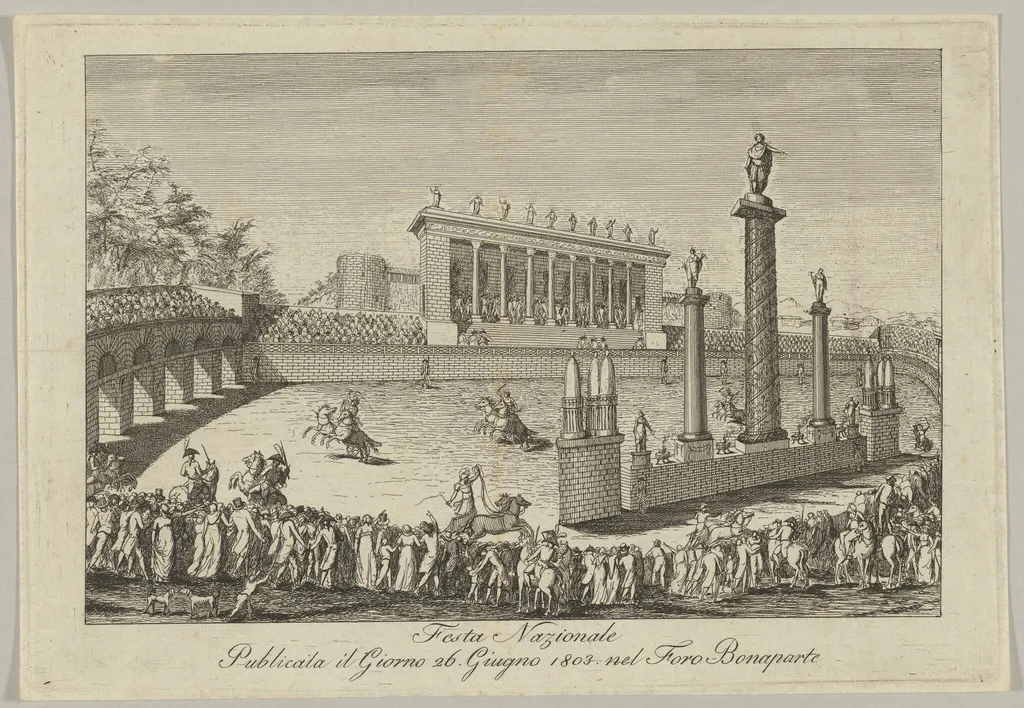
Festa Nazionale (National Holiday) is an ink print by the Romanticist artist Italian 19th Century. It dates from 1803 and is held in the collection of the National Gallery of Art. Festa Nazionale is an etching on laid paper depicting a lively public gathering in an urban setting.
About this work
People in old-fashioned clothes stand, sit, and cheer while musicians play and riders on horseback move through the scene.
This etching shows a crowded outdoor celebration with a big stage and columns in the background. People in old-fashioned clothes stand, sit, and cheer while musicians play and riders on horseback move through the scene. The stage has statues on top, and the whole setting looks like a mix of a parade and a big public event.
Notice the text at the bottom: it says this was published on June 26, 1803, in a place called the *Foro Bonaparte*—that’s the only clue here about when or where this happened.
If you like this busy, dramatic style, look up etching to see how artists made detailed prints like this.
Overview
Festa Nazionale is an etching on laid paper depicting a lively public gathering in an urban setting. The scene is filled with figures in early 19th-century attire, musicians, equestrians, and architectural elements including columns and a raised stage adorned with statues. Published on June 26, 1803, at the Foro Bonaparte, the print captures a moment of civic festivity, likely tied to a state-sponsored celebration during the Napoleonic era in Italy.
Subject & Meaning
The print portrays a communal event blending parade, ceremony, and public spectacle. The presence of a stage with statues suggests a symbolic or political dimension, possibly honoring state ideals or Napoleonic authority. Crowds are shown engaging actively—cheering, observing, and moving through the space—indicating a deliberate effort to visualize collective participation in official festivities of the time.
Technique & Style
Executed as an etching, the work employs fine, incised lines to render dense detail across a complex composition. The artist uses varied line weight and cross-hatching to suggest depth, texture, and movement among the numerous figures and architectural forms. The crowded, dynamic arrangement reflects a tradition of topographical prints that documented public life with precision and narrative energy.
History & Provenance
The print was issued on June 26, 1803, at the Foro Bonaparte, a site in Milan associated with Napoleonic urban projects. Its publication date places it within the period of French administrative control in northern Italy. No artist is credited, and its original commission remains undocumented, though its subject aligns with state-promoted public events of the era.
Context
During the early 1800s, the French administration in Italy frequently organized public celebrations to reinforce political legitimacy and civic unity. Events held at sites like the Foro Bonaparte were designed to merge Roman imperial symbolism with contemporary governance. This print likely served as a visual record or propagandistic artifact of such efforts, capturing the spectacle of state-sponsored festivity.
Legacy
Festa Nazionale remains a rare visual document of public life under Napoleonic rule in Lombardy. Though not widely reproduced or studied, it contributes to the understanding of how civic rituals were visually articulated in print culture. Its detailed depiction offers insight into the intersection of architecture, performance, and political symbolism in early 19th-century Italy.
Artist & collection
Artist
This artist made prints and sculpture in 19th-century Italy, blending old techniques with new.

 Il Greco in Troia: Plate 3
 The Seconda Macchina for the Chinea of 1761: A Magnificent Theater
 Il Solimano, Act II
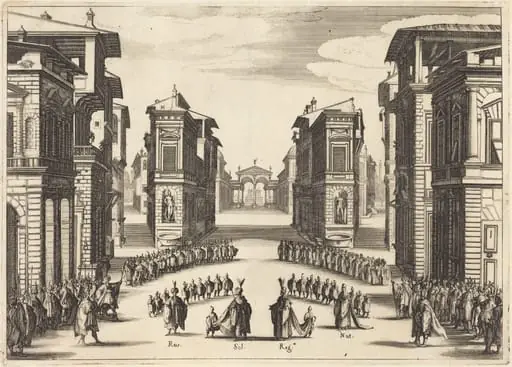 Il Solimano, Act II
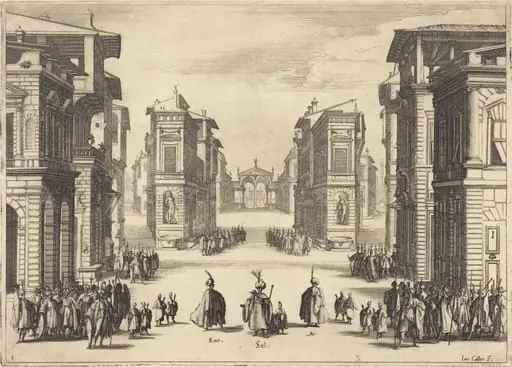 Il Solimano, Act I
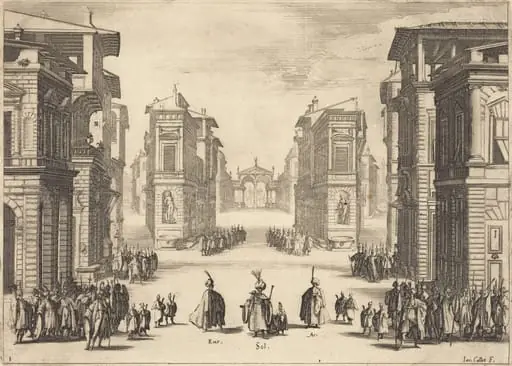 Il Solimano, Act I
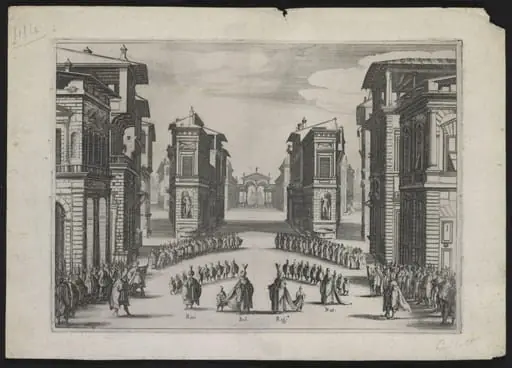 H Beard Print Collection
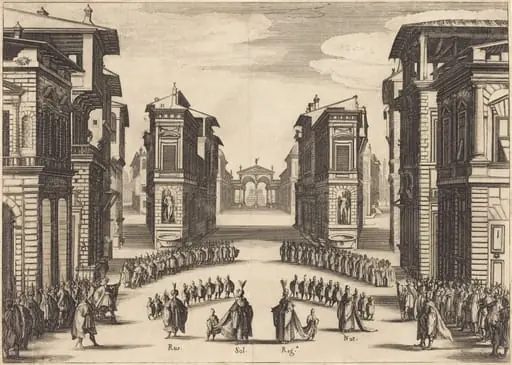 Il Solimano, Act II
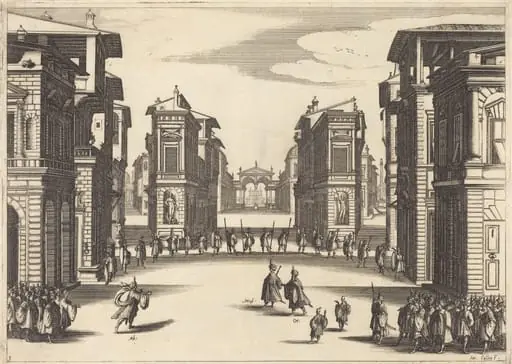 Il Solimano, Act III
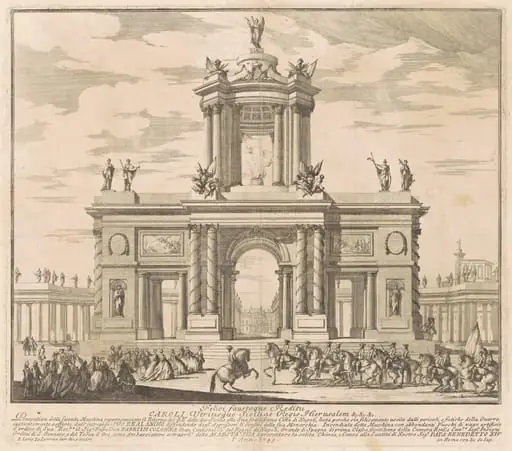 The Seconda Macchina for the Chinea of 1745: Triumphal Arch for the Return of King Charles of Bourbon to Naples
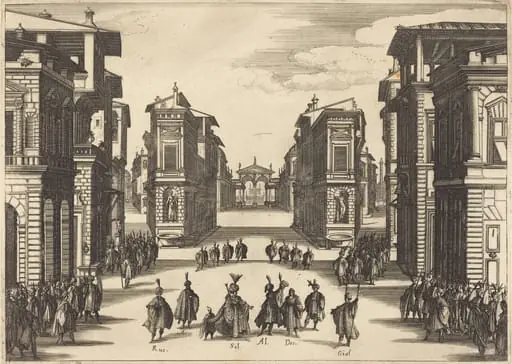 Il Solimano, Act IV
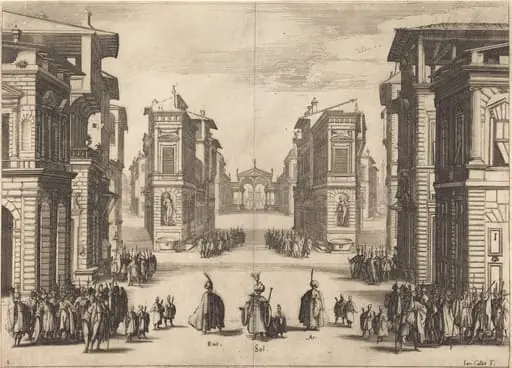 Il Solimano, Act I