Artwork
View across the Moat towards the Thomasschule and the Thomaskirche in Leipzig
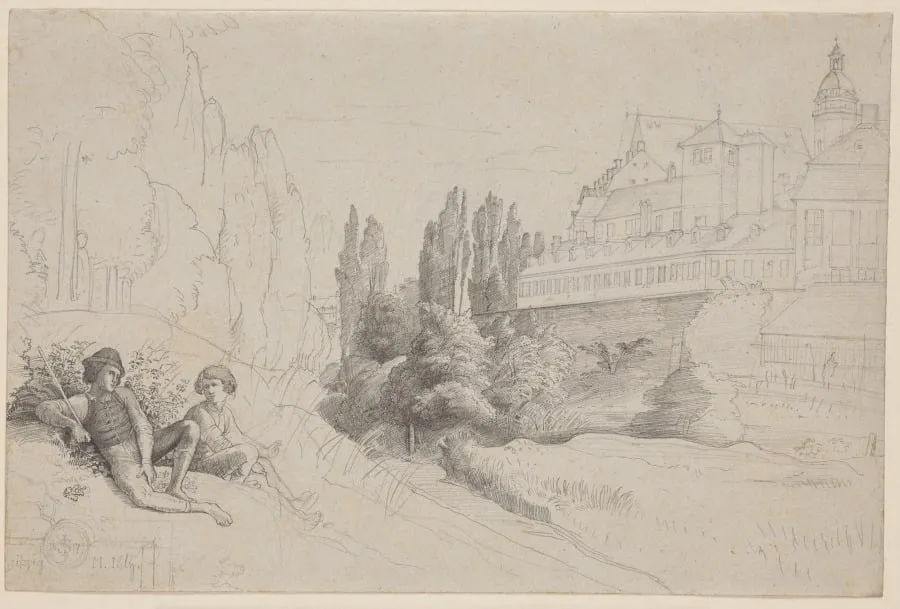
View across the Moat towards the Thomasschule and the Thomaskirche in Leipzig is a drawing by the Romanticist artist Julius Schnorr von Carolsfeld. It dates from 1817 and is held in the collection of the Cleveland Museum of Art.
About this work
The school in the picture is the oldest German-language school in Europe, and the church is where Bach worked.
You see a quiet city scene: a moat, a school, and a church tower in Leipzig, Germany. The buildings are drawn in careful, thin lines, almost like a sketch.
This was made in 1817 by an artist on his way to Rome to join a group called the Nazarenes. They wanted art to be simple and religious, like paintings from the 1400s. The school in the picture is the oldest German-language school in Europe, and the church is where Bach worked.
Look up the subject germany, 19th century to see more of these quiet city views.
Overview
The 1817 drawing presents a tranquil Leipzig vista, foregrounded by a shallow moat that frames the historic Thomasschule and the towering spire of the Thomaskirche. Rendered in fine, delicate lines, the composition balances open sky with the modest urban architecture, inviting a measured contemplation of the city’s enduring landmarks.
Subject & Meaning
The work records two emblematic institutions: the Thomasschule, recognized as Europe’s oldest German‑language school and the artist’s own alma mater, and the Thomaskirche, later famed as Johann Sebastian Bach’s cantorial post in the 18th century. By foregrounding these sites, the drawing underscores Leipzig’s cultural and educational heritage.
Technique & Style
Executed with a sharpened graphite pencil reinforced by pen and ink, the artist alternates loosely sketched atmospheric areas with sections of meticulous detail. This juxtaposition reflects the Nazarene preference for a clear, devotional aesthetic while retaining the spontaneity of a travel sketch.
History & Provenance
Created during the artist’s journey from his native Leipzig to Rome, the drawing marks his transitional phase before joining the Nazarene circle. A small self‑portrait appears in the lower left, identifying the hand that produced the work.
Context
The Nazarene movement, active in the early 19th century, sought inspiration from early Northern Renaissance art, valuing simplicity and spiritual clarity. This drawing embodies those ideals, translating the movement’s reverence for medieval models into a contemporary urban scene.
Artist & collection
Artist
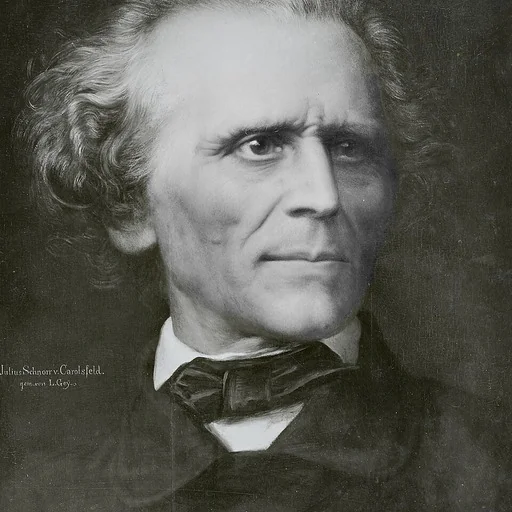
Julius Schnorr von Carolsfeld (26 March 1794 – 24 May 1872) (German pronunciation: ) was a German painter, chiefly of Biblical subjects.

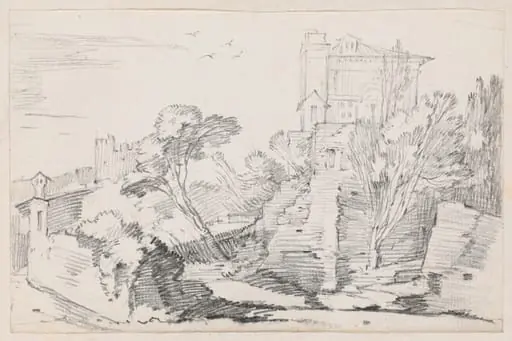 Casino Farnese on the Palatine Hill, Rome
 The Woman and Tambourine
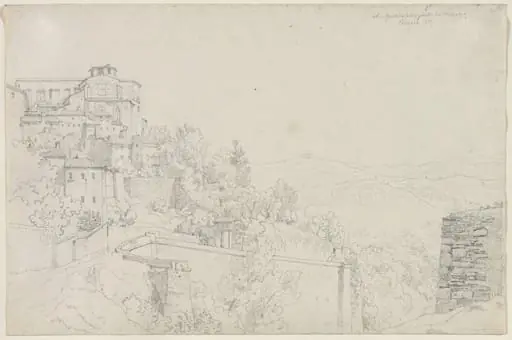 Saint Agostino from Bulagajo, Perugia (San Agostino dalla parte del Bulagajo, Perugia)
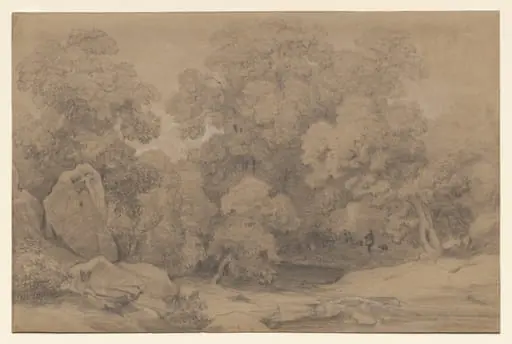 Landscape
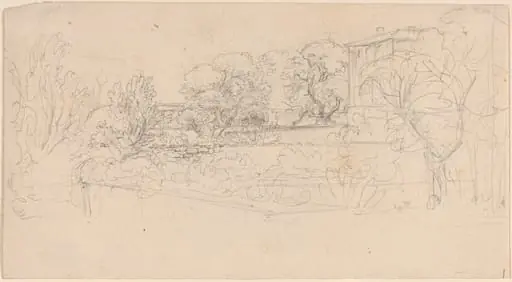 A Terraced Garden by a Villa
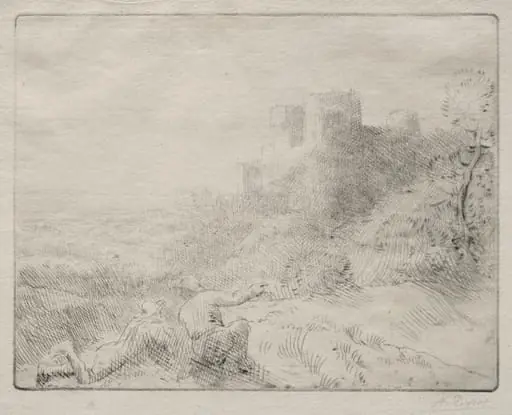 An Old Chateau
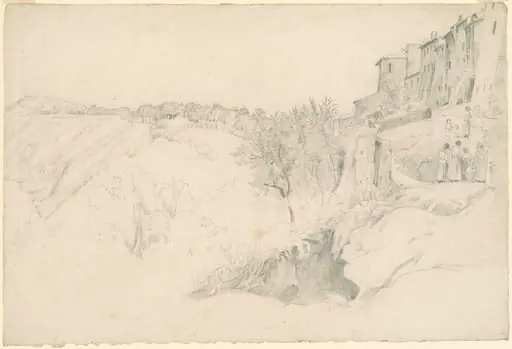 Hillside with Houses and Figures
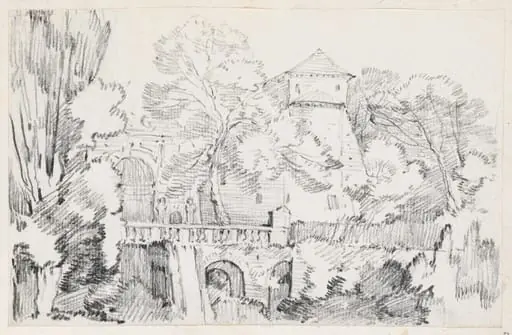 The Water Organ in the Gardens of the Villa d'Este, Tivoli
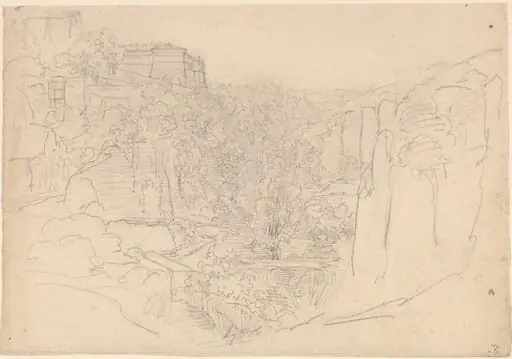 Fortified Castle Above a Narrow Valley
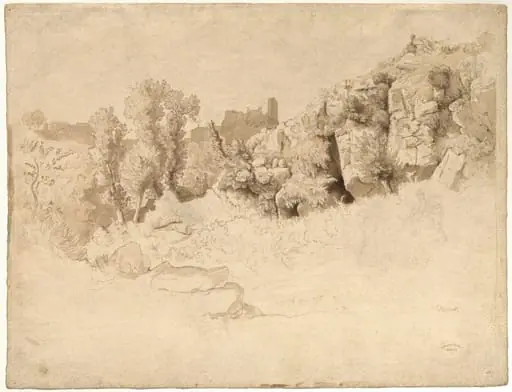 Rock Formations near Olevano
 Landscape with Fortification Between Marino and Frascati
 Sketch of landscape with trees