Artwork
Bohemian waxwing
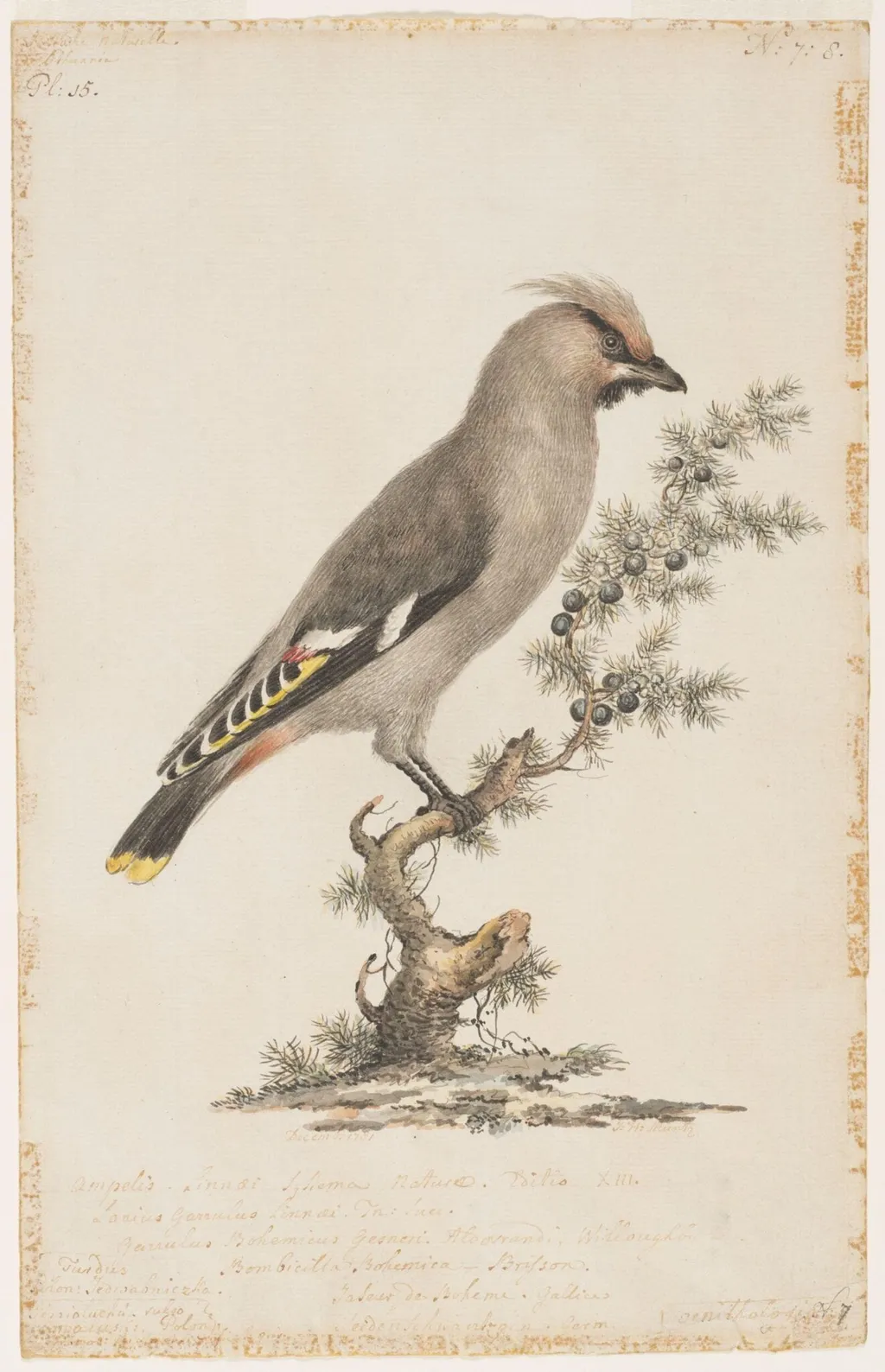
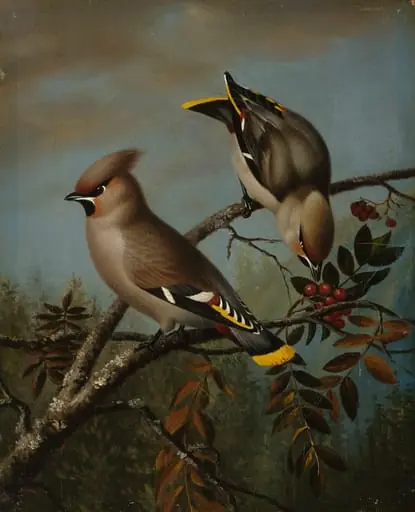
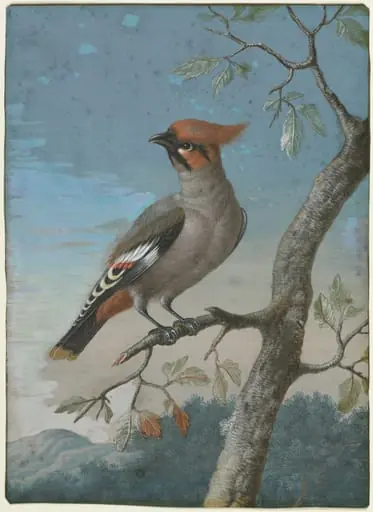
Bohemian waxwing is a watercolor work on paper by the Rococo painting artist Johann Heinrich Müntz. It dates from 1781 and is held in the collection of the Victoria and Albert Museum.
About this work
This bird sits on a bare branch, its feathers gray and brown with a flash of yellow under its tail.
This bird sits on a bare branch, its feathers gray and brown with a flash of yellow under its tail. Its crest is fluffy, and its beak is sharp. Nearby, a sprig of green leaves holds dark berries. The ground below is just a few scattered rocks.
The artist wrote the title in Latin at the bottom—*Bohemian waxwing*—and dated it December 1781. The brushwork is soft, with no harsh lines.
Look up Müntz, Johann Heinrich to see more of his careful bird paintings.
Overview
A watercolor and ink study by Johann Heinrich Müntz, completed in December 1781, portrays a Bohemian waxwing with meticulous attention to detail. The work is signed and annotated with multiple scientific and vernacular names drawn from 18th-century ornithological texts. Rendered in soft, layered washes, the bird is depicted perched on a bare branch amid a sparse setting of berries and rocks, reflecting the precision typical of naturalist illustration of the period.
Subject & Meaning
The Bohemian waxwing is shown in quiet repose, its distinctive crest and yellow-tipped tail feathers rendered with quiet accuracy. The inclusion of berries and minimal foliage suggests its foraging habits, while the Latin title and multilingual annotations emphasize the bird’s role as a subject of scientific classification. This image functions less as artistic expression and more as a visual record, aligning with Enlightenment-era efforts to catalog nature systematically.
Technique & Style
Müntz employed delicate watercolor washes and fine ink lines to capture the bird’s soft plumage without harsh contours. The gray-brown feathers are built up in translucent layers, allowing subtle variations in tone to suggest texture. The background is intentionally minimal—bare branch, scattered rocks, and a few berries—directing focus entirely to the bird’s form. The absence of dramatic lighting or perspective reinforces the work’s documentary purpose.
History & Provenance
Created in late 1781, the watercolor reflects Müntz’s engagement with contemporary natural history scholarship. His annotations reference key figures like Linnaeus, Buffon, and Willughby, indicating direct consultation of their published works. While the work’s immediate provenance is undocumented, its scholarly annotations and precise execution suggest it was produced for a scientific audience, possibly as part of a larger collection of avian studies.
Context
In the late 18th century, naturalists across Europe were compiling detailed visual records of species as taxonomy became increasingly formalized. Müntz’s work aligns with this movement, where artists served as intermediaries between scientific texts and observable reality. His rendering, though modest in scale, contributes to a broader effort to standardize the visual representation of birds, bridging classical references with emerging Linnaean classification.
Legacy
Though not widely exhibited, Müntz’s watercolor remains a quiet example of 18th-century naturalist illustration. Its value lies in its fidelity to observed detail and its integration of contemporary scientific nomenclature. It offers insight into how artists contributed to biological documentation before the advent of photography, preserving a snapshot of avian identification practices at a pivotal moment in ornithological history.
Artist & collection

Artist
Johann Heinrich Müntz (1727–1798) was an Alsatian-Swiss painter and architect, known when working in England as John Henry Muntz.