Artwork
Saint Mark
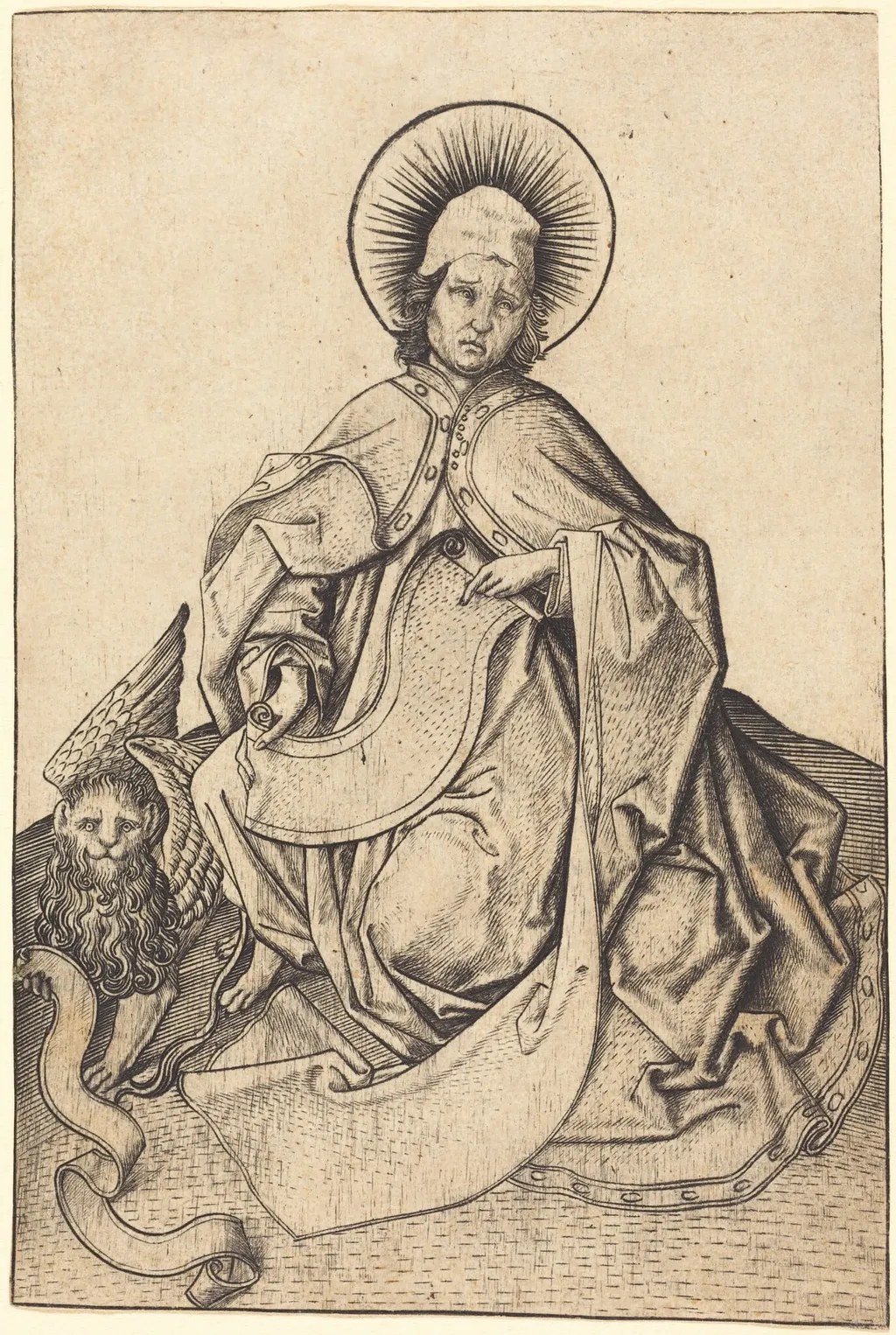
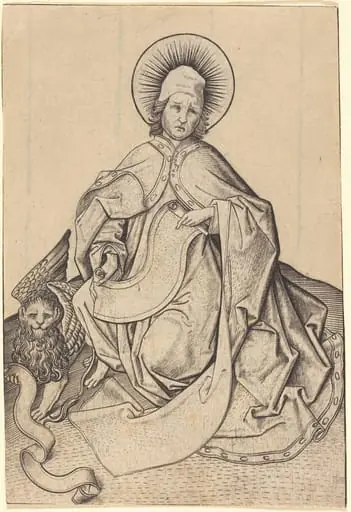
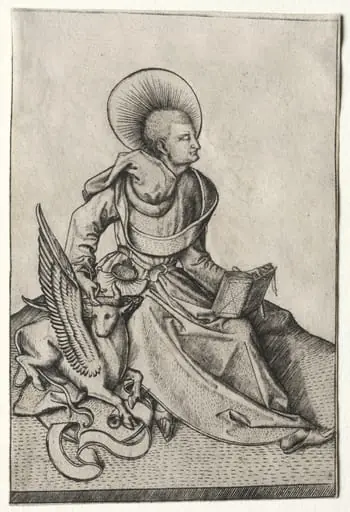
Saint Mark is an ink print by the Renaissance artist Master E.S.. It dates from 1462 and is held in the collection of the National Gallery of Art.
About this work
Overview
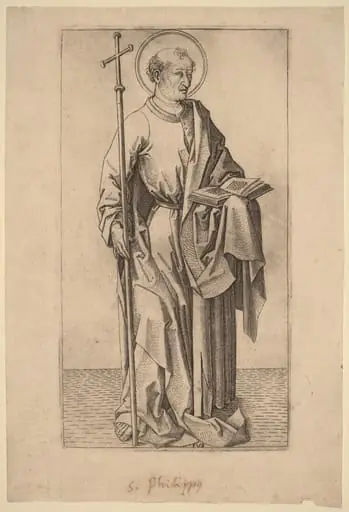
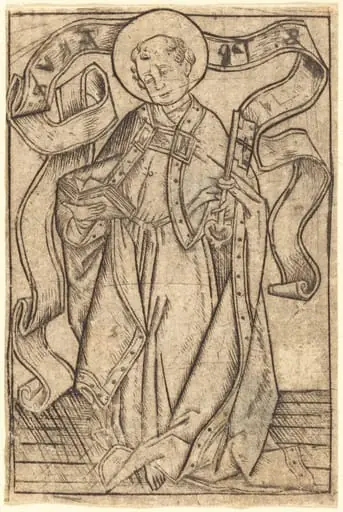
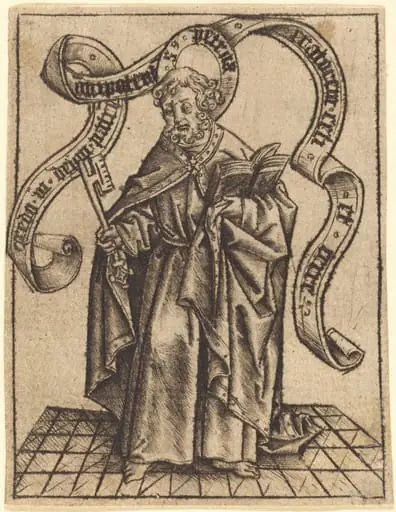
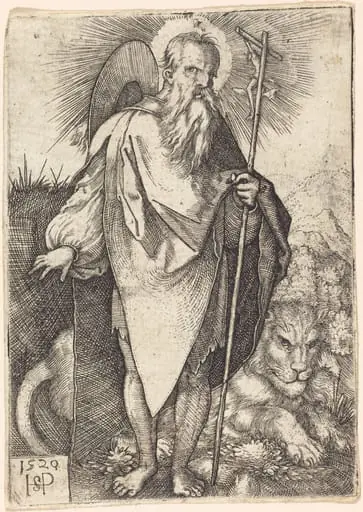
The engraving titled Saint Mark, executed on laid paper around 1462, presents the evangelist seated on a throne. He holds an open book in one hand and a scroll in the other, his head crowned with a halo. A crouching lion, his traditional attribute, rests at his feet. The composition is set against an unadorned background, allowing the intricate line work to dominate the visual field.
Subject & Meaning
The figure represents the apostle Mark, identified by the lion—a symbol long associated with his gospel. The open book and scroll emphasize his role as author of a New Testament text, while the halo denotes sanctity. The serene posture and attentive lion convey a sense of learned authority and divine inspiration, typical of devotional images intended for personal contemplation.
Technique & Style
The print employs fine cross‑hatching, a network of closely spaced parallel lines, to model the folds of the robe, the lion’s fur, and subtle shadows.
The print employs fine cross‑hatching, a network of closely spaced parallel lines, to model the folds of the robe, the lion’s fur, and subtle shadows. This method, common among early German printmakers, creates a delicate tonal gradation despite the monochrome medium. The precision of the line work reflects the artist’s background in metalwork, translating the exacting standards of goldsmithing to paper.
History & Provenance
Attributed to the anonymous German engraver known by the monogram E. S., the work belongs to the mid‑15th‑century German tradition of old master prints. E. S. is recognized as the first prominent figure in that lineage, and his signature appears on many surviving plates. The engraving was widely reproduced by contemporaries, indicating its popularity and the circulation of its imagery among early print collectors.
Context
Created during the late Gothic period, the Saint Mark engraving reflects a transitional moment when printmaking emerged as a new artistic medium. The artist’s training as a goldsmith informed the meticulous line quality, while the subject matter aligns with the era’s devotional focus on the evangelists. The work exemplifies how early prints served both as religious objects and as vehicles for disseminating stylistic innovations across Europe.
Artist & collection

Artist
Master E. S. (c. 1420 – c. 1468; previously known as the Master of 1466) is an unidentified German engraver, goldsmith, and printmaker of the late Gothic period. He was the first major German artist of old master prints…