Artwork
La Tour de l'Horloge, Paris (The Clock Tower, Paris)
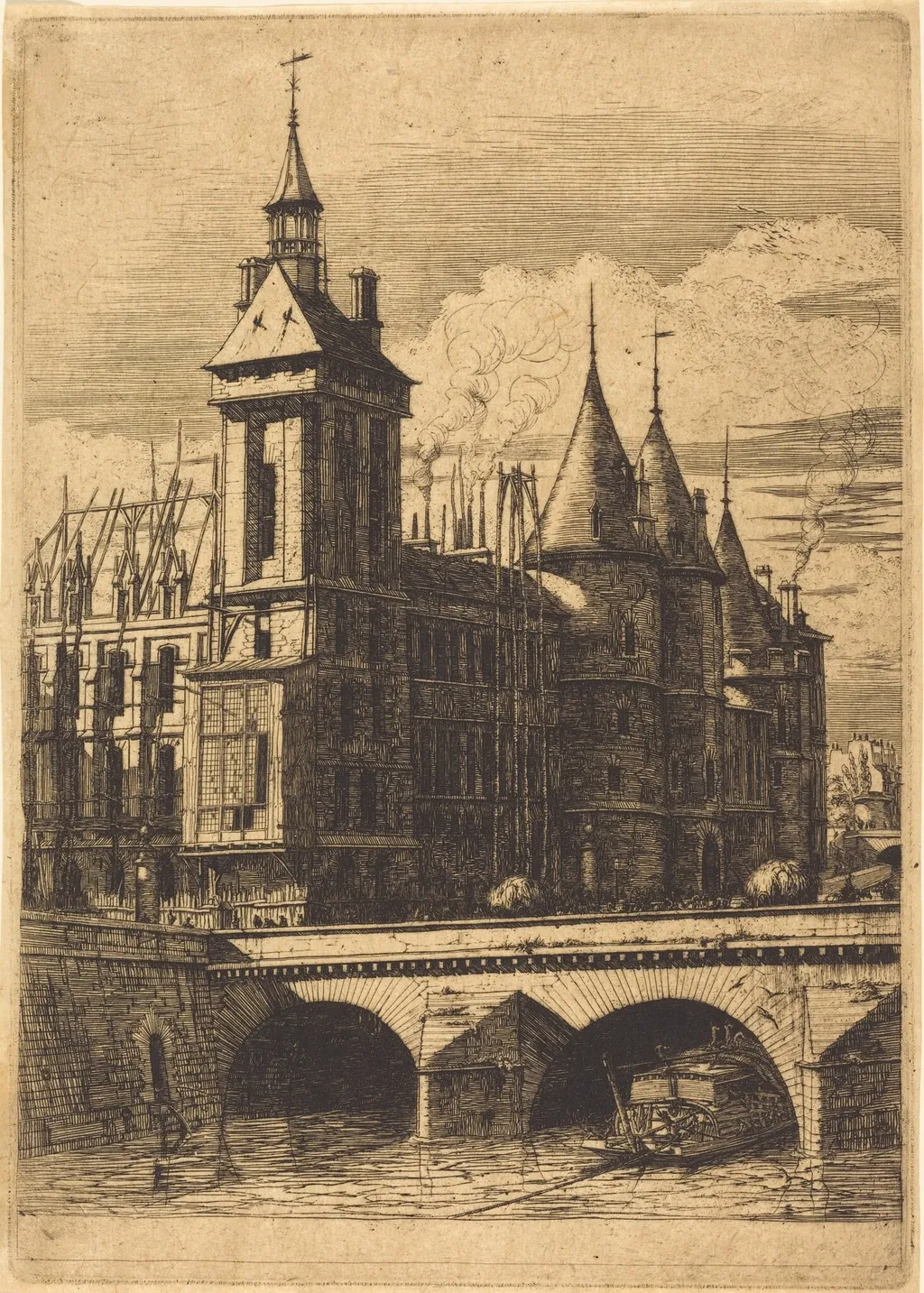
La Tour de l'Horloge, Paris (The Clock Tower, Paris) is an ink print by the Impressionist artist Charles Meryon. It dates from 1852 and is held in the collection of the National Gallery of Art.
About this work
Overview
Executed on wove Japanese paper, the work reflects his singular focus on etching, a medium he favored due to his color blindness.
Charles Meryon produced this etching in 1852, capturing a Parisian clock tower with precise, atmospheric detail. Executed on wove Japanese paper, the work reflects his singular focus on etching, a medium he favored due to his color blindness. It belongs to a broader series documenting Paris’s architectural character, rendered through a distinctly Gothic sensibility that emphasized mood over topographical accuracy.
Subject & Meaning
The composition centers on the clock tower of the Palais de la Cité, its slender form rising above a bridge and clustered buildings. A distant church steeple and hazy skyline suggest the layered history of the city. Meryon’s choice of subject reflects an interest in institutional architecture as silent witnesses to time, reinforcing the theme of temporal endurance embedded in the tower’s function.
Technique & Style
Meryon employed fine, controlled lines to model form and depth, using varied ink density to differentiate foreground from background. The tower is rendered in dense, dark strokes, while distant structures fade into lighter, looser marks. The sky, softly graded with minimal cross-hatching, enhances the sense of atmospheric recession, demonstrating his mastery of tonal gradation without color.
History & Provenance
Created during Meryon’s most productive period, the print was part of his ongoing project to document Paris’s medieval and early modern structures. Though celebrated in France, his work remained largely overlooked in Britain and America until later rediscovery. The etching survives in several institutional collections, preserved for its technical rigor and historical record.
Context
In the mid-19th century, Paris underwent radical urban transformation under Haussmann. Meryon’s etchings, including this one, offered a counter-narrative — one that lingered on the city’s older quarters before they vanished. His focus on decayed grandeur and shadowed alleys stood in contrast to the emerging modernist aesthetic of the era.
Legacy
Meryon’s etchings, though not widely known during his lifetime, influenced later generations of printmakers drawn to urban melancholy and expressive line. His ability to evoke emotional weight through monochrome technique established a precedent for 20th-century artists exploring the psychological dimension of cityscapes.
Artist & collection
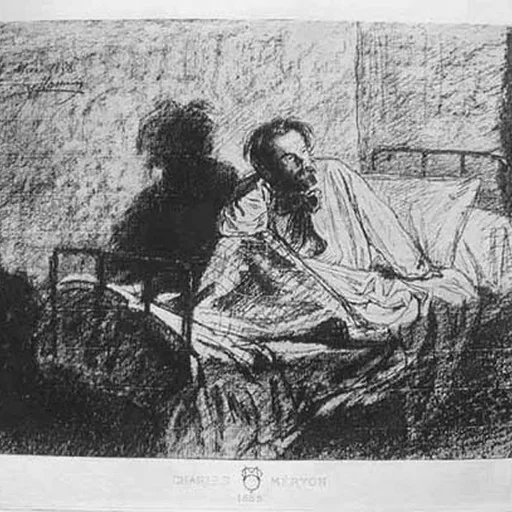
Artist
Charles Meryon (sometimes Méryon, 23 November 1821 – 14 February 1868) was a French artist who worked almost entirely in etching, as he had colour blindness.

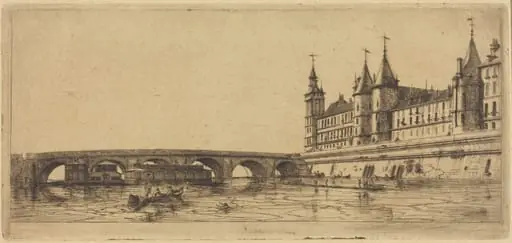 Le Pont-au-Change, Paris
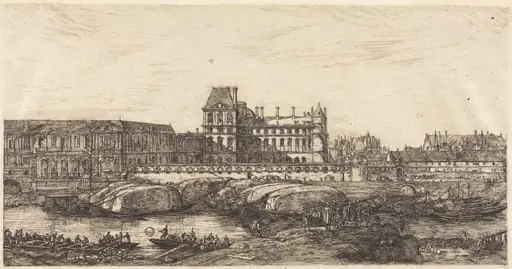 L'ancien Louvre d'après une peinture de Zeeman, 1651 (The Old Louvre, from a Painting by Zeeman, 1651)
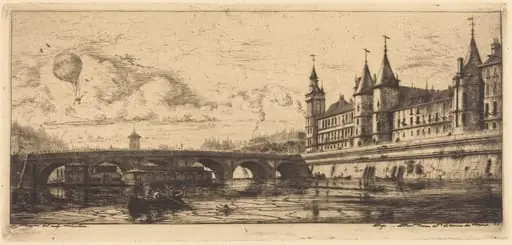 Le Pont-au-Change, Paris
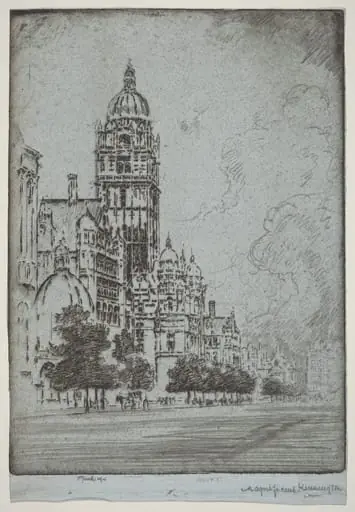 Magnificent Kensington
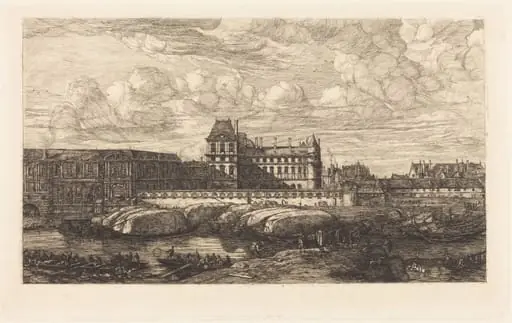 L'ancien Louvre d'après une peinture de Zeeman, 1651 (The Old Louvre, from a Painting by Zeeman, 1651)
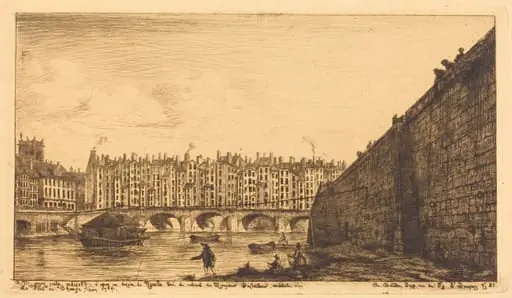 Le Pont-au-Change, Paris, vers 1784
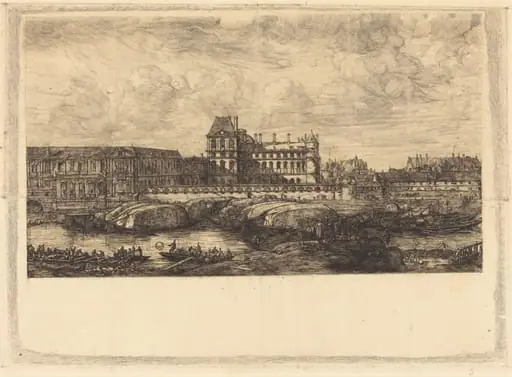 L'ancien Louvre d'après une peinture de Zeeman, 1651 (The Old Louvre, from a Painting by Zeeman, l651)
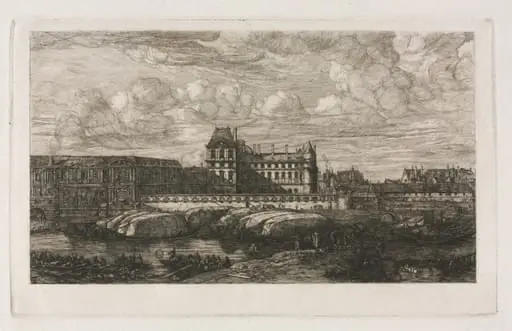 The Old Louvre from a Painting by Zeeman, 1651