Artwork
Tourelle de la Rue de la Tixéranderie, Paris (House with a Turret, Weavers' Street, Paris)
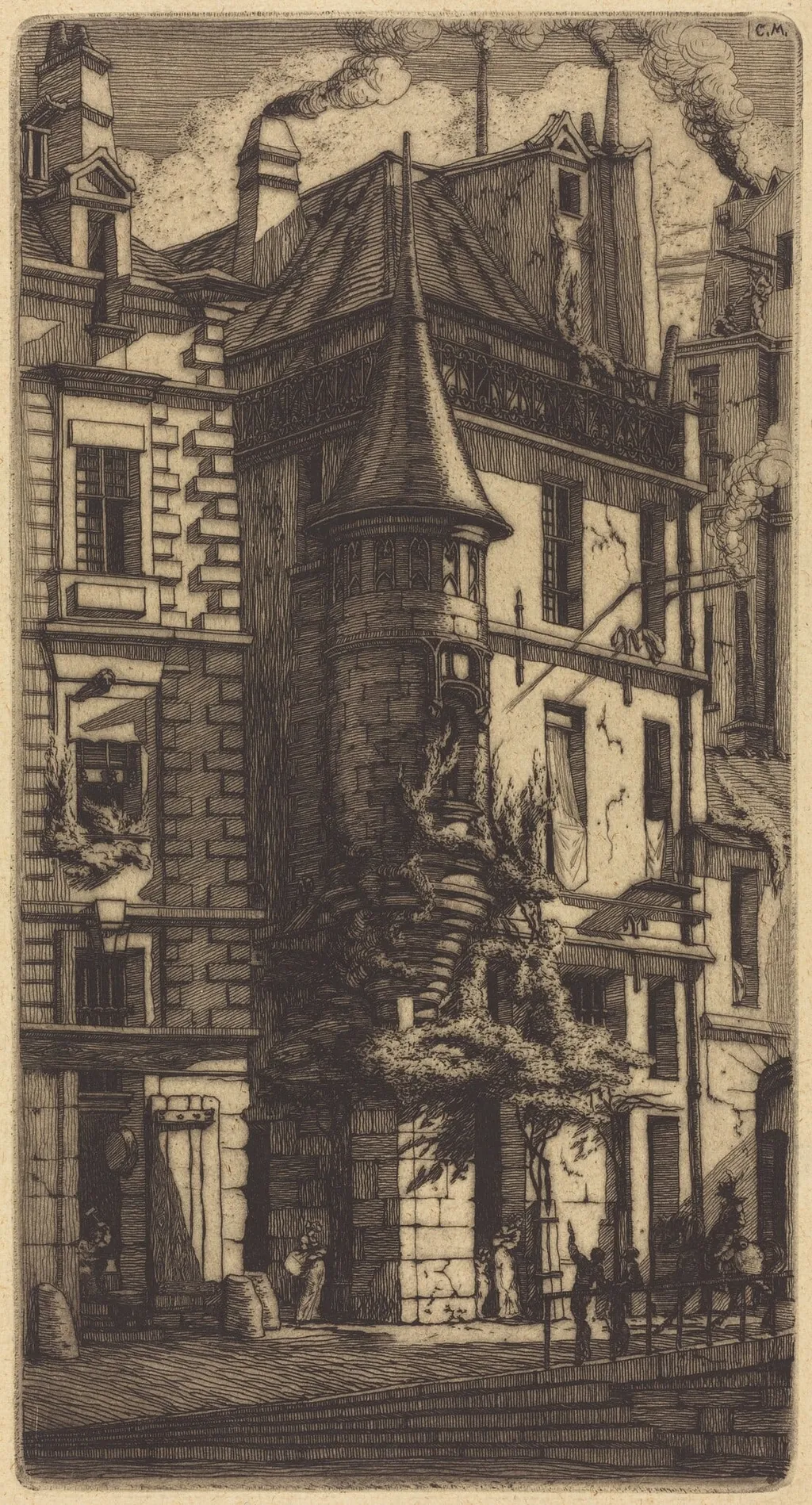
Tourelle de la Rue de la Tixéranderie, Paris (House with a Turret, Weavers' Street, Paris) is an ink print by the Impressionist artist Charles Meryon. It dates from 1852 and is held in the collection of the National Gallery of Art.
About this work
Overview
Created in 1852, this etching by Charles Meryon captures a quiet corner of medieval Paris, specifically a narrow lane known as Rue de la Tixéranderie.
Created in 1852, this etching by Charles Meryon captures a quiet corner of medieval Paris, specifically a narrow lane known as Rue de la Tixéranderie. Executed on green laid paper, the work is part of a larger series documenting the city’s architectural remnants before widespread modernization. Meryon, who avoided color due to his color blindness, relied entirely on the tonal range of ink to convey atmosphere and structure.
Subject & Meaning
The scene centers on a tall, irregularly shaped house with a projecting turret, flanked by closely packed dwellings. Clothes晾晒 on balconies and uneven window placements suggest daily life in a working-class neighborhood. The composition avoids grandeur, instead emphasizing the intimate, worn character of urban fabric. The presence of pedestrians reinforces the street as a lived-in space, not merely an architectural study.
Technique & Style
Meryon employed fine, controlled etching lines to render textures—brickwork, wooden beams, fabric, and cobblestones—with remarkable precision. The use of deep shadows and delicate hatching creates depth without color, guiding the eye through the compressed space. The green paper beneath the ink subtly modulates the tonality, adding warmth to the otherwise monochrome scene and enhancing the sense of age.
History & Provenance
The print was made during Meryon’s most productive period, before his mental health deteriorated. It was likely produced for private collectors and print dealers in Paris, circulating among those interested in topographical art. The work remained in private hands until entering institutional collections in the 20th century, where it is now preserved as a key example of 19th-century French printmaking.
Context
In the 1850s, Paris underwent radical transformation under Baron Haussmann’s urban renewal. Meryon’s etchings documented neighborhoods slated for demolition, preserving their irregular forms and human scale. His focus on overlooked corners contrasted with official celebrations of modernity, offering a quiet counter-narrative rooted in the city’s medieval past.
Legacy
Meryon’s etchings, including this one, influenced later artists interested in urban decay and atmospheric detail. Though largely forgotten after his death in an asylum in 1868, his work was rediscovered in the early 20th century for its emotional precision and technical mastery. Today, it stands as a significant record of Paris’s architectural heritage before industrial modernization.
Artist & collection
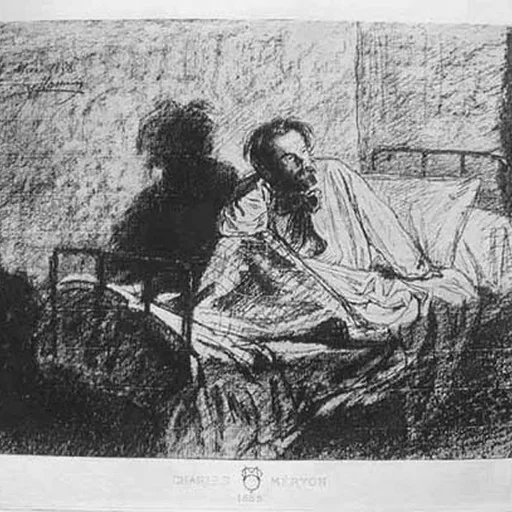
Artist
Charles Meryon (sometimes Méryon, 23 November 1821 – 14 February 1868) was a French artist who worked almost entirely in etching, as he had colour blindness.

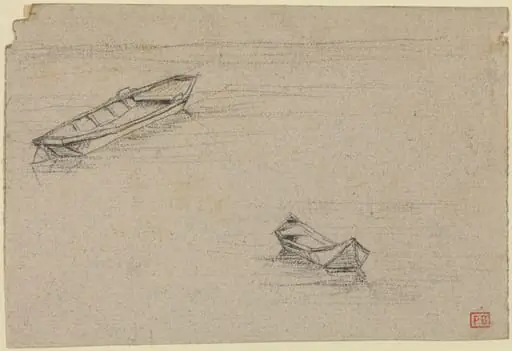
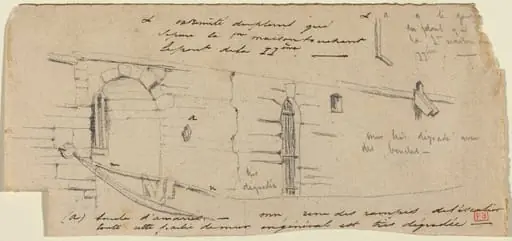
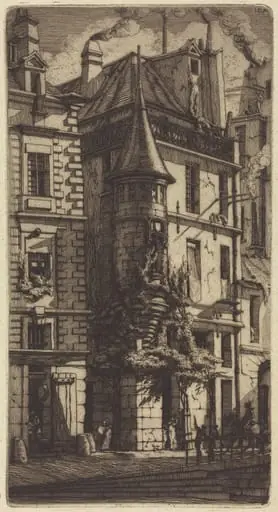 Tourelle de la Rue de la Tixéranderie, Paris (House with a Turret, Weavers' Street, Paris)
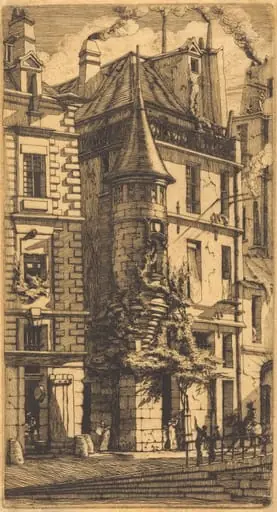 Tourelle de la Rue de la Tixéranderie, Paris (House with a Turret, Weavers' Street, Paris)
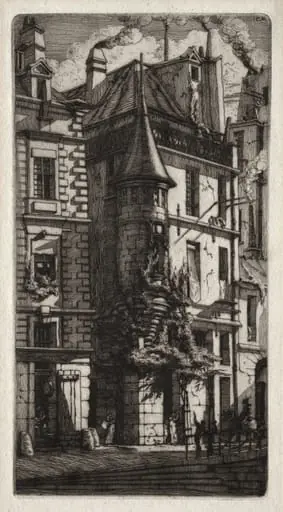 Etchings of Paris: House with a Turret, Weavers' Street
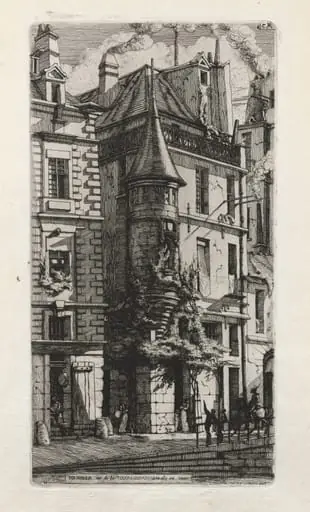 House with a Turret, rue de la Tixéranderie, Paris
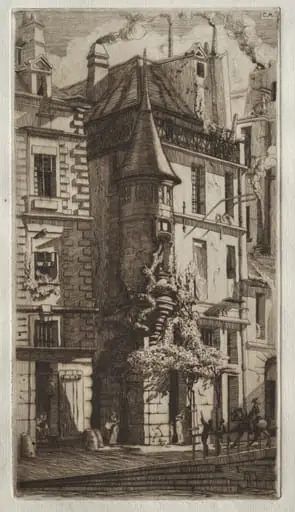 Tourelle de la rue de la Tixéranderie
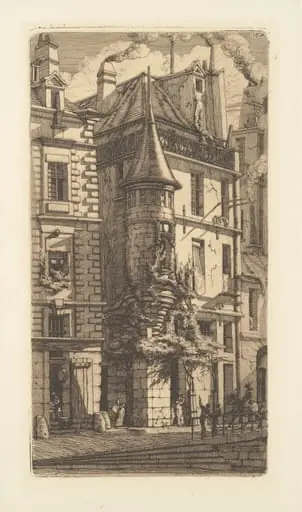 Tourelle, Rue de la Tixeranderie