Artwork
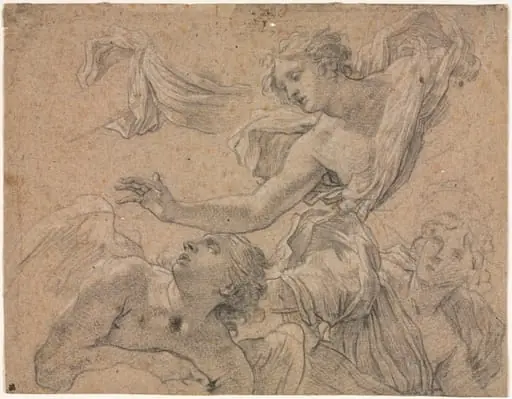
Angel from the Assumption [recto]
![Angel from the Assumption [recto], by Augustin Pajou, chalk, 1754](https://artifactworldgallery.com/img/augustin-pajou--angel-from-the-assumption-recto--59871eebf02790c8-w1024.webp)
Angel from the Assumption [recto] is a chalk drawing by the Romanticist artist Augustin Pajou. It dates from 1754 and is held in the collection of the National Gallery of Art.
About this work
Overview
Created in 1754, this drawing by French sculptor Augustin Pajou is executed in black chalk on laid paper. The work, titled “Angel from the Assumption,” presents a solitary, ethereal figure rendered in a loose, sketch‑like manner. The composition occupies a single side of the sheet (recto) and is signed in a faint hand at the lower edge.
Subject & Meaning
The image depicts an angelic being, its drapery billowing as if caught in an unseen breeze. The figure’s arms are crossed, and the face is rendered only as a faint suggestion, imparting a sense of spiritual anonymity. The floating posture and lack of a defined background evoke the notion of a heavenly presence detached from earthly space.
Technique & Style
Pajou employed only black chalk, allowing for soft, smudged transitions and rapid, gestural strokes that convey movement. The lines are intentionally sketchy, with varying pressure that creates depth without detailed modeling. The use of laid paper provides a subtle texture that interacts with the chalk, enhancing the work’s atmospheric quality.
History & Provenance
The drawing bears a faint inscription at its base reading “aleglich des+ louv,” a cryptic mark that may reflect the artist’s personal notation. While the piece has remained within the artist’s oeuvre, its precise ownership trail after its creation is not documented in the available records.
Artist & collection
Artist
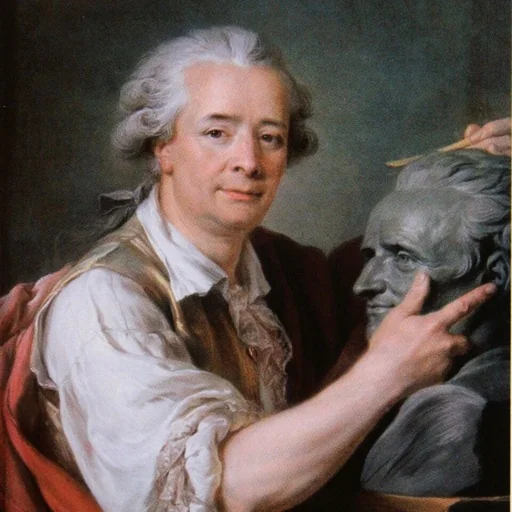
Augustin Pajou (French pronunciation: ; 19 September 1730 – 8 May 1809) was a French sculptor, born in Paris. At eighteen he won the Prix de Rome, and at thirty exhibited his Pluton tenant Cerbère enchaîné (now in the Louvre).

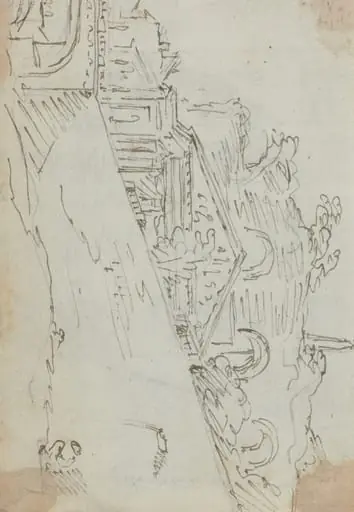
![The Ripetta in Rome [verso], by Augustin Pajou](https://artifactworldgallery.com/img/augustin-pajou--the-ripetta-in-rome-verso--4bc04e9c9476a91b-w320.webp)
![Penitent Magdalene with Angels in a Landscape [recto], by Donato Creti](https://artifactworldgallery.com/img/donato-creti--penitent-magdalene-with-angels-in-a-landscape-recto--329b67c038e377df-w320.webp)