Artwork
The Ludovisi Menander
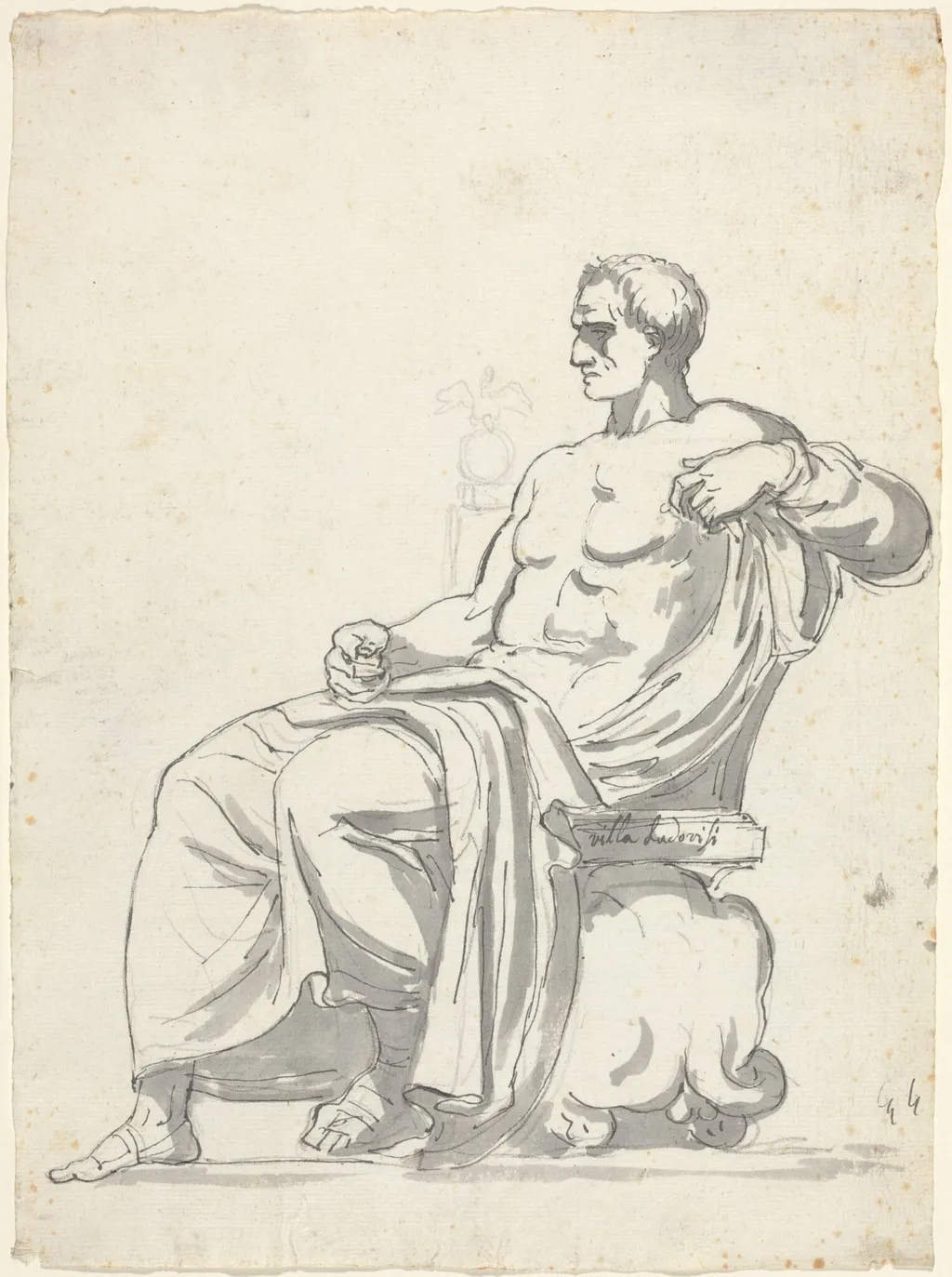
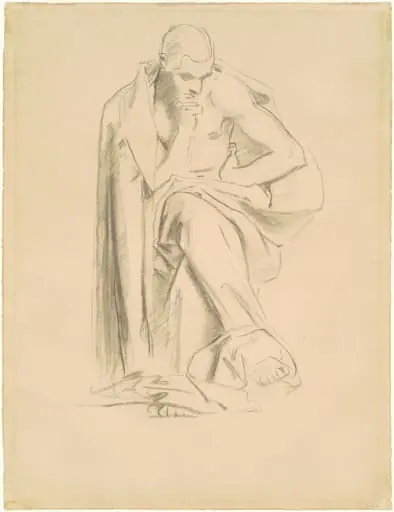
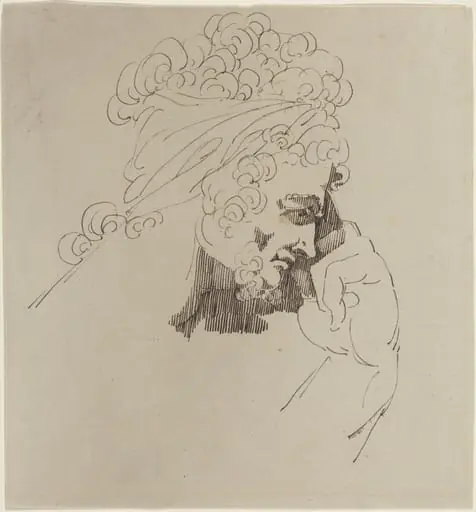
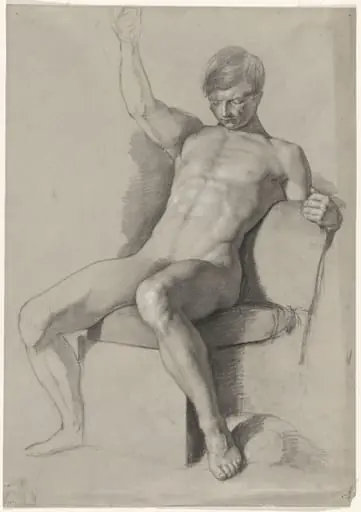
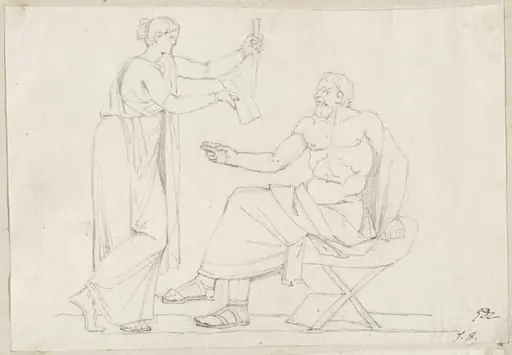
The Ludovisi Menander is an ink drawing by the Romanticist artist Augustin Pajou. It dates from 1754 and is held in the collection of the National Gallery of Art.
About this work
Overview
The Ludovisi Menander is a drawing executed in 1754 by French sculptor Augustin Pajou. Rendered in pen and black ink with a gray wash applied over black chalk on laid paper, the work measures roughly the size of a typical sketch sheet and exhibits the aged yellow tone of historic paper.
Subject & Meaning
The composition presents a nude male figure seated with one knee raised, his arm supporting a heavy spherical object against his shoulder. Behind him, a smaller, draped figure kneels, its loose garment spilling onto the floor, creating a narrative contrast between the robust, active presence of the first figure and the subdued posture of the second.
Technique & Style
Pajou employs swift, gestural lines to delineate musculature and posture, while cross‑hatching builds tonal depth and shadow. The gray wash over the chalk adds subtle modeling, emphasizing the three‑dimensional quality of the bodies despite the drawing’s limited medium.
History & Provenance
Named after the Ludovisi collection, the drawing entered that assemblage sometime after its creation, though the precise path of ownership remains undocumented. Its survival on laid paper indicates careful preservation, allowing contemporary viewers to assess its original condition.
Context
Created during the mid‑eighteenth century, the work reflects the period’s fascination with classical antiquity and the study of the male form. Pajou, primarily known for his marble sculptures, produced this drawing as a study, likely intended to explore anatomical accuracy and dynamic pose for later sculptural projects.
Legacy
The Ludovisi Menander offers insight into Pajou’s preparatory process and the broader academic practice of drawing from life and classical models. It remains a valuable reference for scholars examining the intersection of drawing and sculpture in the French Rococo era.
Artist & collection
Artist
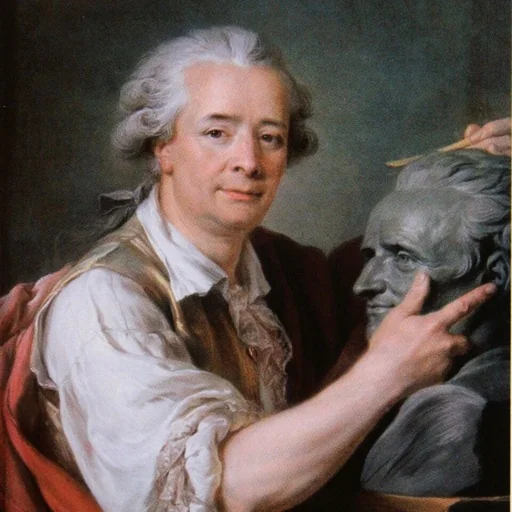
Augustin Pajou (French pronunciation: ; 19 September 1730 – 8 May 1809) was a French sculptor, born in Paris. At eighteen he won the Prix de Rome, and at thirty exhibited his Pluton tenant Cerbère enchaîné (now in the Louvre).

![The Ripetta in Rome [verso], by Augustin Pajou](https://artifactworldgallery.com/img/augustin-pajou--the-ripetta-in-rome-verso--4bc04e9c9476a91b-w320.webp)
![Angel from the Assumption [recto], by Augustin Pajou](https://artifactworldgallery.com/img/augustin-pajou--angel-from-the-assumption-recto--59871eebf02790c8-w320.webp)
![Statue of Jupiter, Seated [recto], by Hubert Robert](https://artifactworldgallery.com/img/hubert-robert--statue-of-jupiter-seated-recto--c8c32a4d67e7a964-w320.webp)