Artwork
Jurământul lui Mihai Viteazul
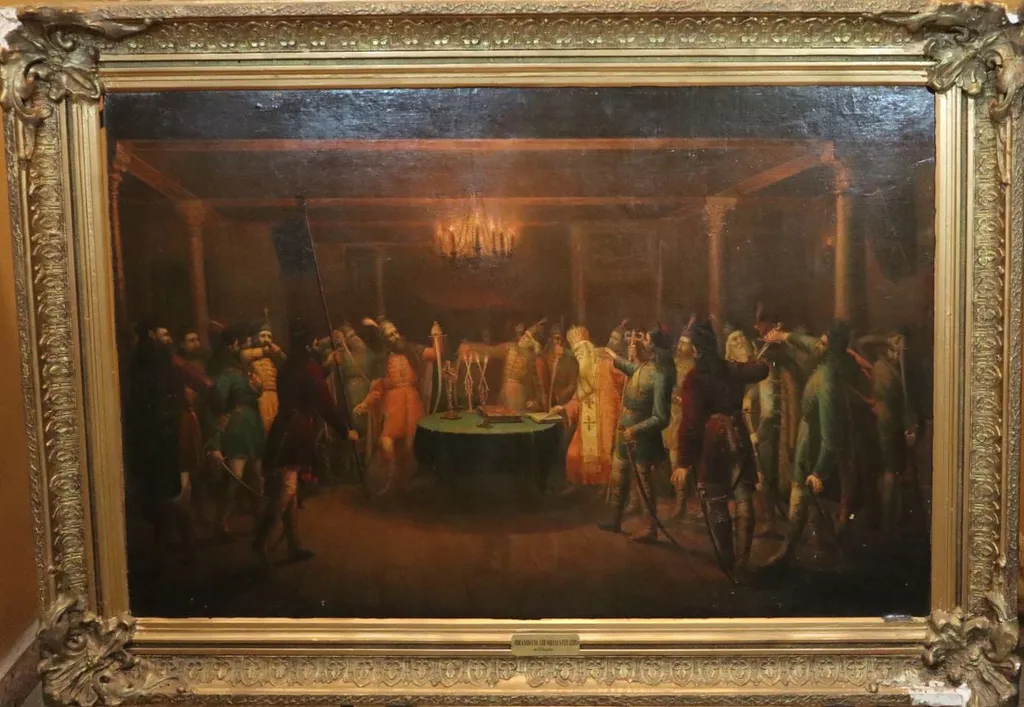
Jurământul lui Mihai Viteazul is a print by Gheorghe (George) Ioachim Pompilian. It is held in the collection of the King Ferdinand I National Military Museum.
About this work
Overview
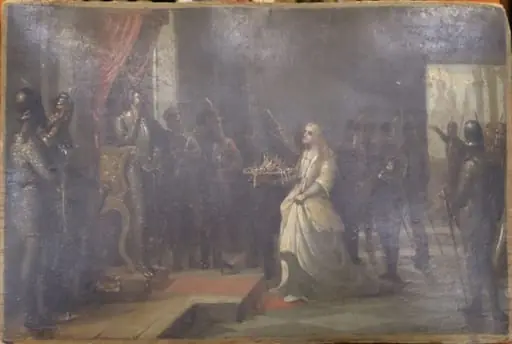
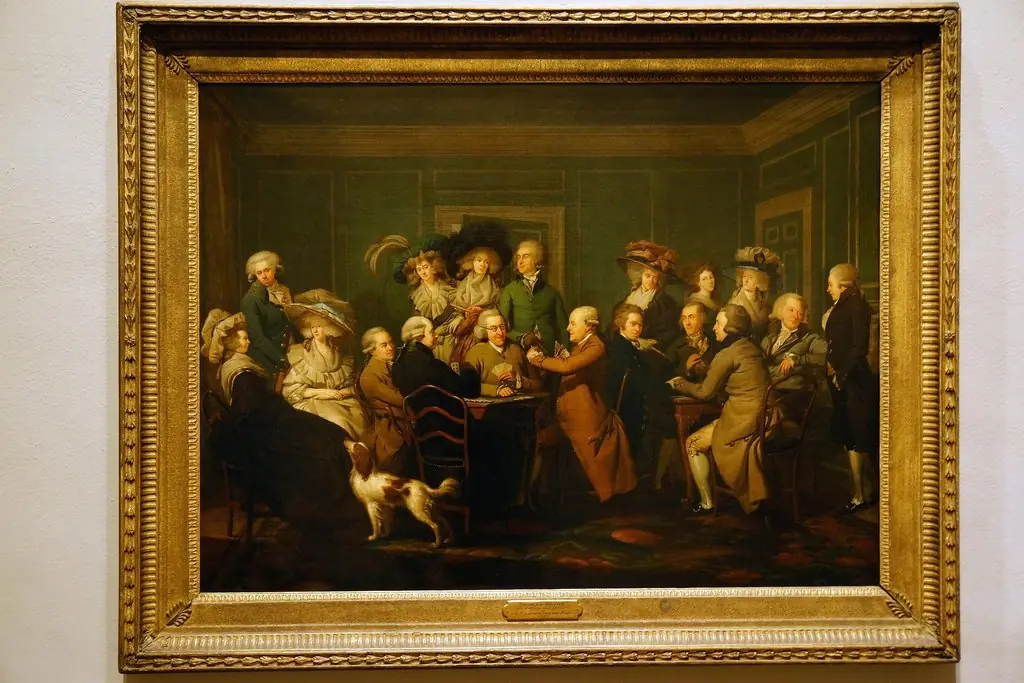
The painting depicts a historical moment involving Mihai Viteazul, the Prince of Wallachia, surrounded by nobles and military leaders in a dimly lit interior.
The painting depicts a historical moment involving Mihai Viteazul, the Prince of Wallachia, surrounded by nobles and military leaders in a dimly lit interior. The scene is rendered with careful attention to light and shadow, using chiaroscuro to model forms and suggest volume. The composition centers on a single figure in vivid orange, drawing focus to a ceremonial act involving a book and candlelight, suggesting an oath or solemn agreement.
Subject & Meaning
The scene illustrates the swearing of an oath by Mihai Viteazul, likely symbolizing unity among Romanian principalities. The gathered figures—nobles, soldiers, and clergy—represent the political and military alliance forming under his leadership. The candle and open book imply a sacred or binding contract, reinforcing the gravity of the moment. The central figure’s posture and attire emphasize his authority amid the assembled ranks.
Technique & Style
The artist employs chiaroscuro to model figures with soft transitions between light and shadow, enhancing the three-dimensionality of faces and fabrics. Warm candlelight casts a golden glow across the scene, contrasting with deep recesses of the room. Textures of armor, velvet, and parchment are suggested rather than meticulously detailed, prioritizing atmospheric effect over precision. The lighting directs the viewer’s eye toward the central group without artificial drama.
History & Provenance
The work originates from the 19th century, created during a period of renewed interest in Romanian national identity. It was likely commissioned to commemorate historical figures who unified territories under a single rule. While the exact provenance is not documented, its style aligns with academic history painting traditions of the time, common in Eastern European cultural institutions.
Context
Painted during the 1800s, this image responds to a broader movement across Europe that sought to define national histories through visual art. In Romania, depictions of medieval rulers like Mihai Viteazul served to legitimize modern statehood by connecting it to a heroic past. The setting, though historically approximate, reflects contemporary ideals of solemnity, unity, and leadership rather than strict archaeological accuracy.
Legacy
The painting remains a reference point in Romanian cultural memory, frequently reproduced in textbooks and public spaces. It helped solidify Mihai Viteazul’s image as a unifying national symbol. While modern scholarship questions its historical fidelity, its enduring presence underscores the power of visual narrative in shaping collective identity during nation-building eras.
Artist & collection
Artist
Gheorghe (George) Ioachim Pompilian
George Ioachim Pompilian had the habit of turning history into something you can almost touch.
Museum
King Ferdinand I National Military Museum
Continue through works from the same source collection.
 Bătălia de la Călugăreni
 Uciderea lui Grigorie Ghica
 Ștefan cel Mare primind solii tătari
 Maskerade. Intermedium
 Intrarea lui Traian în Sarmizegetusa
 Frederick the Great at Lissa: Bonsoir, Messieurs
 Mohrenstechen in der spanischen Hofreitschule
 Proclamarea Unirii Principatelor (24 Ianuarie 1859)
 Fountain in a town
 A Masquerade at the King's Theatre, Haymarket
 Societate la curtea lui Iosif II
 Portrait of Thomas Payne with His Family and Friends