Artwork
Thomas Jefferson
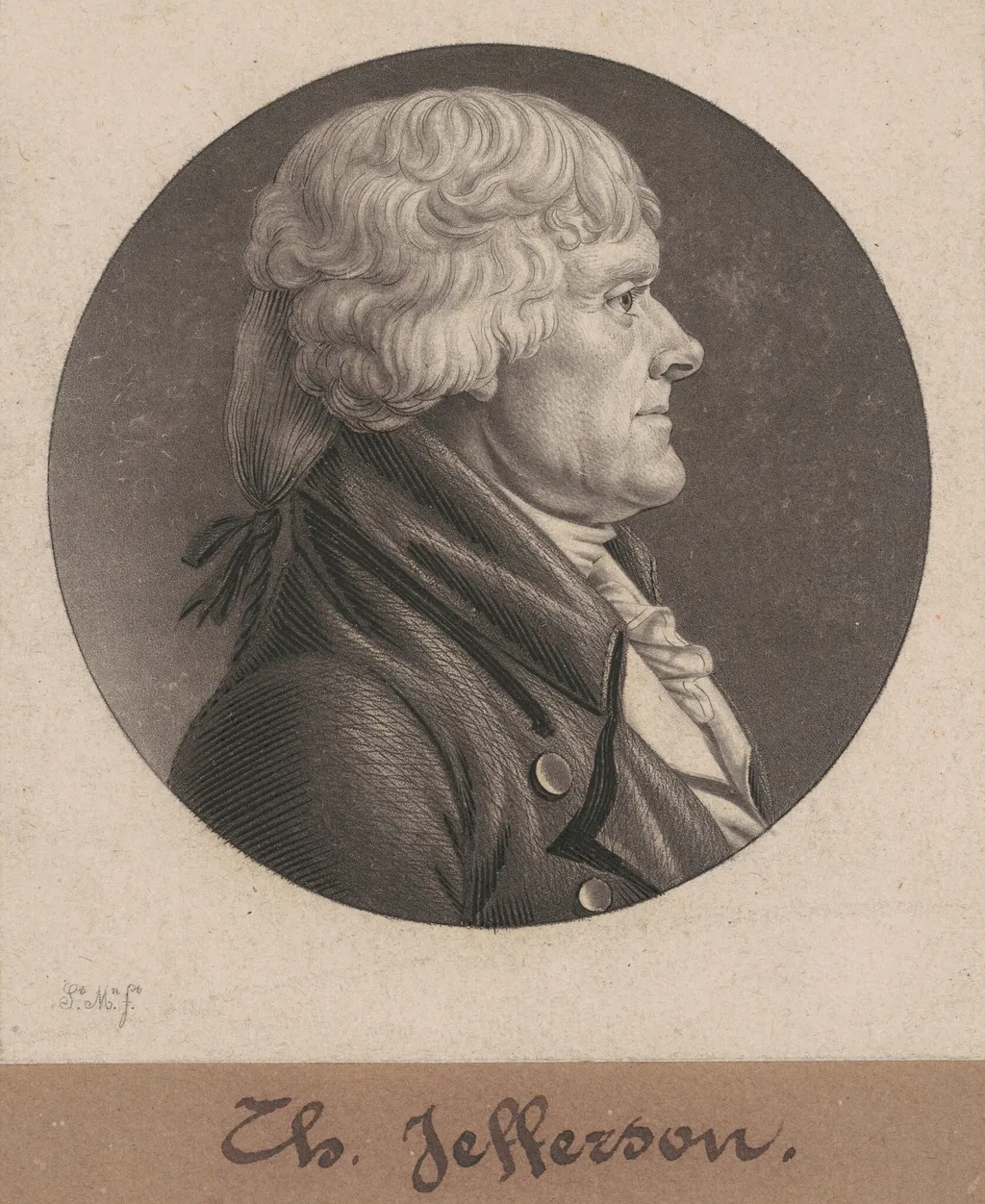
Thomas Jefferson is an ink print by the Romanticist artist Charles Balthazar Julien Févret de Saint-Mémin. It dates from 1804 and is held in the collection of the National Gallery of Art. Created in 1804 by Charles B.
About this work
Overview
Its medium and composition reflect the artist’s commitment to capturing likeness through careful draftsmanship.
Created in 1804 by Charles B. J. Févret de Saint-Mémin, this print is a profile portrait of Thomas Jefferson executed in mezzotint and engraving on wove paper, later mounted to brown wove paper. The work belongs to a series of portrait prints Saint-Mémin produced during his time in the United States, combining technical precision with direct observation from life. Its medium and composition reflect the artist’s commitment to capturing likeness through careful draftsmanship.
Subject & Meaning
The portrait presents Jefferson in strict profile, facing left, with a composed, unsmiling expression. His features—prominent brow, straight nose, and firm jaw—are rendered with clinical clarity, emphasizing his intellectual presence rather than emotional expression. As a sitting president at the time, the image served not as propaganda but as a documentary record, aligning with Jefferson’s own preference for restrained public representation.
Technique & Style
Saint-Mémin employed mezzotint to achieve subtle gradations of tone, enhanced by fine engraving lines to define contours and texture. The use of wove paper allowed for crisp detail, while the monochrome palette focused attention on form and structure. His method—drawing directly from life, then translating it into print—was uncommon in American portraiture of the period, lending the image an unusual fidelity to the sitter’s actual appearance.
History & Provenance
Saint-Mémin made this portrait during his residence in Washington, D.C., where he produced numerous likenesses of prominent figures between 1796 and 1804. Jefferson sat for the artist in 1804, likely at the President’s House. The print was issued in limited quantities and distributed to institutions and private collectors. Surviving impressions are held in major American collections, including the Library of Congress and the National Portrait Gallery.
Context
In early 19th-century America, portraiture was often idealized or symbolic. Saint-Mémin’s approach stood apart by prioritizing anatomical accuracy over embellishment. His practice reflected European academic traditions, which he brought to the young republic. This portrait emerged during a period of intense nation-building, when visual records of leaders were sought to establish a shared public identity grounded in realism.
Legacy
This portrait became a primary reference for later depictions of Jefferson, influencing both contemporary and 19th-century artists seeking an authentic likeness. Its technical rigor and fidelity to observation set a standard for American print portraiture. Though not widely reproduced in its time, it remains one of the most trusted visual sources for Jefferson’s physical appearance, valued by historians and institutions for its documentary integrity.
Artist & collection

Artist
Charles Balthazar Julien Févret de Saint-Mémin
Charles Balthazar Julien Févret de Saint-Mémin (French pronunciation: ; 1770–1852) was a French portrait painter and museum director.