Artwork
Chiesa di Sta Francisca Romana in Campo Vaccine
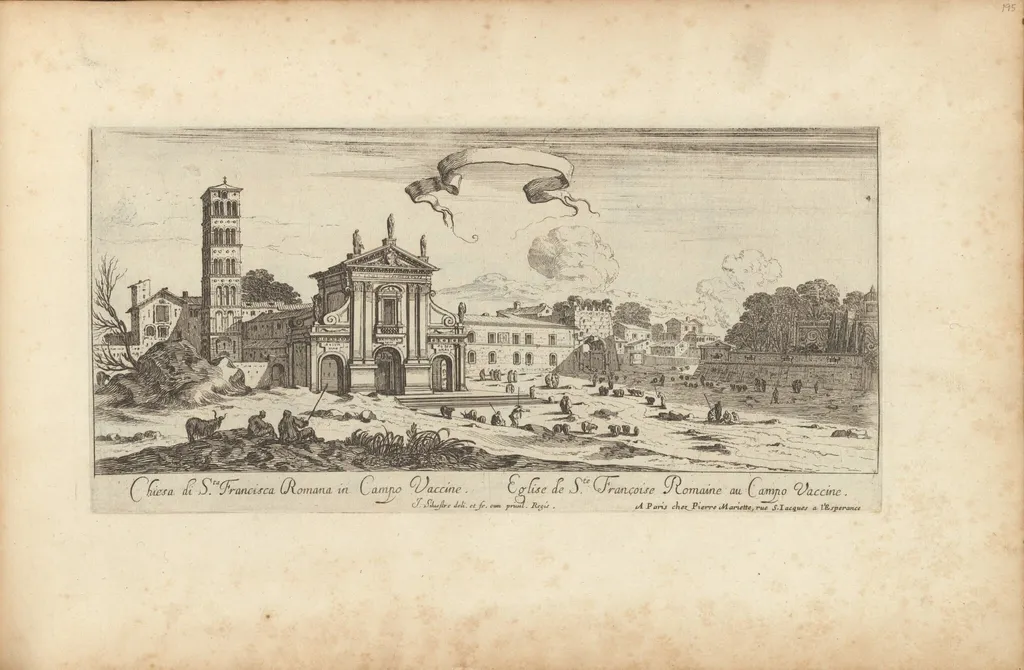
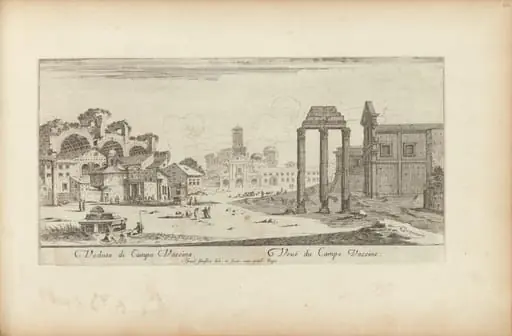
Chiesa di Sta Francisca Romana in Campo Vaccine is an ink print by the Baroque artist Israël Silvestre. It dates from 1650 and is held in the collection of the National Gallery of Art. Created in 1650 by Israel Silvestre, this etching on laid paper captures the Church of Santa Francesca Romana in Rome’s Campo Vaccino.
About this work
Overview
Silvestre, a French artist trained in the tradition of topographical printmaking, produced this work during one of his several visits to Italy.
Created in 1650 by Israel Silvestre, this etching on laid paper captures the Church of Santa Francesca Romana in Rome’s Campo Vaccino. Silvestre, a French artist trained in the tradition of topographical printmaking, produced this work during one of his several visits to Italy. The piece belongs to a broader body of architectural studies he made from direct observation, later refined into precise printed images for collectors and scholars.
Subject & Meaning
The scene centers on the church, its classical façade and modest bell tower rendered with careful proportion. In the foreground, daily life unfolds: sheep are driven across a shallow stream, while figures move along the riverbank. The inclusion of ordinary activity alongside sacred architecture suggests a quiet harmony between religious presence and rural routine, reflecting the lived reality of Rome’s outskirts rather than idealized grandeur.
Technique & Style
Silvestre employed fine, controlled etching lines to model form and light, creating a sense of volume in the stone structures and subtle reflections in the water. The use of laid paper, with its visible chain lines, enhances the texture of the print. His approach aligns with Baroque naturalism—attentive to atmospheric detail, spatial depth, and the interplay of shadow, yet avoiding theatricality in favor of quiet observation.
History & Provenance
Orphaned in childhood, Silvestre was raised by his uncle, a Parisian print-seller linked to Jacques Callot, which exposed him early to the print trade. He traveled widely across Europe, making detailed sketches in Italy that became the basis for his etchings. This particular work likely originated from one of his mid-17th century stays in Rome, where he documented architectural landmarks for a European audience interested in antiquity and contemporary urban life.
Context
In mid-1600s Rome, topographical prints served both documentary and aesthetic functions. Artists like Silvestre catered to travelers, scholars, and collectors seeking accurate depictions of cities. His focus on churches and public spaces aligned with a broader European fascination with Roman antiquity and ecclesiastical architecture, even as the city’s daily rhythms—pastoral, commercial, domestic—remained visible in the margins of his compositions.
Legacy
Silvestre’s etchings contributed to the dissemination of Italian architectural forms beyond Italy, influencing later topographical artists and surveyors. Though not widely celebrated in his time, his precise, unembellished renderings preserved visual records of Rome’s urban fabric during a period of transition. His work remains a reference for historians studying the intersection of art, travel, and urban documentation in early modern Europe.
Artist & collection
Artist
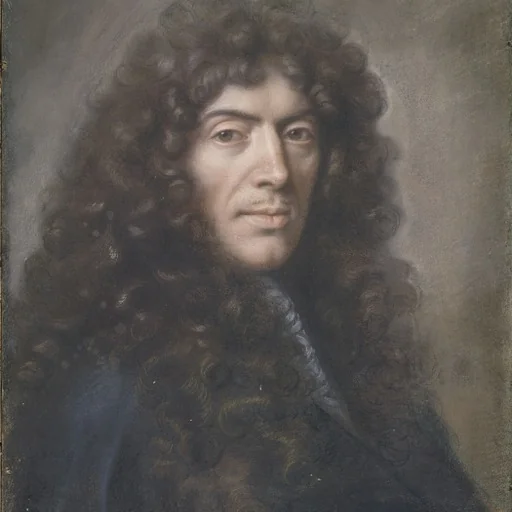
Israel Silvestre (13 August 1621 in Nancy – 11 October 1691 in Paris), called the Younger to distinguish him from his father, was a prolific French draftsman, etcher and print dealer who specialized in topographical views and perspectives…

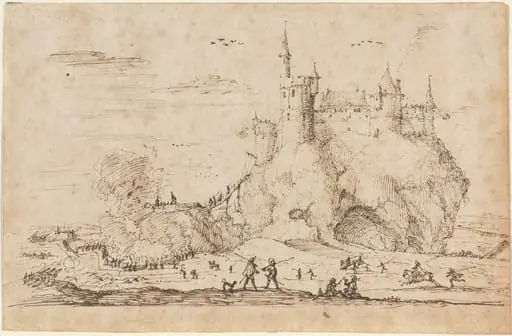 Castle under Siege
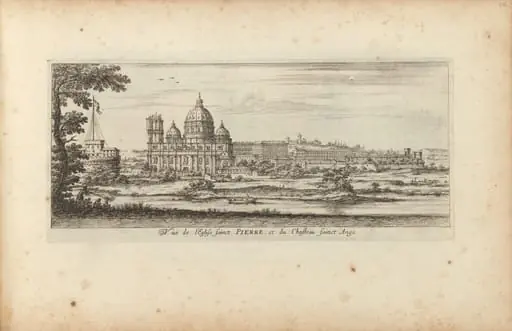 Vuë de l'Eglise sainct Pierre, et du Chasteau Sainct Ange
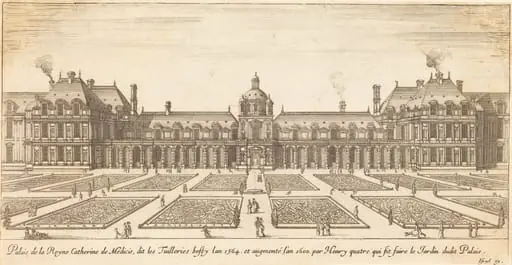 Palais de la Reyne Catherine de Medicis
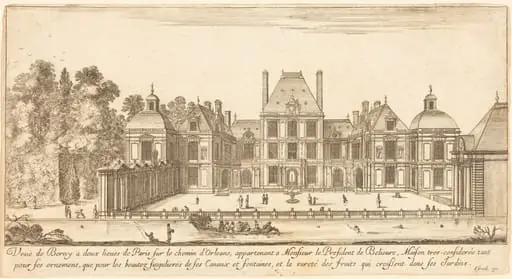 Veue de Berny a deux lieues de Paris sur le chemin d'Orléans
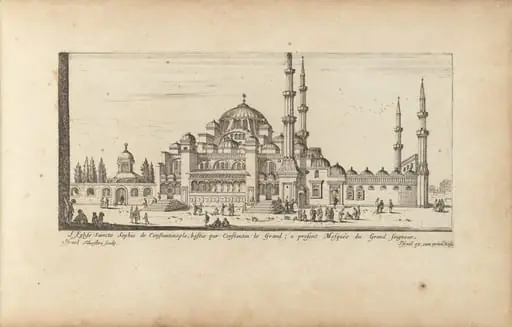 L'Eglise Saincte Sophie de Constantinople, bastie par Constantin le Grand; a present Mosquée du Grand seigneur
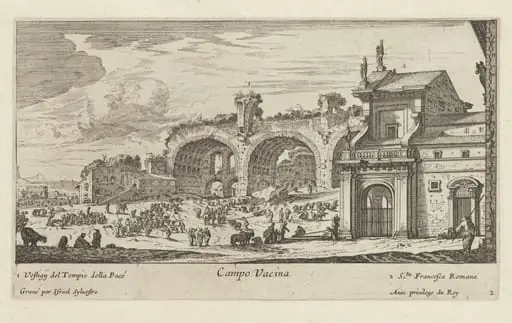 Campo Vacina
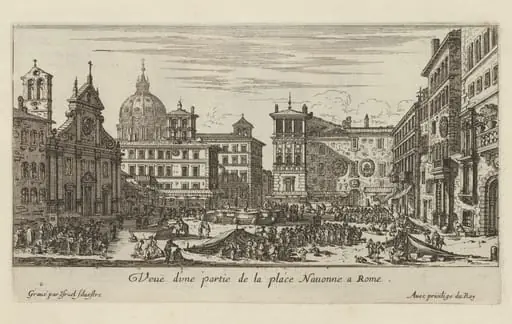 Veuë d'une partie de la place Navonne a Rome
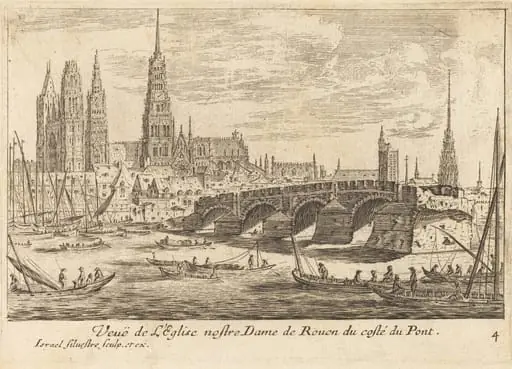 Veue de l'Eglise nostre Dame de Rouen