Artwork
Dark Single Hollyhocks
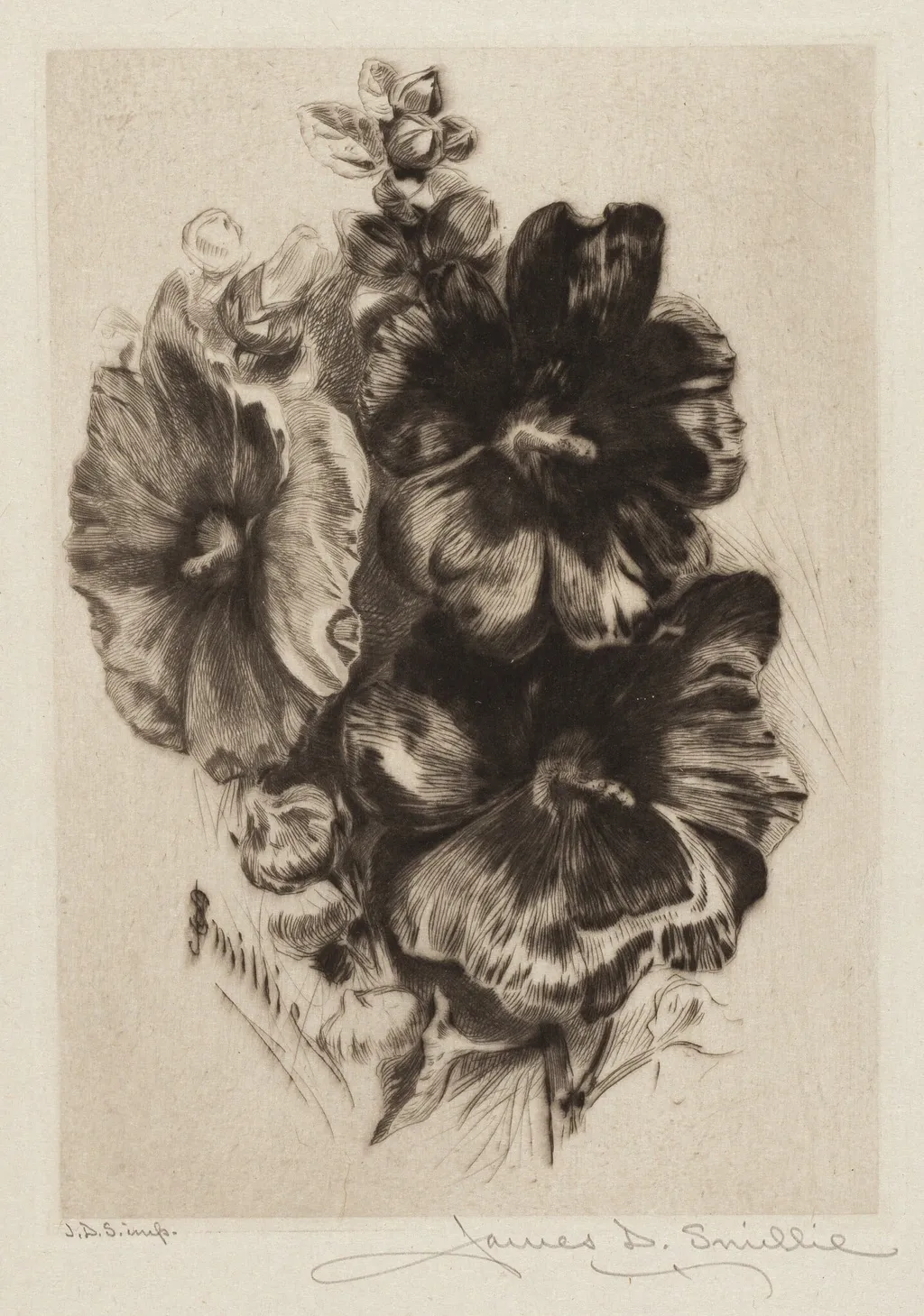
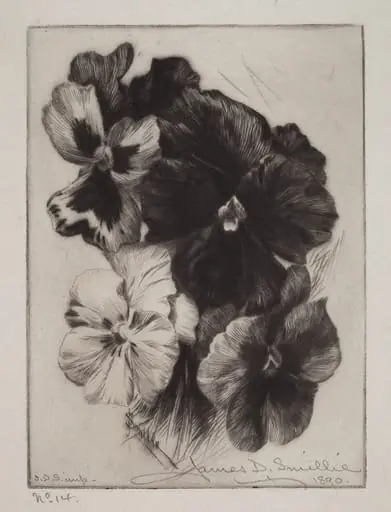
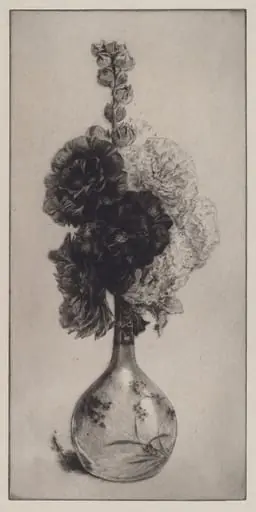
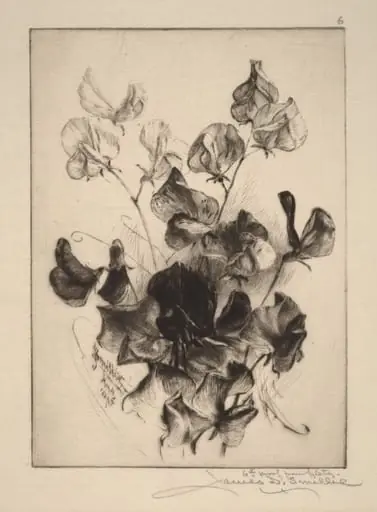
Dark Single Hollyhocks is an ink print by the Impressionist artist James David Smillie. It dates from 1890 and is held in the collection of the National Gallery of Art.
About this work
Overview
The work presents a solitary arrangement of hollyhocks, their stems and petals rendered with incised lines that capture both form and texture.
Dark Single Hollyhocks is a 1890 drypoint print by James David Smillie, executed in black ink on wove paper. The work presents a solitary arrangement of hollyhocks, their stems and petals rendered with incised lines that capture both form and texture. The contrast between the dark floral elements and the pale paper ground creates a quiet, focused composition, emphasizing the natural elegance of the subject without embellishment.
Subject & Meaning
The subject is a cluster of dark hollyhocks, their tall, slender forms arranged with deliberate simplicity. The choice of a single, unadorned bouquet suggests an intimate observation of nature rather than a symbolic narrative. The absence of context or background directs attention to the plant’s intrinsic structure, inviting contemplation of its quiet presence and the transient beauty of botanical life.
Technique & Style
Smillie employed drypoint, a printmaking method involving direct scratching into a metal plate, to produce rich, velvety lines. The technique’s inherent texture is evident in the dense, slightly blurred strokes that define the petals and stems. The artist leveraged the medium’s capacity for tonal variation, using overlapping lines to suggest shadow and volume, resulting in a tactile, almost sculptural rendering of the flowers.
History & Provenance
Created in 1890, the print belongs to Smillie’s later period, when he increasingly focused on botanical subjects in print form. While specific ownership history is not widely documented, the work aligns with his broader engagement with American etching and drypoint traditions during the late 19th century. It reflects his commitment to capturing natural forms with technical precision and restrained aesthetic.
Context
In the late 1800s, American artists were re-engaging with printmaking as a serious medium, moving beyond reproduction toward original expression. Smillie’s work fits within this revival, particularly among those drawn to intimate, observational subjects. His hollyhocks echo contemporary interests in naturalism and the quiet dignity of everyday flora, resonating with broader cultural shifts toward domestic and botanical themes in art.
Legacy
Though not widely exhibited today, Dark Single Hollyhocks remains a representative example of Smillie’s contribution to American printmaking. It exemplifies the quiet, technical mastery that characterized his approach to botanical subjects. The work continues to be studied for its refined use of drypoint and its role in the late 19th-century American print movement, preserving a subtle but significant moment in the history of the medium.
Own this work as a print
Artist & collection

Artist
James David Smillie was an American artist, cofounder of the American Watercolor Society and New York Etching Club. His brother was painter George Henry Smillie.