Artwork
The young prince is crowned and the wicked handmaiden is executed, from a Tuti-nama (Tales of a Parrot): Eighth Night
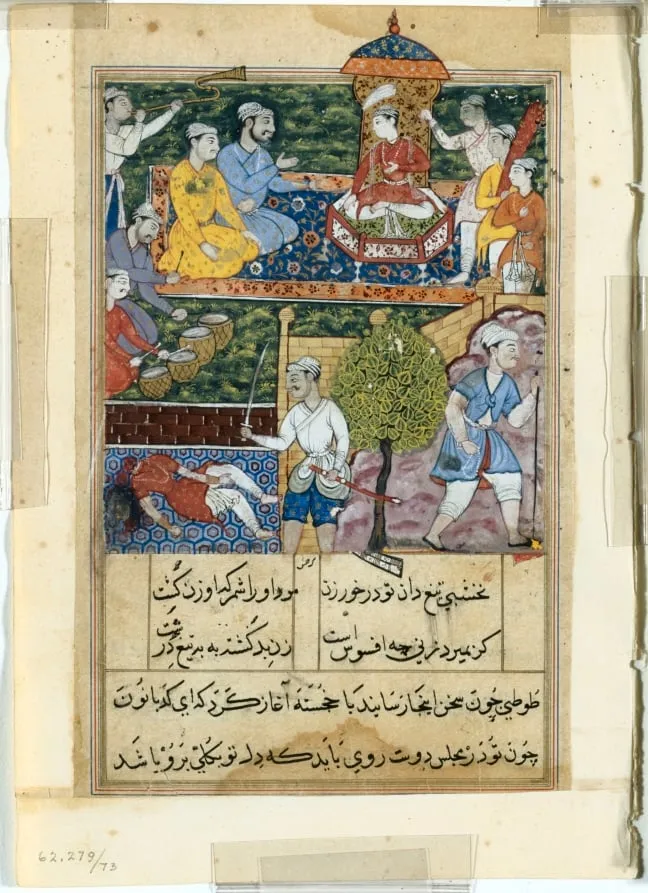
The young prince is crowned and the wicked handmaiden is executed, from a Tuti-nama (Tales of a Parrot): Eighth Night is an unspecified painting by the Mughal Painting artist Suraju. It dates from 1560 and is held in the collection of the Cleveland Museum of Art. The final image of the eighth night in the illustrated manuscript depicts a coronation scene.
About this work
If you like this mix of storytelling and royal drama, look up Mughal India, court of Akbar (reigned 1556–1605).
You see a prince being crowned on a throne while musicians play. Below him, a handmaiden is executed, and an old king leaves with a walking stick and prayer beads.
This painting wraps up a story told by a parrot over eight nights. Look closely—you can spot older brushstrokes peeking out from under the new paint. Artists often reused paper to save time and materials.
If you like this mix of storytelling and royal drama, look up Mughal India, court of Akbar (reigned 1556–1605).
Overview
The final image of the eighth night in the illustrated manuscript depicts a coronation scene. A young ruler sits upon an elevated throne while musicians perform, and beneath the throne a servant is being put to death. In the lower right corner, an elderly monarch departs, carrying a staff and prayer beads, suggesting a ritual withdrawal from power.
Subject & Meaning
The composition conveys the transfer of authority from an aging king to his heir, juxtaposing celebration with punitive justice. The execution of the handmaiden underscores the narrative’s moral resolution, while the departing elder, accompanied by symbols of piety, reflects the customary retreat of former rulers into seclusion after relinquishing the throne.
Technique & Style
The painting reveals layers of pigment, with earlier brushwork faintly visible beneath the surface, indicating that the artist painted over a pre‑existing design. Such reworking was typical in the manuscript tradition, allowing apprentices to experiment with evolving visual conventions while conserving costly paper and pigments.
History & Provenance
Created as part of a Mughal illustrated manuscript that recounts a parrot’s storytelling over eight evenings, the work originates from the court of Emperor Akbar (1556–1605). The manuscript was produced in a royal atelier, where senior and junior artists collaborated, and the practice of overpainting reflects workshop methods of the period.
Context
The scene reflects courtly customs of the Mughal empire, where succession rituals were accompanied by elaborate music and ceremonial display. The depiction of the former king’s retirement into the forest aligns with contemporary ideals of ascetic withdrawal, while the punitive act against the handmaiden illustrates the narrative’s moral climax.
Artist & collection

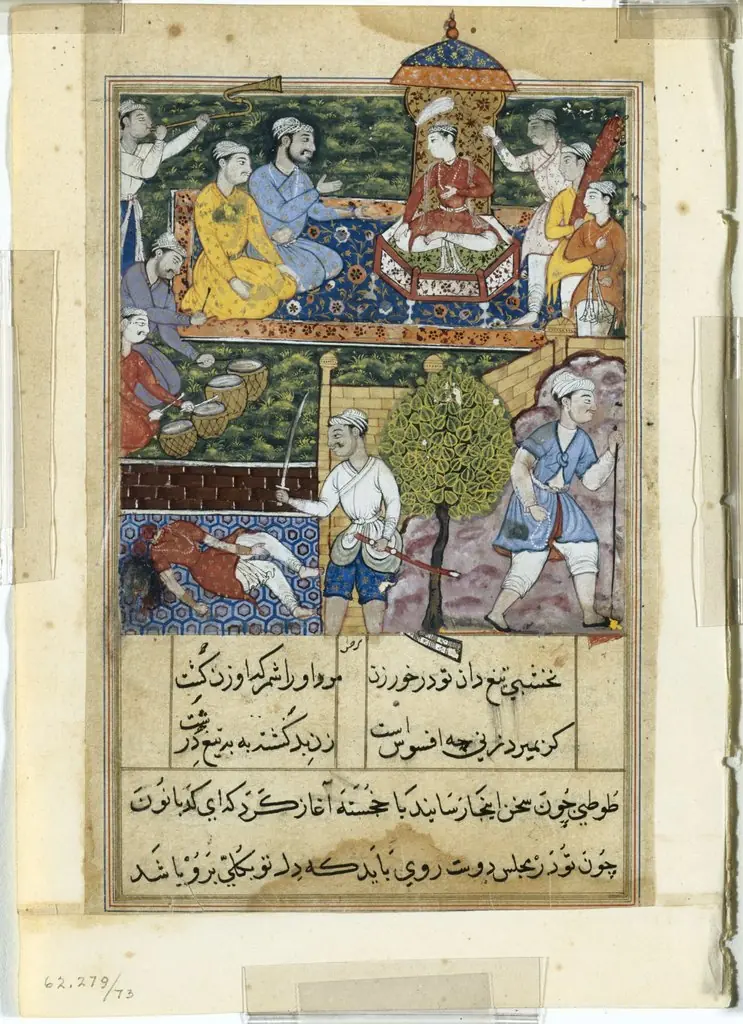 The young prince is crowned and the wicked handmaiden is executed, from a Tuti-nama (Tales of a Parrot): Eighth Night
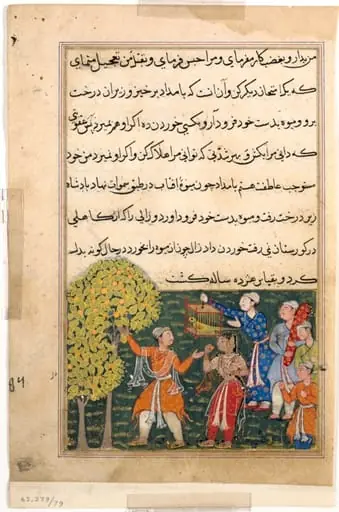 The king plucks fruit from the Tree of Life with his own hands and feeds it to a lady, from a Tuti-nama (Tales of a Parrot): Ninth Night
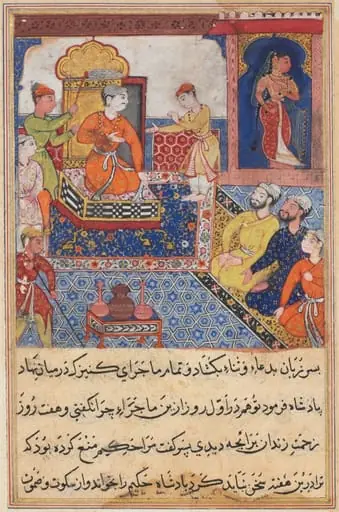 The young prince recounts his experiences to his father, the king, from a Tuti-nama (Tales of a Parrot): Eighth Night
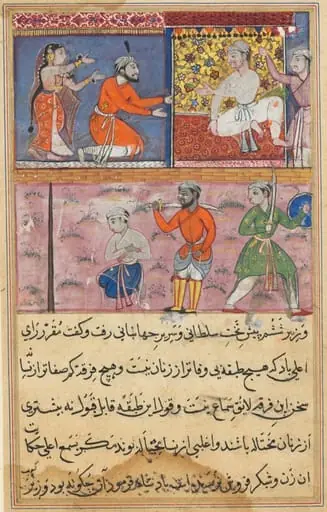 The prince sent back to the place of execution for the sixth time, from a Tuti-nama (Tales of a Parrot): Eighth Night
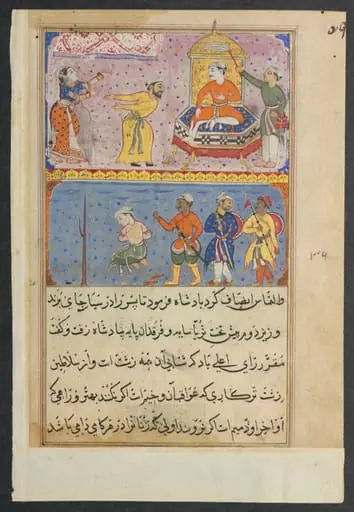 The prince, once reprieved, is returned to the palace of execution a second time on the plea of the king’s handmaiden, from a Tuti-nama (Tales of a Parrot): Eighth Night
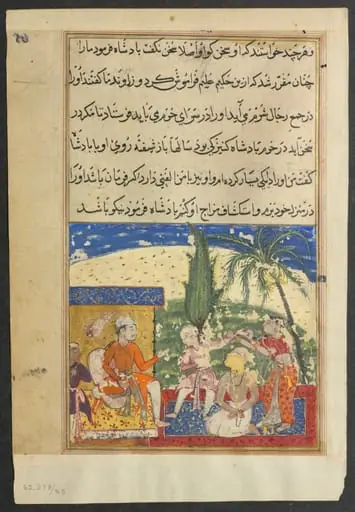 The king’s handmaiden takes the prince away to the harem, from a Tuti-nama (Tales of a Parrot): Eighth Night
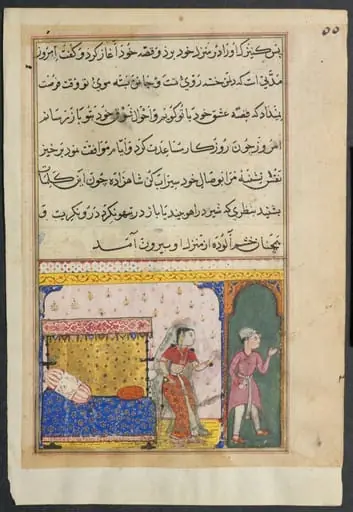 The prince rejects the amorous advances of the king’s handmaiden, from a Tuti-nama (Tales of a Parrot): Eighth Night
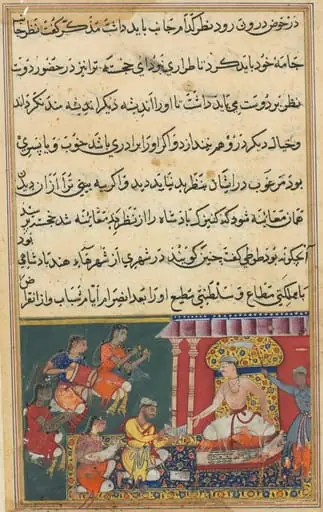 The astrologer predicts a calamity for the newly born prince in his thirteenth year, but one which he would be able to overcome, from a Tuti-nama (Tales of a Parrot): Eighth Night
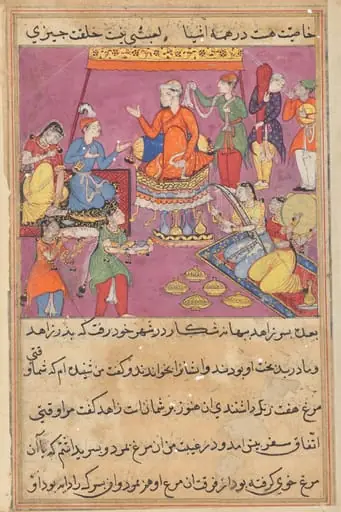 The king gives his daughter in marriage to the pious man’s son, from a Tuti-nama (Tales of a Parrot): Fifty-second Night
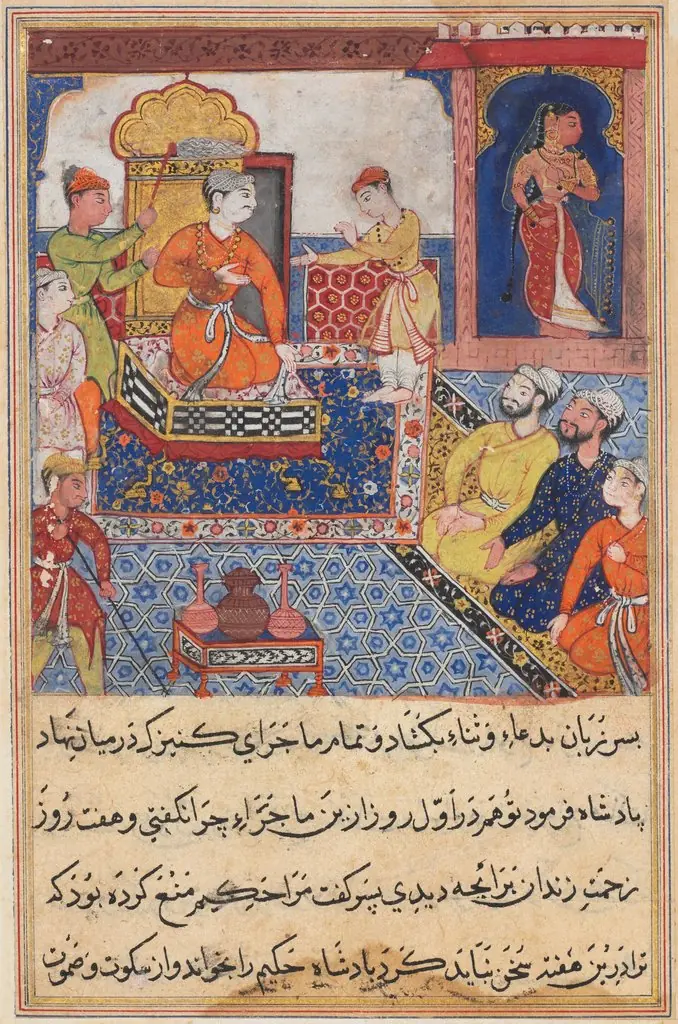 The young prince recounts his experiences to his father, the king, from a Tuti-nama (Tales of a Parrot): Eighth Night
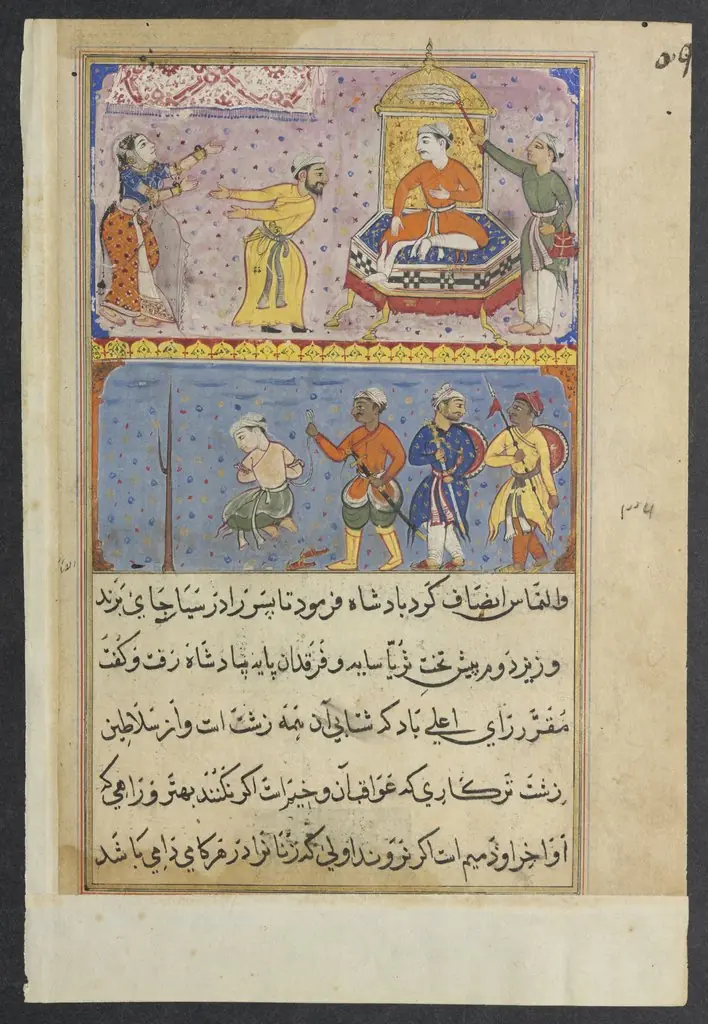 The prince, once reprieved, is returned to the palace of execution a second time on the plea of the king’s handmaiden, from a Tuti-nama (Tales of a Parrot): Eighth Night
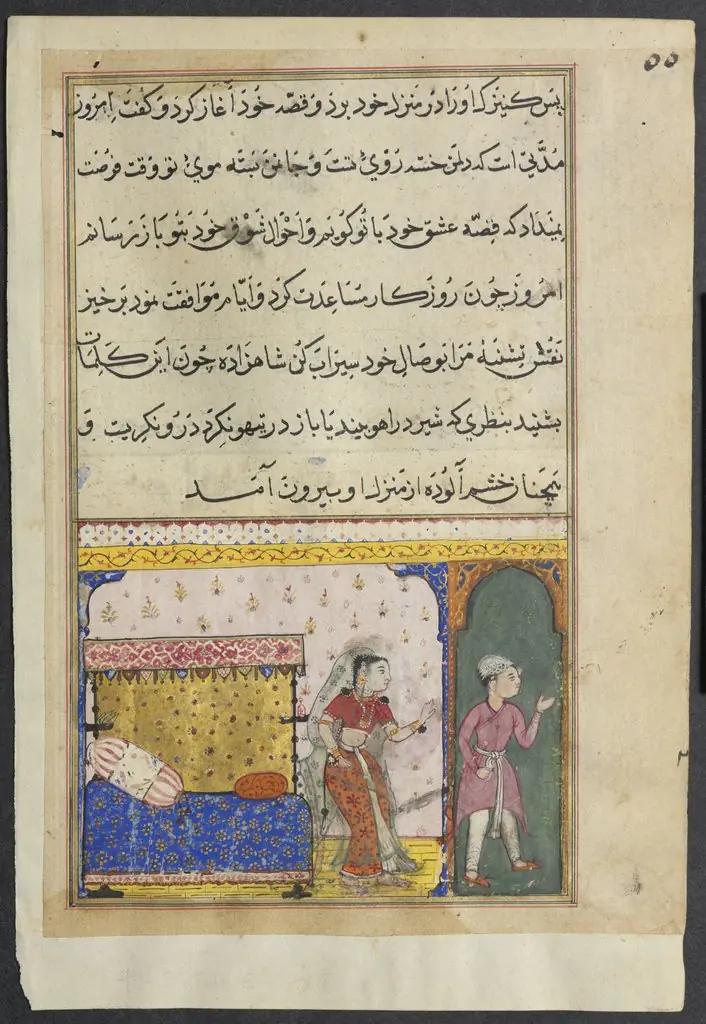 The prince rejects the amorous advances of the king’s handmaiden, from a Tuti-nama (Tales of a Parrot): Eighth Night