Artwork
Tablou, ulei pe pânză, ”23 August”, nesemnat, atribuit Teodor Cioată. Nicolae și Elena Ceaușescu sunt prezentați în mijlocul mulțimii. Proporțiile reprezentării personajelor principale, soții Ceaușescu, nu sunt respectate de către artist - capetele sunt prea mari, la fel și mâinile care sunt ținute în poziții nefirești. În partea de jos a tabloului oameni ai muncii cu steaguri ovaționând. Tablou oferit de autor, Iași, august 1974.
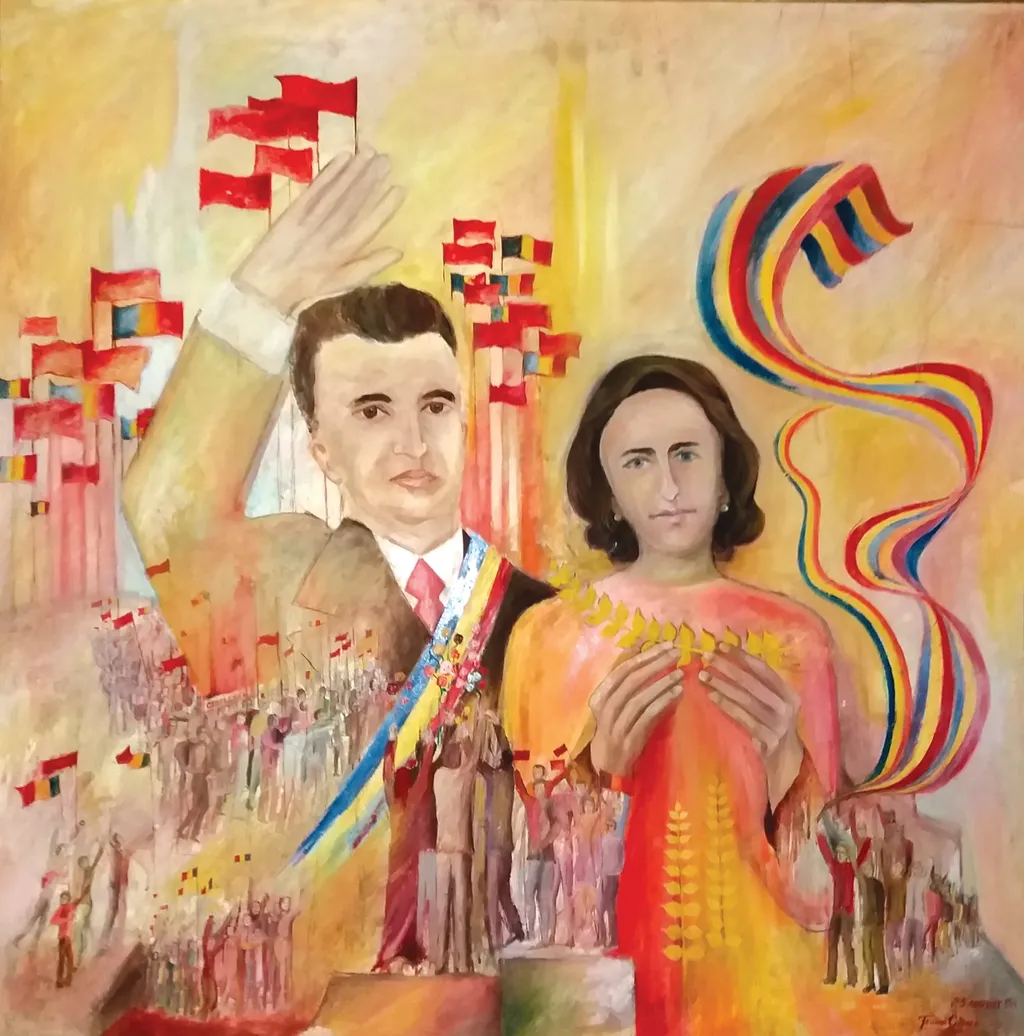
Tablou, ulei pe pânză, ”23 August”, nesemnat, atribuit Teodor Cioată. Nicolae și Elena Ceaușescu sunt prezentați în mijlocul mulțimii. Proporțiile reprezentării personajelor principale, soții Ceaușescu, nu sunt respectate de către artist - capetele sunt prea mari, la fel și mâinile care sunt ținute în poziții nefirești. În partea de jos a tabloului oameni ai muncii cu steaguri ovaționând. Tablou oferit de autor, Iași, august 1974. is a print by Teodor Cioată. It is held in the collection of the National Museum of Romanian History.
About this work
This painting shows two people standing side by side in the center, with a crowd holding flags in the background.
This painting shows two people standing side by side in the center, with a crowd holding flags in the background. The man wears a suit with a red sash, and the woman has her hands clasped together. Bright colors—reds, yellows, and blues—fill the scene, with wavy brushstrokes and thick paint. The background looks busy, like a celebration or parade.
The faces are oversized, and the hands look stiff, almost like they’re posed for a photo. This was painted in 1974 in Iași, Romania, and given to the museum by the artist himself.
If you like this style, check out impasto for more on thick paint techniques.
Overview
This unsigned oil painting, attributed to Teodor Cioată, depicts Nicolae and Elena Ceaușescu at the center of a public gathering, created in Iași in August 1974. The artist presented it directly to a museum that same month. Rendered with thick, expressive brushwork and vivid hues of red, blue, and yellow, the scene evokes a state-sponsored celebration. The figures are rendered with exaggerated proportions, suggesting a deliberate departure from naturalism in favor of symbolic representation.
Subject & Meaning
The painting portrays the Romanian communist leaders surrounded by a crowd of workers waving flags, reinforcing the regime’s narrative of popular support. Their central positioning and elevated stature, despite distorted anatomy, signal authority and divine-like presence. The clasped hands of Elena and the sash worn by Nicolae align with official iconography, while the crowd’s uniform gestures imply collective loyalty, transforming the scene into a visual affirmation of state ideology.
Technique & Style
The artist employs heavy impasto and wavy brushstrokes to build texture, emphasizing surface over anatomical accuracy. Faces and hands are enlarged and stiffly posed, deviating from realistic proportion. The background is densely packed with figures and flags, creating visual noise that contrasts with the static, almost sculptural quality of the central pair. Bright, unmodulated colors heighten the theatricality, aligning the work with state-approved visual language rather than individual artistic expression.
History & Provenance
Painted in Iași in August 1974, the work was donated to a museum by the artist himself the same month. No record of prior ownership or commission exists, suggesting it was produced independently but aligned with official aesthetics. Its attribution to Teodor Cioată rests on stylistic analysis and the artist’s documented activity in Iași during the period. The painting entered institutional collection without public exhibition history at the time of donation.
Context
Created during the height of Ceaușescu’s cult of personality, the painting reflects the state’s demand for imagery that fused mass mobilization with leader worship. Official art of the era prioritized symbolic clarity over realism, using exaggerated forms to convey ideological messages. Regional artists like Cioată often produced such works under informal pressure or personal alignment with the regime, contributing to a visual culture designed to legitimize political power.
Legacy
The painting remains an artifact of Romania’s communist visual propaganda, preserved not for aesthetic innovation but as a document of its time. Its technical shortcomings and stylized distortions are now interpreted as indicators of the regime’s control over artistic expression. It holds historical value as a case study in how state ideology shaped artistic production, rather than as a significant contribution to modern Romanian painting.
Artist & collection
Artist
This artist painted a single large oil canvas titled “23 August,” showing Romania’s 1944 coup day.

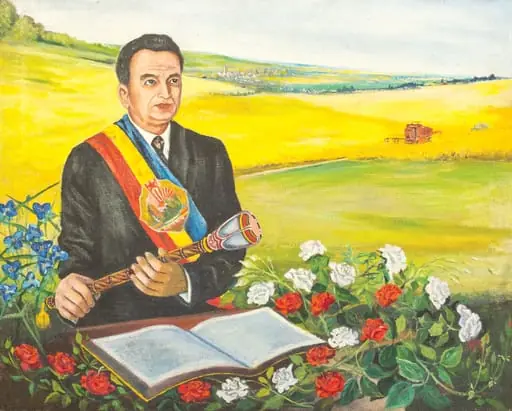 Tablou, ulei pe pânză, ”Nicolae Ceaușescu, președinte”, nesemnat, atribuit I.C. Popescu - Stolojan. Nicolae Ceaușescu este prezentat în momentul învestirii în funcția de președinte al Republicii Socialiste România. Poartă însemnele funcției eșarfa tricoloră, sceptrul prezidențial. Sala Marii Adunări Naționale a fost înlocută cu un fundal agricol - un lan de grâu treierat de o combină. Pupitrul este decorat cu trandafiri și iriși. Oferit de autor, 1976.
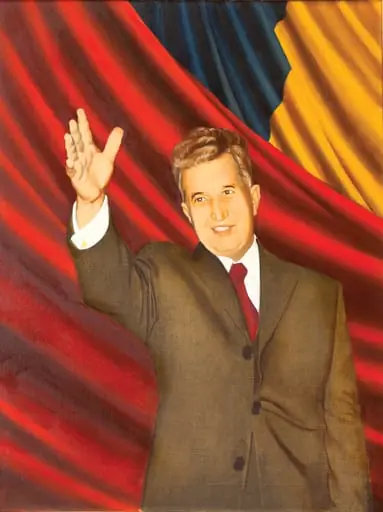 Tablou, ulei pe pânză, „Salutul președintelui”, atribuit lui Viorel Toma, nedatat. Nicolae Ceaușescu este reprezentat în centrul tabloului salutând, pe fundal steagul PCR și cel al RSR. Comandat și oferit de Comitetul Județean de Partid Timiș (1985).
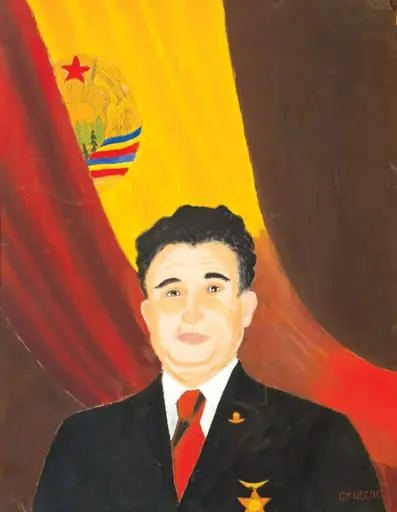 Tablou, ulei pe carton, ”Nicolae Ceaușescu”, semnat Gh. Nechita în partea dreaptă jos. Nicolae Ceaușescu este prezentată cu o figură veselă, în piept are însemnul de ”Erou al Republicii Socialiste România. În spatele său s-a vrut a fii reprezentat steagul cu stema RSR, numai ca, nu există culoarea albastru ea fiind înlocuită de culoarea maro. Oferit lui Nicolae Ceaușescu de către autor Gheorghe Nechita din Baia Mare, 26 ianuarie 1976.
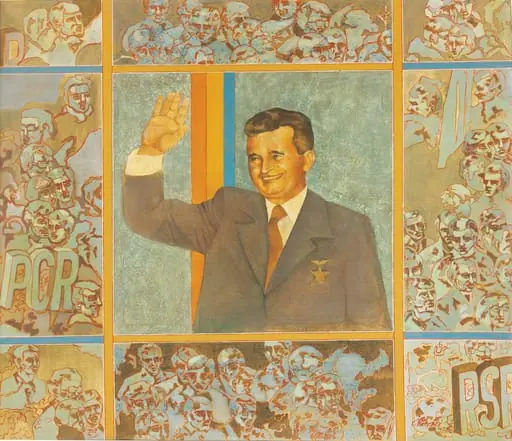 Tablou, ulei pe pânză, „Portret Nicolae Ceaușescu”, semnat în partea dreaptă jos C.Macavei și datat 1978. Tablou împărțit în mai multe registre, în plan central Nicolae Ceaușescu salutând oamenii muncii din celelalte registre. Comandat și oferit de Comitetul Județean de Partid Ilfov, 23 ianuarie 1978.
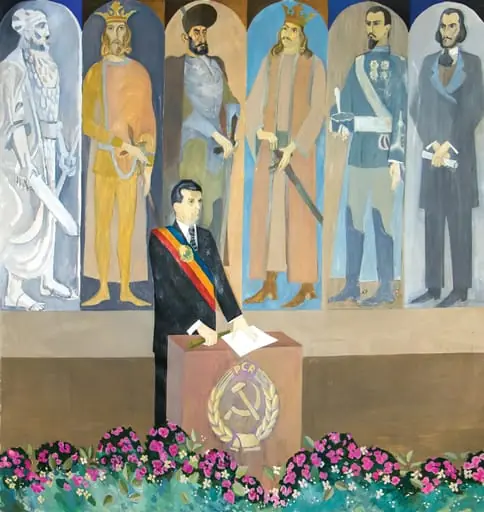 Tablou, ulei pe pânză, ”Omagiu”, semnat Constantin Piliuță. Nicolae Ceaușescu la un pupitru cu însemnele PCR depunând jurământul de învestire; poarte însemnele prezidențiale eșarfa tricoloră cu stema RSR, sceptrul, însemnul de ”Erou al Republicii Socialiste România”. Pe fundal sunt reprezentați Burebista, Mircea cel Bătrân, Mihai Viteazul, Ștefan cel Mare, Alexandru Ioan Cuza, Nicolae Bălcescu, personajele au o mimică solemnă, dau impresia că sunt garanții jurământului pe care-l face Nicolae Ceaușescu. Comandat și oferit lui Nicolae Ceaușescu de Consiliul Culturii și Educației Socialiste, ianuarie 1978.
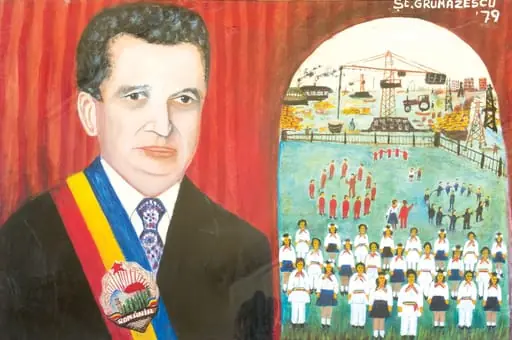 Tablou, ulei pe pânză, Nicolae Ceaușescu și copii, semnat și datat în partea dreaptă sus Șt. Grumăzescu, 1979. Nicolae Ceaușescu este prezentat în partea stângă urmărind o festivitate - pionieri, copii dansând în horă. Maniera de realizare a tabloului este una naivă. Oferit de Ștefan Grumăzescu din București.
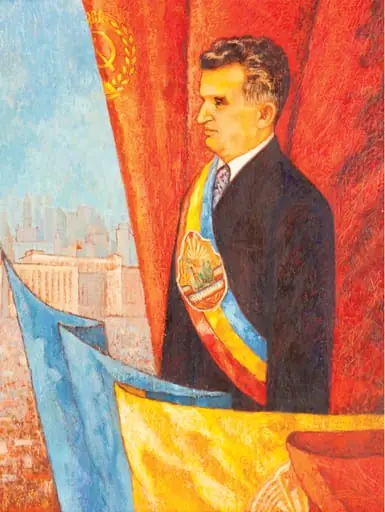 Tablou, ulei pe pânză, „Nicolae Ceaușescu, întâiul președinte al României”, semnat C.Aurel și datat 1974 în partea dreaptă jos. Nicolae Ceaușescu purtând banderolă tricoloră cu stema R.S.R., stând la balcon primind ovații din partea oamenilor muncii adunați într-o piață. În spatele său, steagul cu sigla PCR. Tablou oferit de către autor originar din Câmpina (Prahova), 19 august 1974.
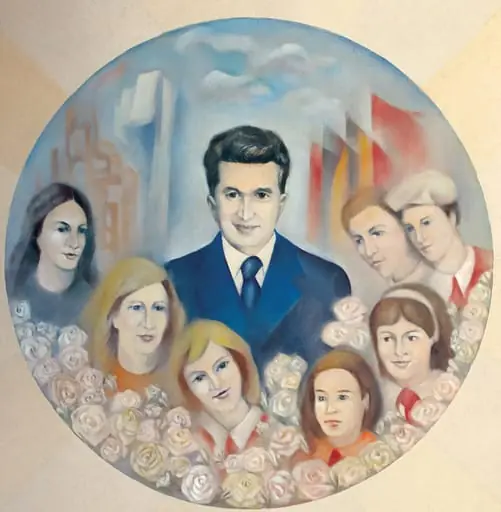 Tablou ulei pe pânză, „Nicolae Ceaușescu”, nesemnat, atribuit lui Ion Pantilie, nedatat. Nicolae Ceaușescu este reprezentat în mijlocul copiilor și tinerilor. Comandat și oferit de Comitetul Județean de Partid Argeș (1988).
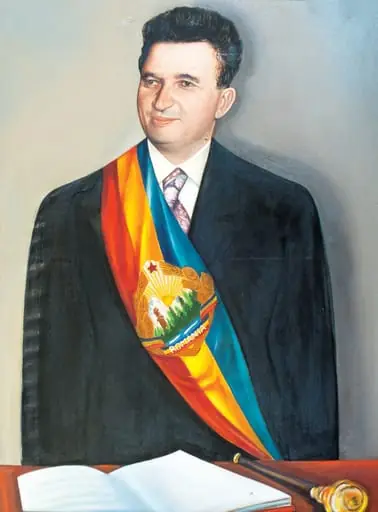 Tablou, ulei pe pânză, ”Portret Nicolae Ceaușescu”, nesemnat, atribui lui Nicolae Toma. Oferit de autor, cu ocazia zilei de naștere a lui Nicolae Ceaușescu, Ploiești, ianuarie 1978.
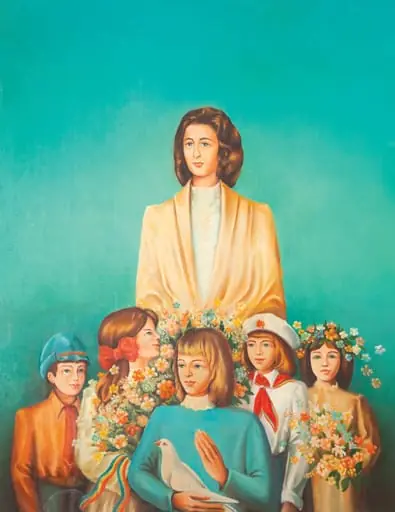 Tablou, ulei pe pânză, „Elena Ceușescu cu un grup de copii”, nesemnat, atribuit Constantin Oprea. Elena Ceaușescu este prezentată înconjurată de copii, șoimi ai patriei, pionieri. Autorul tabloului o înfățișează pe Elena Ceaușescu ca pe o profesoară, o îndrumătoare a tinerei generații. Comandat și oferit de Comitetul Județean de Partid Caraș Severin (1984).
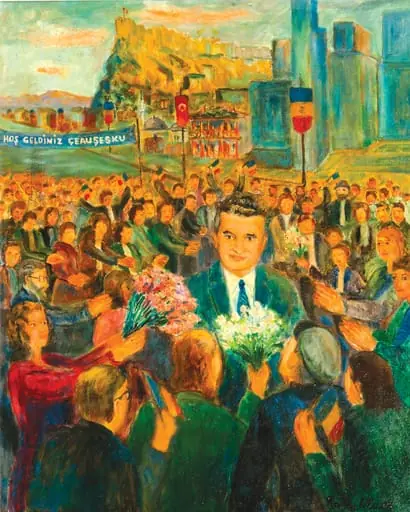 Tablou, portret Nicolae Ceaușescu în vizită la Ankara. Tablou realizat și oferit de Rami Uluer (președintele Asociației Pictorilor Turci din Ankara) lui Nicolae Ceaușescu cu ocazia vizitei la Ankara din 1985. Tabloul îl înfățișază pe Nicolae Ceaușescu într-o baie de mulțime aclamat de mulțimea entuziastă.
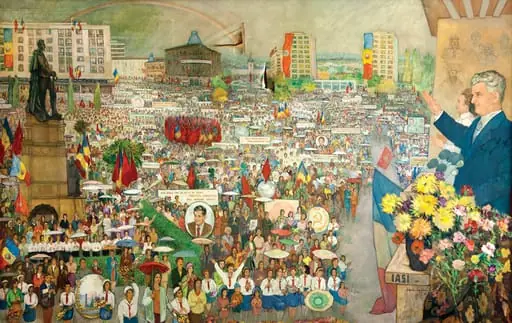 Tablou ”Mitingul din Piața Unirii din Iași de la 15 septembrie 1980”, semnat Costache Agafiței și datat în partea dreaptă jos. Tabloul îi înfățișază pe Elena și pe Nicolae Ceaușescu la balcon salutând mulțimea adunată în Piața Unirii din Iași. Comandat de Comitetul Județean de Partid Iași și dăruit soților Ceaușescu în octombrie 1981.
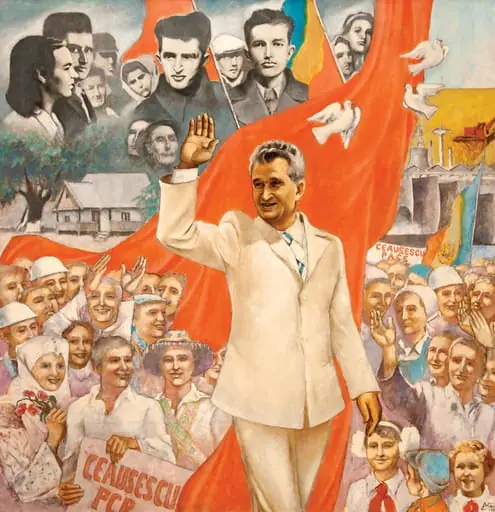 Tablou „Eroul României Socialiste” , semnat și datat în dreapta jos ”Constantin Nițescu 1988”. Comandat de Comitetul Județean de Partid Olt și oferit cadou lui Nicolae Ceaușescu la împlinirea vârstei de 70 de ani (ianuarie 1988).
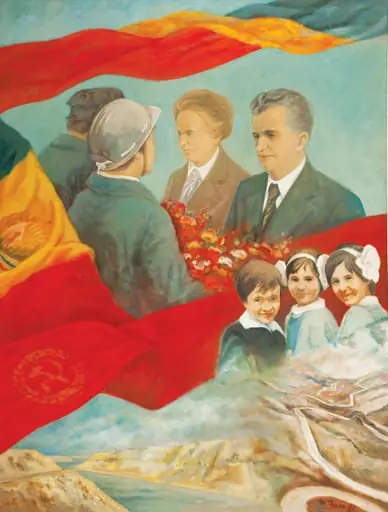 Tablou „Omagiul Președintelui Țării”, ulei pe pânză; semnat Gheorghe Pogan și datat în partea dreaptă jos. Tabloul îi prezintă pe soții Ceaușescu întâmpinați cu flori de două personaje masculine (un miner și un petrolist), învăluiți de tricolor și steagul PCR. În dreapta lui Nicolae Ceaușescu (dreapta tabloului) trei elevi. Partea de jos a tabloului este completată cu reprezentarea Transfăgărășanului și a Canalului Dunăre - Marea Neagră. Comandat și oferit de Comitetul Județean de Partid Hunedoara (1988).
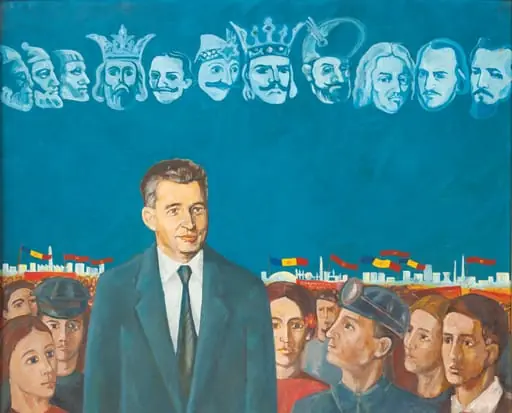 Tablou, ulei pe pânză, „Omagiu”, nesemnat. Nicolae Ceaușescu este prezentat în mijlocul oamenilor muncii vegheat de ”fantomele” eroilor neamului : Burebista, Decebal, Traian, Mircea cel Bătrân, Iancu de Hunedoara, Vlad Țepeș, Ștefan cel Mare, Mihai Viteazul, Dimitrie Cantemir, Nicolae Bălcescu, Alexandru Ioan Cuza (de la stânga la dreapta). Comandat și oferit de Comitetul Județean de Partid Tulcea, 22 ianuarie 1978.
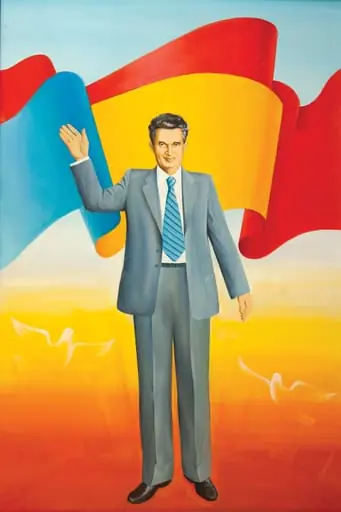 Tablou „ Ceaușescu Pace”, semnat M. Ceacîru și datat dreapta jos. Tabloul îl prezintă pe Nicolae Ceaușescu salutând, în spatele său flutură tricolorul și stegul PCR, în stânga și în dreapta sa doi porumbei albi în zbor.Comandat de Comitetul Județean de Partid Neamț (1989)
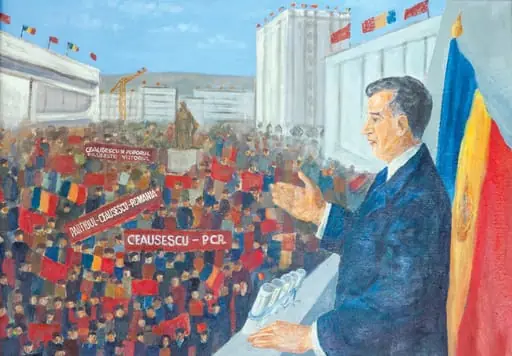 Tablou, ulei pe pânză, „Adunarea populară din Vaslui, iulie 1975”. Realizat de Cercul de Artă Plastică „Arta Vaslui”. Nicolae Ceaușescu vorbește de la balcon oamenilor muncii adunați în centrul civic din Vaslui. Se distinge statuia lui Ștefan cel Mare. Oamenii muncii flutură steaguri și pancarte (”Ceaușescu PCR”, ”Partidul - Ceaușescu - România”, ”Ceaușescu și Poporul Făurește Viitorul”. Oferit de Comitetul Județean de Partid Vaslui, 23 ianuarie 1978.
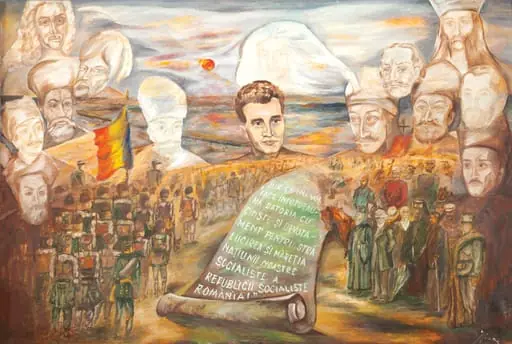 Tablou, ulei pe pânză, executat de Cercul Pionerilor din Drăgănești. A fost realizat, probabil, pentru aniversarea centenarului Independenței (1977). În parte inferioară este reprezentată trercerea Dunării de către armatele române (inspirat dintr-o coromolitografie a Institutuli de Arte Grafice București). În centrul tabloului este figura lui Nicolae Ceaușescu și un pergament pe care este notat jurământul rostit la investitură ”Jur că îmi voi face întodeauna datoria cu cinste și devotament pentru strălucirea și măreția națiunii noastre socialiste a Republicii Socialiste România”. Pe fundal chipurile eroilor neamului ce-l veghează pe ”marele erou” : Dimitrie Cantemir, Ioan Vodă cel Cumplit, Alexandru cel Bun, Avram Iancu, Constantin Brâncoveanu, Matei Basarab, Neagoe Basarab, Iancu de Hunedoara, Vlad Țepeș, Mihai Viteazul, Alexandru Ioan Cuza, Tudor Vladimirescu. Comandat și oferit de Comitetul Județean de Partid Olt, 24 ianuarie 1978.