Artwork
Akbar and Jaimal
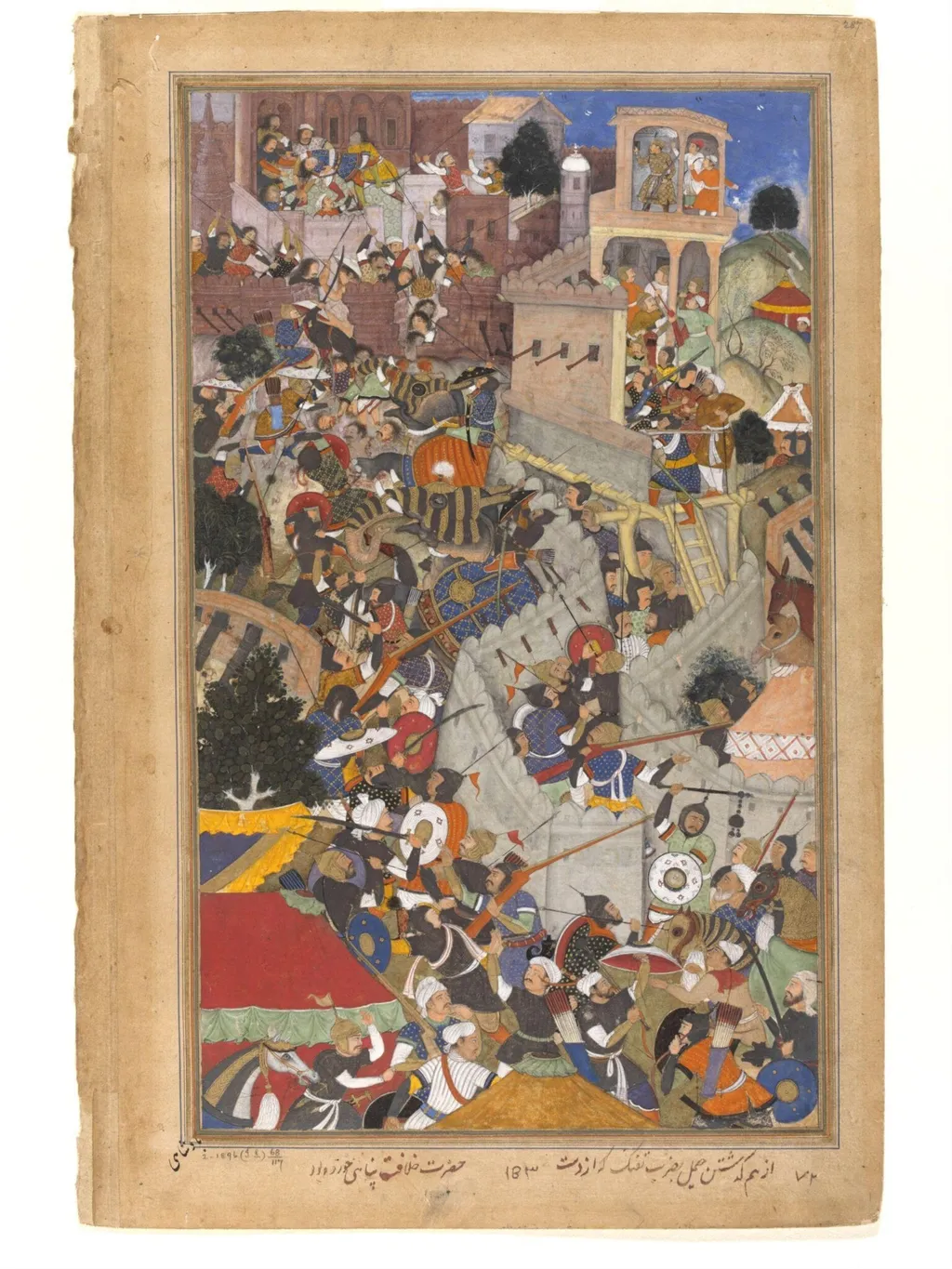
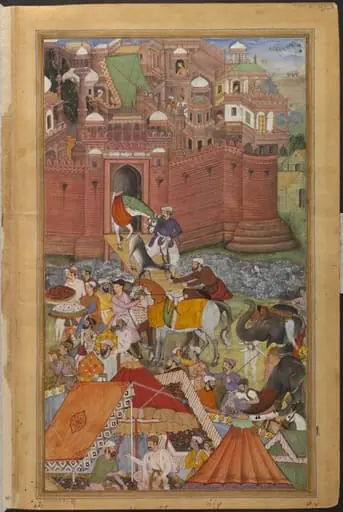
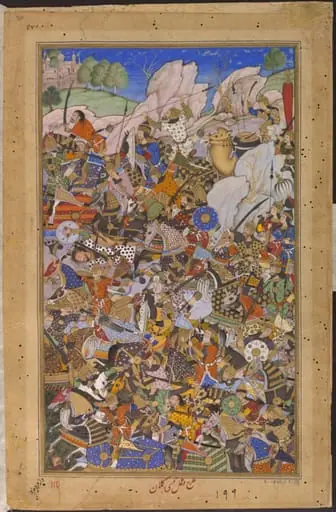
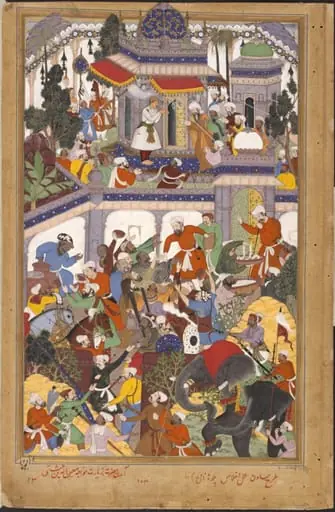
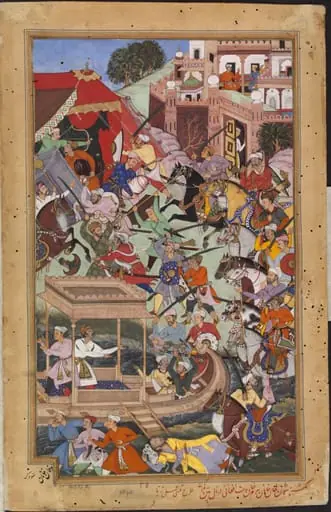
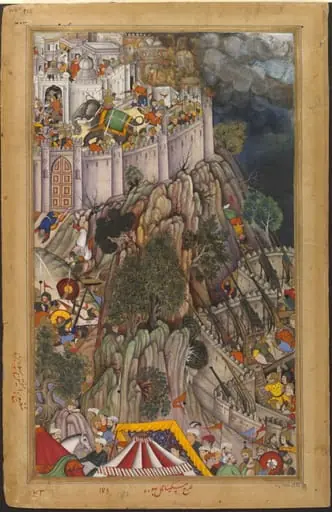
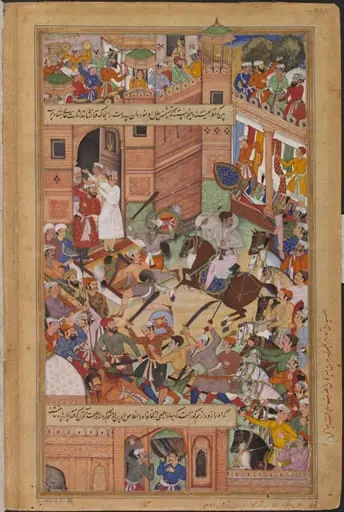
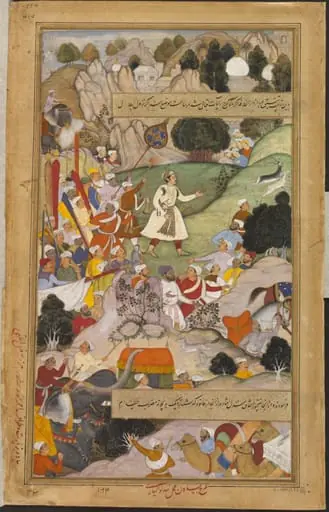
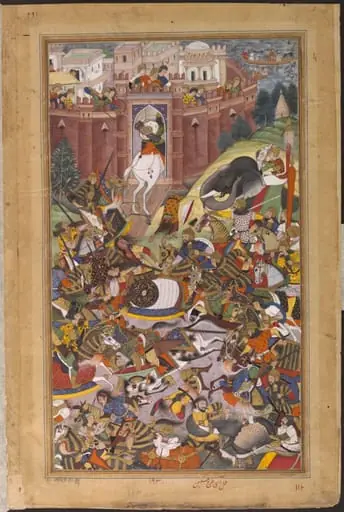
Akbar and Jaimal is a paint painting by the Mughal Painting artist Unknown. It dates from 1592 and is held in the collection of the Victoria and Albert Museum. This painting is one of many illustrations created for the Akbarnama, the official chronicle of Emperor Akbar’s reign.
About this work
Overview
This painting is one of many illustrations created for the Akbarnama, the official chronicle of Emperor Akbar’s reign.
This painting is one of many illustrations created for the Akbarnama, the official chronicle of Emperor Akbar’s reign. It captures a pivotal moment during the 1568 siege of Chitor, a Rajput stronghold in Rajasthan. The scene portrays Akbar, observing from a distance, taking aim at a defender on the ramparts. The work was produced in the imperial atelier between 1592 and 1594, part of a larger manuscript commissioned to legitimize Mughal authority through visual and textual history.
Subject & Meaning
The painting depicts the death of Jaimal, a revered Rajput commander, struck by Akbar’s bullet during the siege. His fall is presented as a turning point that led to the fortress’s surrender. By showing Akbar personally engaging in combat, the image reinforces his image as a warrior-emperor. The portrayal subtly blends historical fact with political symbolism, framing Mughal victory as both inevitable and divinely sanctioned.
Technique & Style
Executed in opaque watercolor and gold on paper, the painting employs fine brushwork and layered pigments to render textures of armor, fabric, and stone. Figures are rendered with precise detail, while the background suggests depth through atmospheric perspective rather than linear perspective. Subtle gradations in tone, akin to sfumato, soften transitions between light and shadow, enhancing the drama without overt realism.
History & Provenance
The Akbarnama manuscript was completed under Akbar’s patronage and remained in the imperial library through the reigns of Jahangir and Shah Jahan. After centuries in royal collections, it entered private hands in the 19th century. In 1896, the Victoria and Albert Museum acquired the volume from Mrs. Frances Clarke, widow of a British colonial officer who had obtained it during his service in northern India.
Context
The Akbarnama was part of a broader imperial project to document Mughal rule with scholarly rigor and artistic grandeur. Its illustrations merged Persian, Indian, and emerging European influences, reflecting Akbar’s cosmopolitan court. The siege of Chitor was particularly significant, symbolizing the subjugation of powerful Rajput resistance and the consolidation of Mughal control over Rajasthan.
Legacy
The Akbarnama’s illustrations set a standard for Mughal historiographic art, influencing later court painting traditions. This particular scene endures as a key example of how political narratives were visually encoded in early modern India. Today, it remains a vital artifact for understanding the intersection of power, memory, and representation in Mughal culture.
Artist & collection

 Domestic Scene
 Giacomo and Cardinal Marco, investing Andrea, Abbot of San Zeno, with his Benefice
 The Nymph of Fontainebleau
 Portrait of a Woman
 Madonna and Child with Saints in the Enclosed Garden
 Venus and Minerva
 Family Group of Four on Sofa
 Wall painting from Room H of the Villa of P. Fannius Synistor at Boscoreale