Artwork
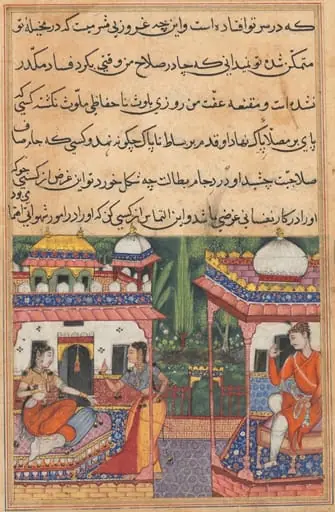
The daughter of the merchant of Mazanderan asks the gardener for the rose, from a Tuti-nama (Tales of a Parrot): Twelfth Night
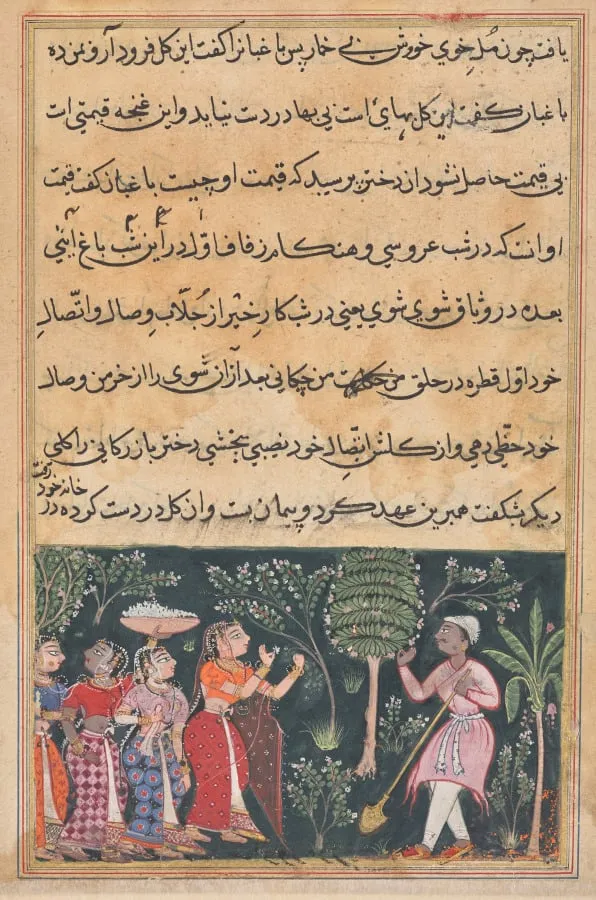
The daughter of the merchant of Mazanderan asks the gardener for the rose, from a Tuti-nama (Tales of a Parrot): Twelfth Night is an unspecified painting by the Mughal Painting artist Unknown. It dates from 1560 and is held in the collection of the Cleveland Museum of Art. The miniature illustrates a scene from the Tuti‑nama, a collection of fifty‑two parrot tales traditionally read from right to left.
About this work
A woman in a stiff, gold-trimmed robe kneels in a garden, pointing at a rose held by a gardener.
A woman in a stiff, gold-trimmed robe kneels in a garden, pointing at a rose held by a gardener. Behind them, a servant waits with a tray of sweets. The trees are flat, bright green shapes against a plain background.
This painting comes from a book of 52 parrot tales read right to left. The artist kept older Persian styles—figures in sharp profile, bold outlines, no deep space. It was made for Emperor Akbar’s court, where artists mixed Persian and Indian traditions.
Look up *Mughal India, court of Akbar (reigned 1556–1605)* to see more work from this time.
Overview
The miniature illustrates a scene from the Tuti‑nama, a collection of fifty‑two parrot tales traditionally read from right to left. In the image a woman in a gold‑trimmed robe kneels in a garden, indicating a rose to a gardener, while a servant stands nearby with a tray of sweets. The composition is confined to a single horizontal band, characteristic of the manuscript’s visual format.
Subject & Meaning
The narrative depicts a merchant’s daughter requesting a rose from the garden’s caretaker, a motif drawn from the story’s dialogue. The presence of the servant with sweets suggests hospitality and the social customs surrounding courtly courtship rituals within the tale.
Technique & Style
The artist employs bold, flat outlines for trees and figures, preserving pre‑Mughal Persian conventions. Characters are rendered in sharp profile, their garments falling in stiff, angular folds, and gestures are exaggeratedly expressive. The limited depth and use of bright, flat green foliage reflect an adaptation of earlier Persian visual language within a Mughal manuscript context.
History & Provenance
Created for the imperial workshop of Emperor Akbar (reigned 1556–1605), the miniature belongs to a period when Mughal painters blended Persian artistic heritage with emerging Indian influences. The work remains part of a bound manuscript of the Tuti‑nama, a text that circulated among the court’s literary circles.
Context
During Akbar’s reign, the imperial atelier encouraged the synthesis of Persian and indigenous Indian styles, resulting in works that retained traditional Persian figure types while incorporating local color palettes and decorative motifs. This painting exemplifies that cultural exchange, illustrating how narrative illustration served both literary and decorative functions in the Mughal court.
Artist & collection

 Domestic Scene
 Giacomo and Cardinal Marco, investing Andrea, Abbot of San Zeno, with his Benefice
 The Nymph of Fontainebleau
 Portrait of a Woman
 Madonna and Child with Saints in the Enclosed Garden
 Venus and Minerva
 Family Group of Four on Sofa
 Wall painting from Room H of the Villa of P. Fannius Synistor at Boscoreale
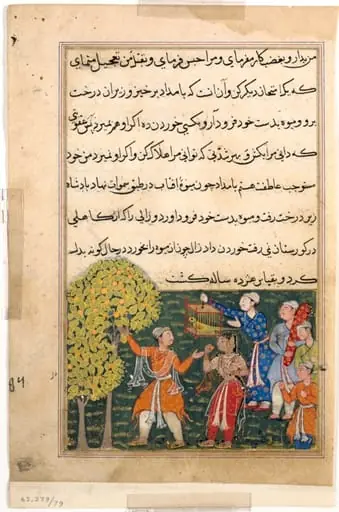 The king plucks fruit from the Tree of Life with his own hands and feeds it to a lady, from a Tuti-nama (Tales of a Parrot): Ninth Night
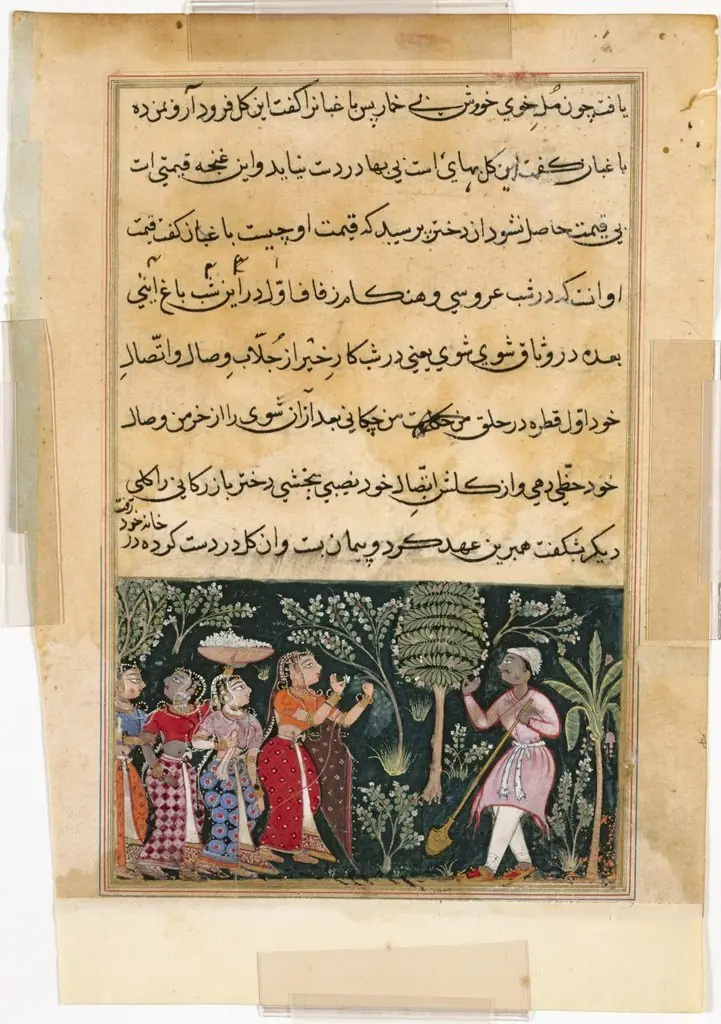 The daughter of the merchant of Mazanderan asks the gardener for the rose, from a Tuti-nama (Tales of a Parrot): Twelfth Night
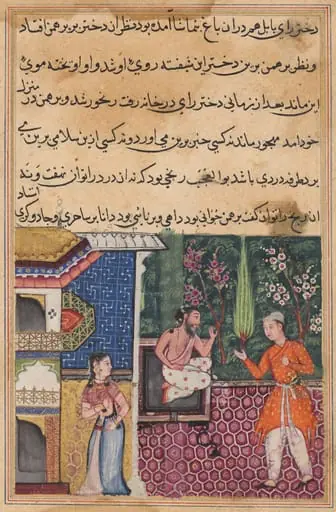 The Brahman gives an account of his falling in love with the king of Babylon’s daughter to his friend, the magician, from a Tuti-nama (Tales of a Parrot): Thirty-fifth Night
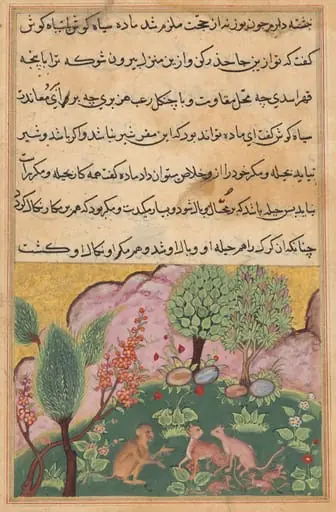 The monkey, serving as the lion’s chamberlain, converses with the lynx and its mate who have arrived with their cubs to settle in the lion’s domain, from a Tuti-nama (Tales of a Parrot): Twenty-ninth Night
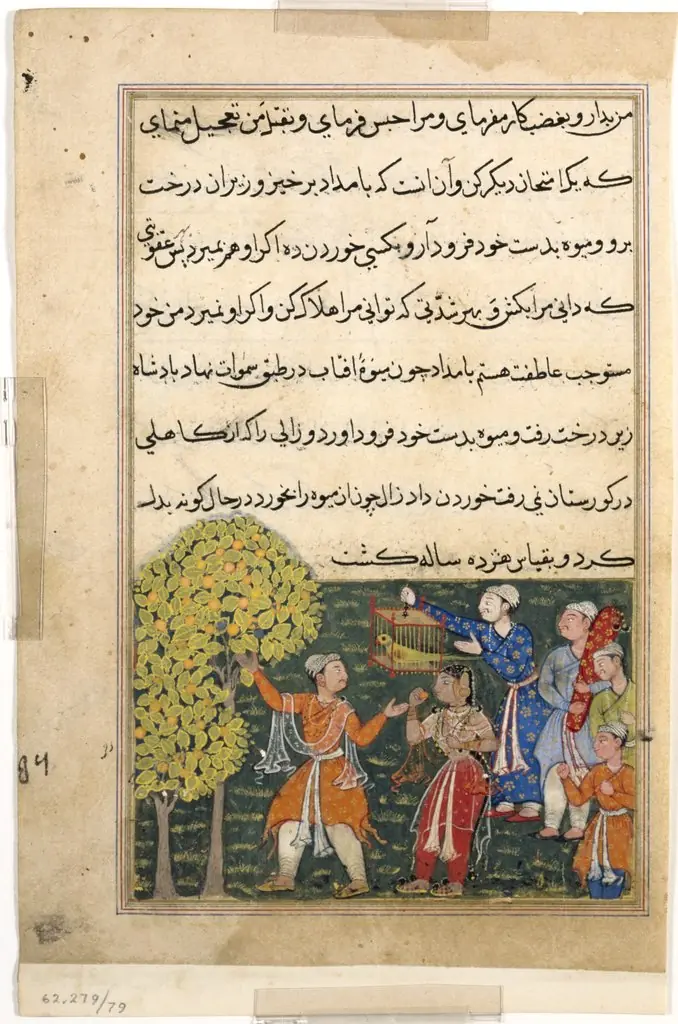 The king plucks fruit from the Tree of Life with his own hands and feeds it to a lady, from a Tuti-nama (Tales of a Parrot): Ninth Night
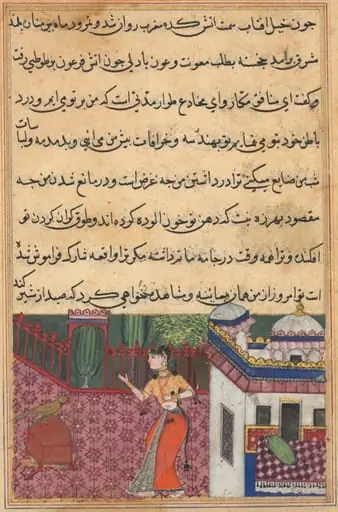 The parrot addresses Khujasta at the beginning of the thirty-third night, from a Tuti-nama (Tales of a Parrot)
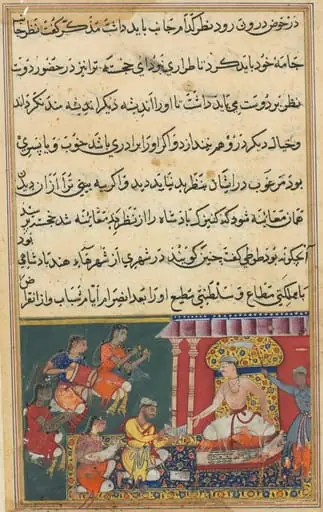 The astrologer predicts a calamity for the newly born prince in his thirteenth year, but one which he would be able to overcome, from a Tuti-nama (Tales of a Parrot): Eighth Night
 Kaiwan sends a message of love to Khurshid, wife of his brother Utarid who is away on a journey, from a Tuti-nama (Tales of a Parrot): Thirty-second Night