Artwork
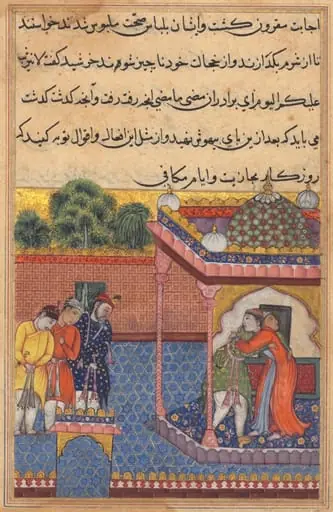
Kaiwan sends a message of love to Khurshid, wife of his brother Utarid who is away on a journey, from a Tuti-nama (Tales of a Parrot): Thirty-second Night
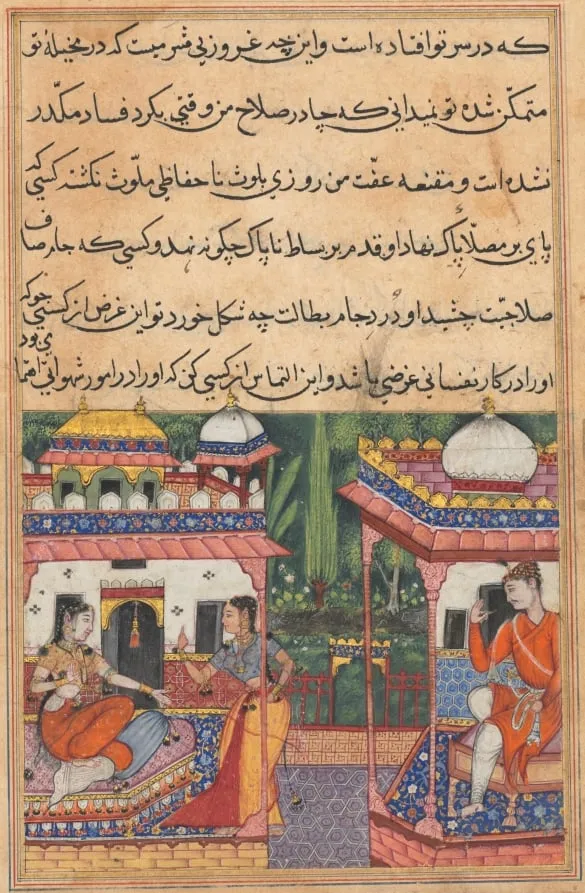
Kaiwan sends a message of love to Khurshid, wife of his brother Utarid who is away on a journey, from a Tuti-nama (Tales of a Parrot): Thirty-second Night is an unspecified painting by the Mughal Painting artist Unknown. It dates from 1560 and is held in the collection of the Cleveland Museum of Art. The painting illustrates a scene from the thirty‑second night of the *Tuti‑nama*, a collection of parrot stories presented to Emperor Akbar.
About this work
The story here is about love, loyalty, and secrets—Kaiwan sends a love note to his brother’s wife, but she rejects him.
You see two men and a woman in a richly decorated room. One man kneels, handing a letter to the woman, who sits stiffly on a bed. The other man waits nervously in the corner.
This painting comes from a *Tuti-nama*, a book of parrot tales told to Emperor Akbar. The story here is about love, loyalty, and secrets—Kaiwan sends a love note to his brother’s wife, but she rejects him.
To see more art like this, look up Mughal India, court of Akbar (reigned 1556–1605).
Overview
The painting illustrates a scene from the thirty‑second night of the *Tuti‑nama*, a collection of parrot stories presented to Emperor Akbar. In a lavishly appointed interior, a messenger delivers a love letter from Kaiwan to Khurshad, his brother Utarid’s wife, while Kaiwan watches anxiously from a corner.
Subject & Meaning
Khurshad, portrayed seated upright on a bed, receives the note with composure and rejects Kaiwan’s advances, reflecting her virtue and devotion. Kaiwan’s expression conveys nervous anticipation, and the messenger’s kneeling posture underscores the formality of the communication. The narrative explores themes of forbidden desire, loyalty, and the concealment of transgression.
Technique & Style
Rendered in the Mughal court style, the work combines detailed figural modeling with intricate decorative motifs on walls and furnishings. Fine brushwork delineates the characters’ garments and the sumptuous textiles, while a restrained palette highlights the interior’s richness without overwhelming the narrative focus.
History & Provenance
The composition originates from a manuscript of the *Tuti‑nama*, a literary project commissioned during Akbar’s reign (1556–1605). The illustrated page was likely produced in the imperial workshop, where artists adapted Persianate storytelling to the visual language of the Mughal court.
Context
The scene reflects the broader cultural milieu of Akbar’s empire, where courtly literature often intertwined moral instruction with entertainment. Parrot tales served as allegorical vehicles for exploring ethical dilemmas, and their illustrations provided a visual complement to the didactic content.
Artist & collection

 Domestic Scene
 Giacomo and Cardinal Marco, investing Andrea, Abbot of San Zeno, with his Benefice
 The Nymph of Fontainebleau
 Portrait of a Woman
 Madonna and Child with Saints in the Enclosed Garden
 Venus and Minerva
 Family Group of Four on Sofa
 Wall painting from Room H of the Villa of P. Fannius Synistor at Boscoreale
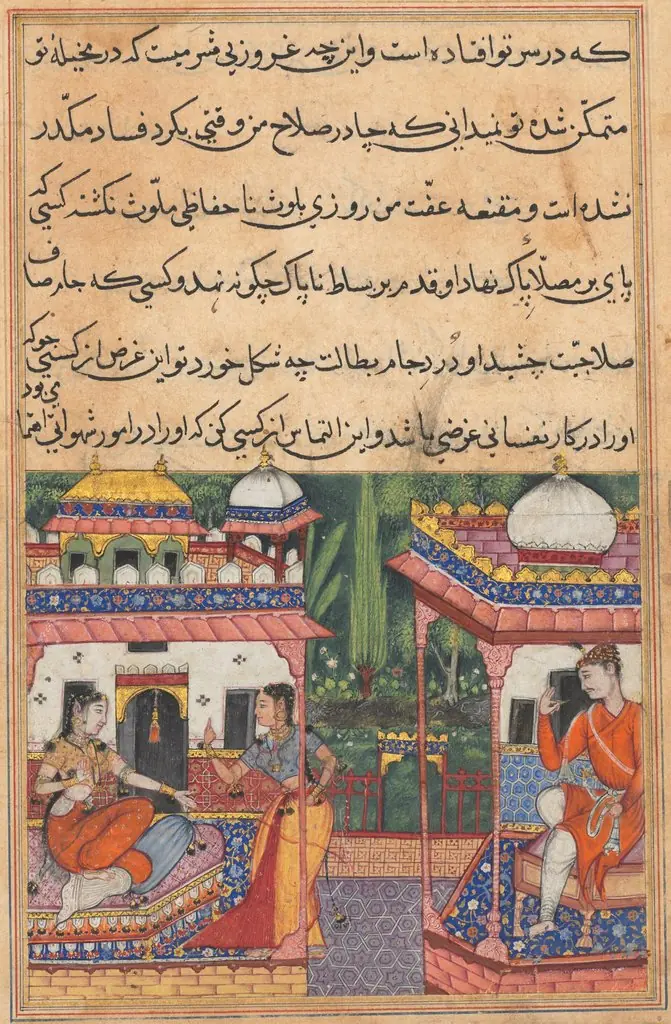 Kaiwan sends a message of love to Khurshid, wife of his brother Utarid who is away on a journey, from a Tuti-nama (Tales of a Parrot): Thirty-second Night
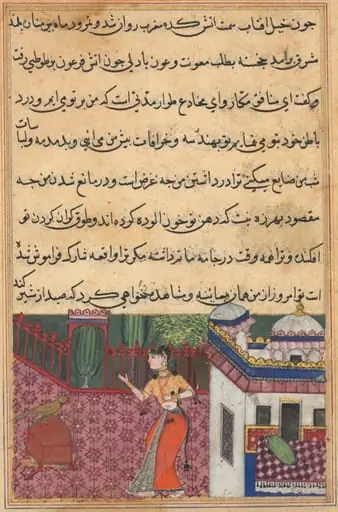 The parrot addresses Khujasta at the beginning of the thirty-third night, from a Tuti-nama (Tales of a Parrot)
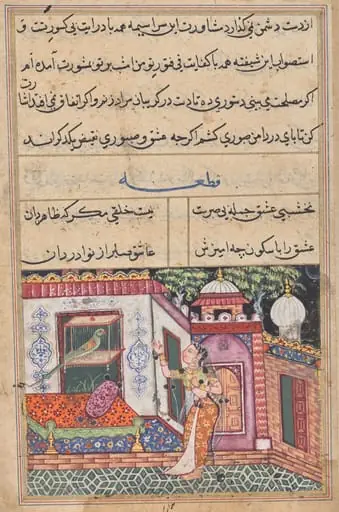 The Parrot Addresses Khujasta at the Beginning of the Eleventh Night, from a Tuti-nama (Tales of a Parrot)
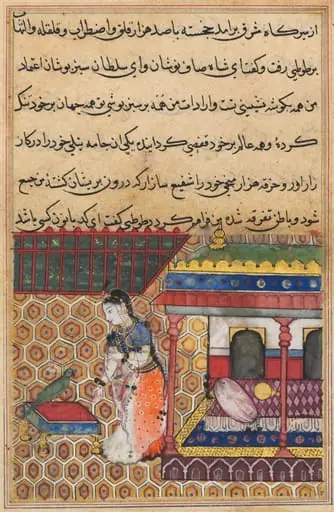 The parrot addresses Khujasta at the beginning of the thirty-eighth night, from a Tuti-nama (Tales of a Parrot)
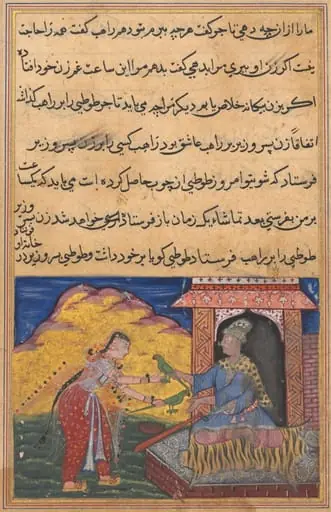 The wife of the son of the vizier brings the magic wooden parrot to her lover, the monk, who exchanges it for the replica, from a Tuti-nama (Tales of a Parrot): Tenth Night
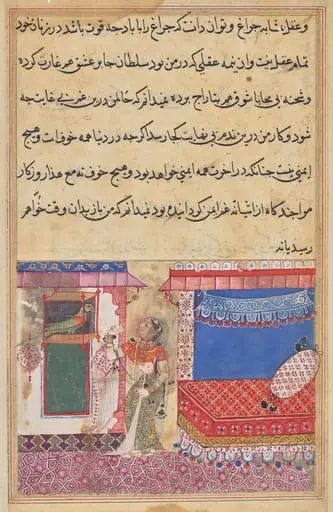 The Parrot Addresses Khujasta at the Beginning of the Eighteenth Night, from a Tuti-nama (Tales of a Parrot)
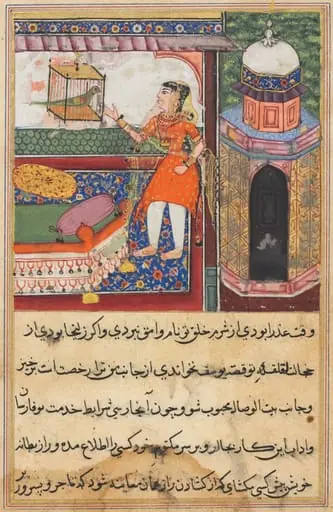 The Parrot Addresses Khujasta at the Beginning of the Tenth Night, from a Tuti-nama (Tales of a Parrot)
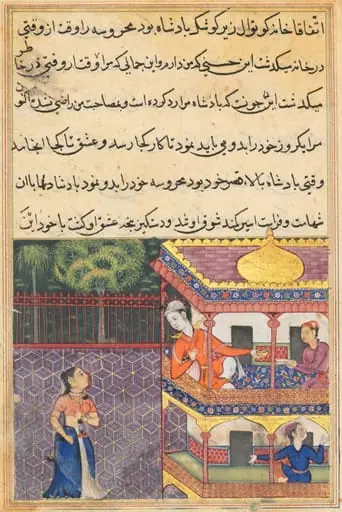 The king of Zabul sees Mahrusa from his palace balcony, from a Tuti-nama (Tales of a Parrot): Thirty-sixth Night
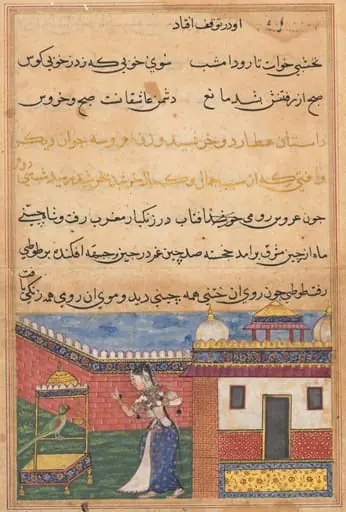 The parrot addresses Khujasta at the beginning of the thirty-second night, from a Tuti-nama (Tales of a Parrot)
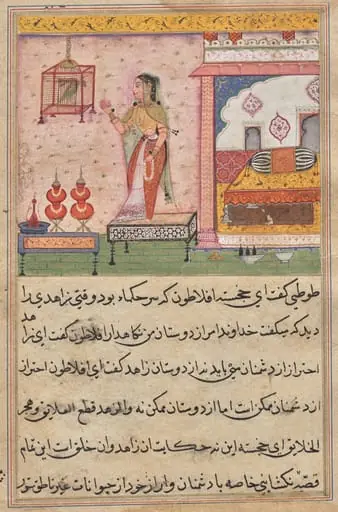 The Parrot Addresses Khujasta at the Beginning of the Twenty-third Night, from a Tuti-nama (Tales of a Parrot)
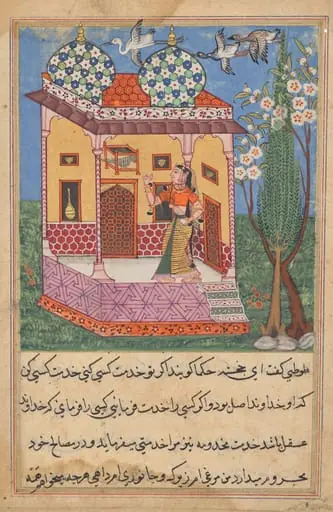 The Parrot Addresses Khujasta at the Beginning of the Twenty-sixth Night, from a Tuti-nama (Tales of a Parrot)
 Khurshid reunited with her husband Utarid, from a Tuti-nama (Tales of a Parrot): Thirty-second Night