Artwork
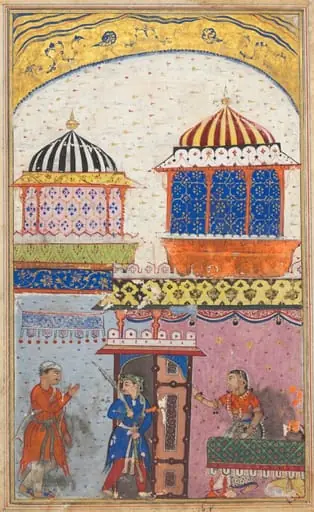
The merchant returns bringing a young slave who is really the son of the princess of Rum, now married to the king, from a Tuti-nama (Tales of a Parrot): Fiftieth Night
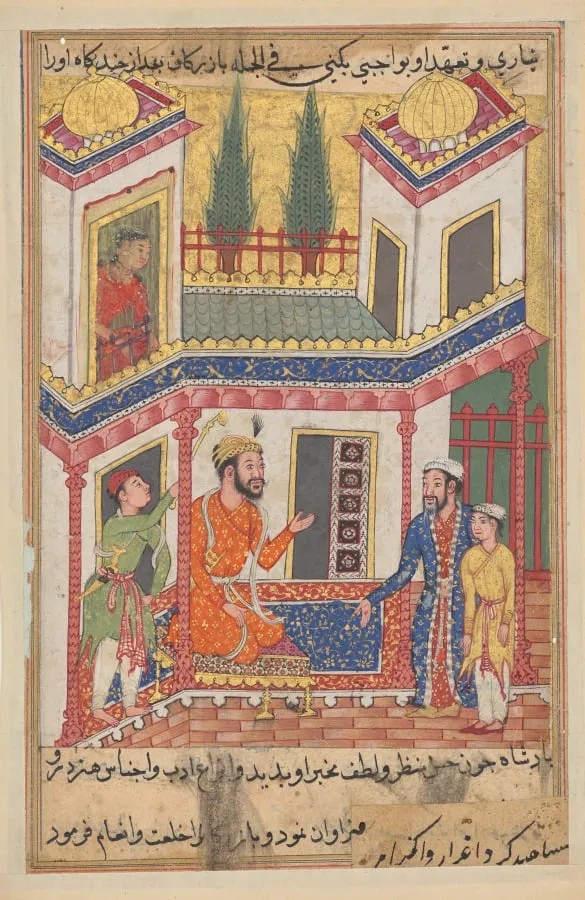
The merchant returns bringing a young slave who is really the son of the princess of Rum, now married to the king, from a Tuti-nama (Tales of a Parrot): Fiftieth Night is an unspecified painting by the Mughal Painting artist Unknown. It dates from 1560 and is held in the collection of the Cleveland Museum of Art. The work portrays a courtly encounter drawn from the fiftieth night of the Tuti‑nama, a collection of parrot tales.
About this work
The artist packed the scene with tiny clues—embroidered robes, jeweled turban ornaments—that show off the wealth of Akbar’s court.
You see a king on a throne, a merchant kneeling, and a young man in fine clothes standing between them. A woman watches from a high window, her face tight with worry.
This painting tells a secret story from a book of parrot tales. The young man is really the king’s stepson, smuggled in as a slave to hide his royal blood. The artist packed the scene with tiny clues—embroidered robes, jeweled turban ornaments—that show off the wealth of Akbar’s court.
To see more stories like this, look up Mughal India, court of Akbar (reigned 1556–1605).
Overview
The work portrays a courtly encounter drawn from the fiftieth night of the Tuti‑nama, a collection of parrot tales. A king seated on a throne receives a kneeling merchant who presents a young man in elegant attire. A princess watches anxiously from an elevated window, her expression tense as the boy is introduced to the ruler.
Subject & Meaning
The narrative centers on a concealed lineage: the youth is actually the son of the princess of Rum, now married to the king, but is presented as a slave to mask his royal origin. The princess’s concealed hope and the king’s curiosity about the boy’s supposed expertise in gemstones underscore themes of identity, deception, and political intrigue within the Mughal court.
Technique & Style
Rendered in the refined Mughal miniature tradition, the painting employs delicate brushwork and a rich palette to emphasize courtly opulence. Intricate details such as embroidered garments, jeweled turban ornaments, and the ornate throne convey the wealth of Akbar’s era, while the composition balances narrative focus between the central figures and the observing princess.
Context
The scene reflects the cultural milieu of late‑sixteenth‑century Mughal India under Emperor Akbar (1556–1605), a period noted for its patronage of Persian literature and illustrated manuscripts. The Tuti‑nama, a Persian anthology of moral tales, was adapted for Mughal audiences, and this painting exemplifies the court’s interest in integrating literary storytelling with visual art.
Artist & collection

 Domestic Scene
 Giacomo and Cardinal Marco, investing Andrea, Abbot of San Zeno, with his Benefice
 The Nymph of Fontainebleau
 Portrait of a Woman
 Madonna and Child with Saints in the Enclosed Garden
 Venus and Minerva
 Family Group of Four on Sofa
 Wall painting from Room H of the Villa of P. Fannius Synistor at Boscoreale
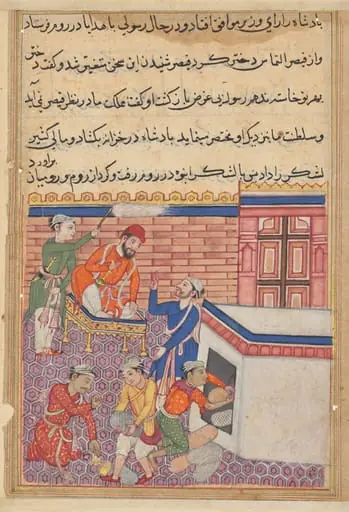 The king’s emissary being provided with gifts for his mission to Rum in order to seek the hand of the emperor’s daughter in marriage, from a Tuti-nama (Tales of a Parrot): Fiftieth Night
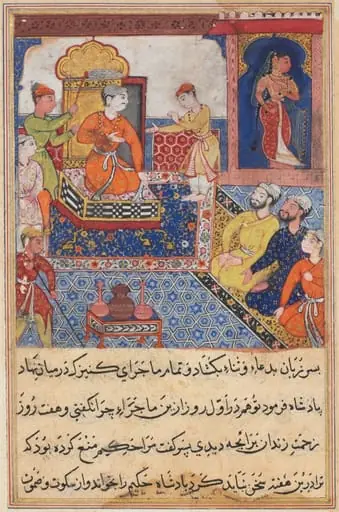 The young prince recounts his experiences to his father, the king, from a Tuti-nama (Tales of a Parrot): Eighth Night
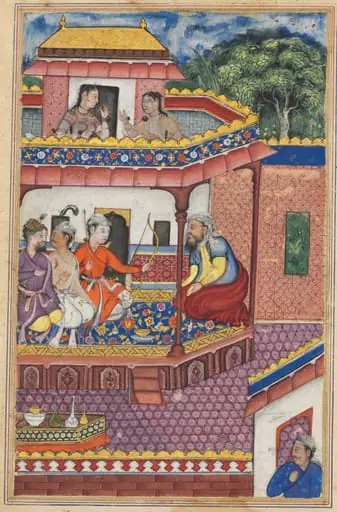 The three young men present themselves as suitors for the hand of Zuhra, the daughter of the merchant of Kabul, from a Tuti-nama (Tales of a Parrot): Thirty-fourth Night
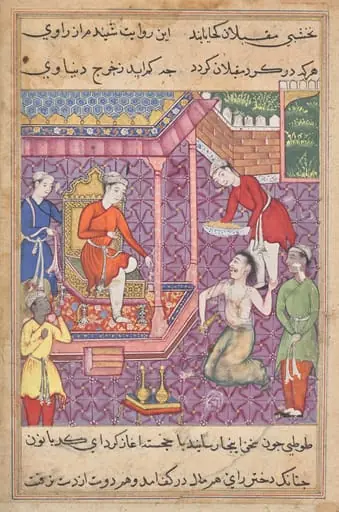 The magician disguised as a Brahman returns to claim his “daughter-in-law,” from a Tuti-nama (Tales of a Parrot): Thirty-fifth Night
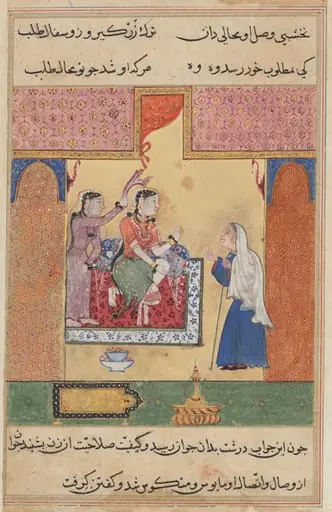 The old procuress conveys the young man’s message of love to Mansur’s wife, from a Tuti-nama (Tales of a Parrot: Seventeenth Night
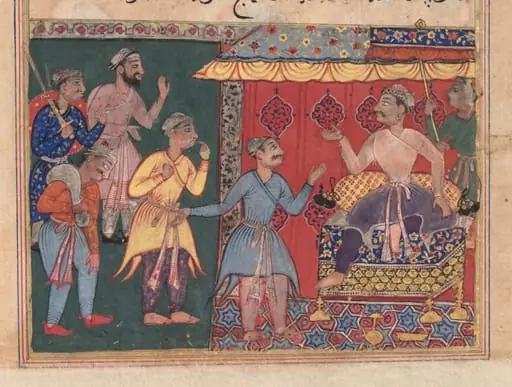 King Bhojaraja tries in vain to ascertain the whereabouts of the pearl from the four travelling companions, from a Tuti-nama (Tales of a Parrot): Twelfth Night
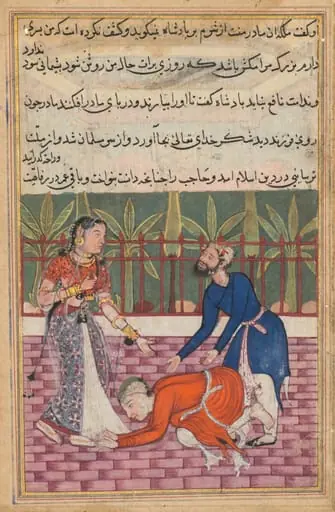 The guard restores the son who falls at his mother’s feet, from a Tuti-nama (Tales of a Parrot): Fiftieth Night
 A woman asks her lover to leave her house, brandishing his sword and feigning rage in order to deceive her husband who has just arrived, from a Tuti-nama (Tales of a Parrot): Eighth Night