Artwork
The guard restores the son who falls at his mother’s feet, from a Tuti-nama (Tales of a Parrot): Fiftieth Night
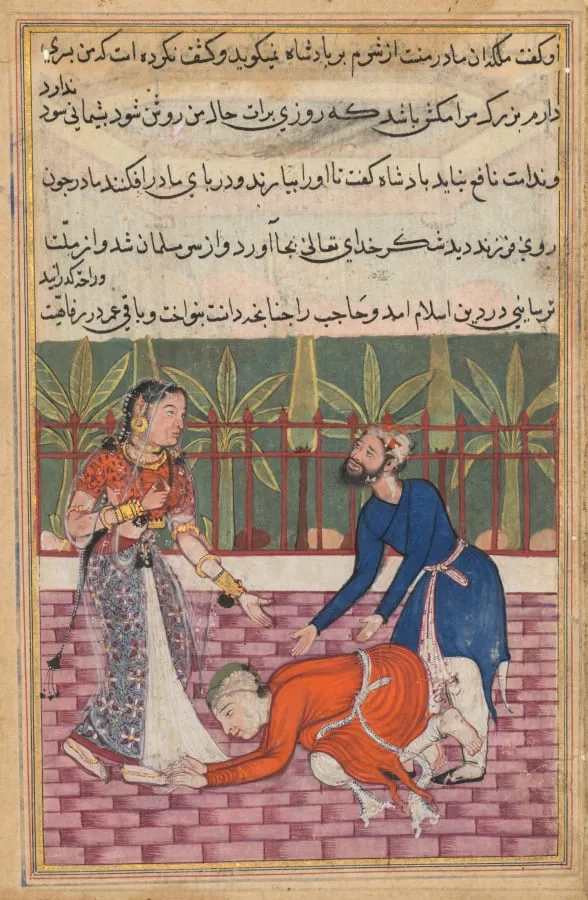
The guard restores the son who falls at his mother’s feet, from a Tuti-nama (Tales of a Parrot): Fiftieth Night is an unspecified painting by the Mughal Painting artist Unknown. It dates from 1560 and is held in the collection of the Cleveland Museum of Art. This painting illustrates a scene from the Tuti-nama, a collection of stories.
About this work
You see a richly dressed guard kneeling beside a young man who has collapsed at his mother’s feet, while a king and courtiers look on.
You see a richly dressed guard kneeling beside a young man who has collapsed at his mother’s feet, while a king and courtiers look on.
This scene comes from a *Tuti-nama*, or "Tales of a Parrot," a book of stories Emperor Akbar loved. The guard secretly saved the prince’s life, and now the truth is out. The bright colors and crowded composition show how Mughal artists told stories—every figure has a role, every gesture matters.
To see more paintings like this, look up Mughal India, court of Akbar (reigned 1556–1605).
Overview
This painting illustrates a scene from the Tuti-nama, a collection of stories. It depicts a dramatic moment of revelation and reunion, as a prince is restored to his mother.
Subject & Meaning
The scene shows a guard, having spared a prince's life, being rewarded by a king who had previously ordered the prince's execution due to a misunderstanding. The prince has collapsed at his mother's feet, overcome with emotion.
Technique & Style
The painting features a crowded composition with richly dressed figures, utilizing bright colors to convey the emotional intensity of the scene. Every figure and gesture plays a role in telling the story, characteristic of Mughal narrative art.
Context
The Tuti-nama was a favored text of Emperor Akbar, and this painting is an example of the artistic style that flourished during his reign. It reflects the storytelling techniques employed by Mughal artists.
History & Provenance
The painting is associated with the court of Akbar, who reigned from 1556 to 1605. It is part of a broader tradition of Mughal Indian art from this period.
Artist & collection

 Domestic Scene
 Giacomo and Cardinal Marco, investing Andrea, Abbot of San Zeno, with his Benefice
 The Nymph of Fontainebleau
 Portrait of a Woman
 Madonna and Child with Saints in the Enclosed Garden
 Venus and Minerva
 Family Group of Four on Sofa
 Wall painting from Room H of the Villa of P. Fannius Synistor at Boscoreale
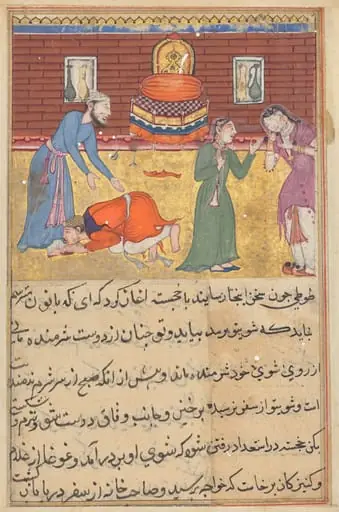 The pious man’s son, now a king, reveals himself to his father; his nurse upbraids his unfaithful mother, from a Tuti-nama (Tales of a Parrot): Fifty-second Night
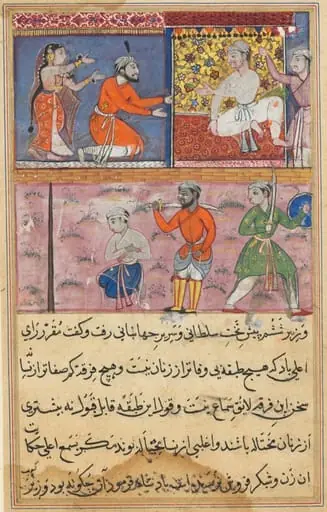 The prince sent back to the place of execution for the sixth time, from a Tuti-nama (Tales of a Parrot): Eighth Night
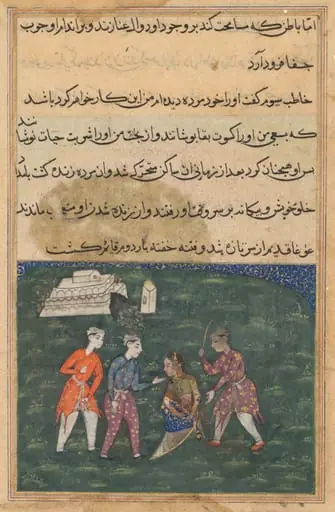 The third suitor strikes the devotee’s daughter and thus restores her to life, from a Tuti-nama (Tales of a Parrot): Twentieth Night
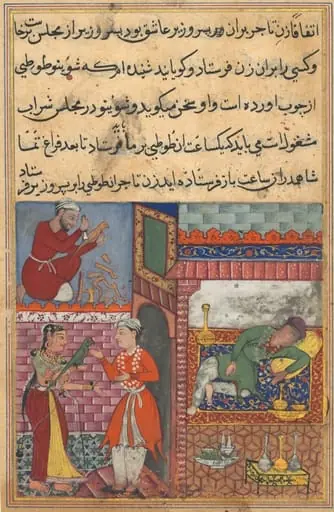 The vizier’s son receives the magic wooden parrot from the wife of the merchant, who is drunk, and has a replica made by a carpenter, from a Tuti-nama (Tales of a Parrot): Tenth Night
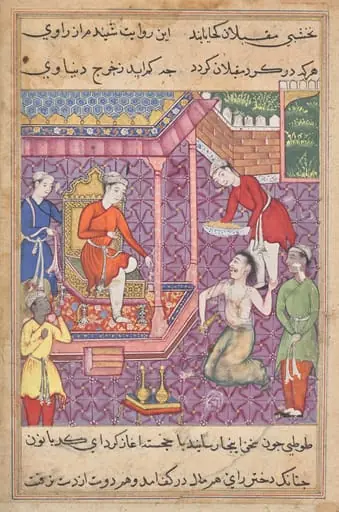 The magician disguised as a Brahman returns to claim his “daughter-in-law,” from a Tuti-nama (Tales of a Parrot): Thirty-fifth Night
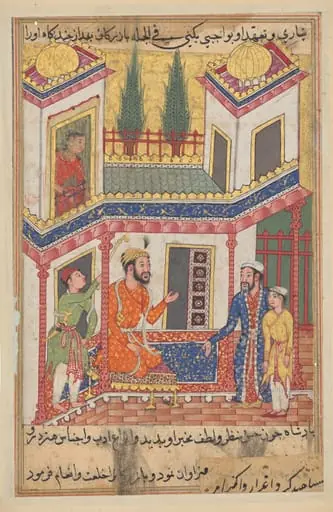 The merchant returns bringing a young slave who is really the son of the princess of Rum, now married to the king, from a Tuti-nama (Tales of a Parrot): Fiftieth Night
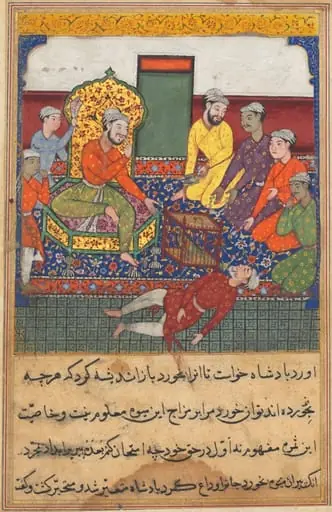 The old man eats of the fruit of the Tree of Life, but drops dead, from a Tuti-nama (Tales of a Parrot): Ninth Night
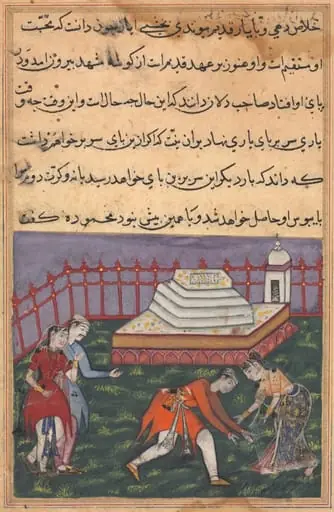 Hearing her declaration of love, Ayaz falls at the feet of Mahmuda at the holy shrine. The scene is witnessed by Salim, Ayaz’s friend, and a maid, from a Tuti-nama (Tales of a Parrot): Thirty-third Night
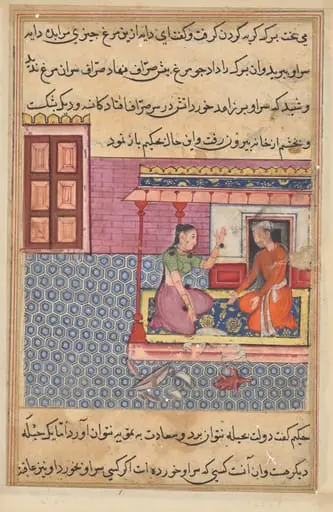 The pious man’s wife offers the seven-colored bird as food to her lover, but not finding its head, he breaks the pot and bowl in anger, from a Tuti-nama (Tales of a Parrot): Fifty-second Night